Written by Rajeev Gupta, founder of EliteAlgo. Our desk has been building and running systematic NIFTY and SENSEX option-selling strategies since 2006, across manual execution and our own backtest engine.
Paper trade this before it touches live capital. Nothing below is investment advice, and nothing below recommends a strike, a strike distance, an expiry or an underlying. EliteAlgo is proprietary trading research and analytical software, not an advisory service. This page is a reference for how the structure behaves, not a signal to trade it.
Quick Answer
In options, a strangle is a call and a put at two different strikes on the same underlying and the same expiry, with both legs normally out of the money. Sell both and you have a short strangle: you collect the combined premium, which is the most the position can ever make, and you keep all of it as long as the underlying finishes anywhere between your two strikes. Your break-evens sit at the call strike plus the total premium and the put strike minus the total premium. Between those two levels you are not losing; outside them the loss grows point for point, with no ceiling above and a very large one below. Compared with a structure built at a single at-the-money strike, a strangle collects less premium and buys itself room — the profit zone is a wide flat band rather than a single peak. That extra room is the whole reason people use it, and it is also the reason it gets misread: a strangle lowers the chance of being wrong, and does nothing at all about the size of being wrong.

What the word actually means
Taken on its own, "strangle" is a shape on the option chain, nothing more. Three conditions define it, and all three have to hold:
- One call and one put.
- Two different strike prices — this is the condition that makes it a strangle.
- The same expiry on both, on the same underlying.
That is the complete definition. Nothing about direction, nothing about quantity, nothing about which strikes or how far apart they sit. If both legs were at the same strike it would not be a strangle at all — it would be a straddle, and that single difference is the only thing separating the two words.
By near-universal convention the two legs are placed out of the money: the call above spot, the put below it. Nothing in the definition forces that, and a strangle built with both legs in the money is still technically a strangle, but it is not what anyone means by the word in practice and it is not what this page describes. When a trading desk, a broker screen or a strategy builder says "strangle", it means a call above and a put below, with a gap of unsold strikes in the middle.
Two naming notes, because both cause real confusion:
- "Strangle" on its own tells you nothing about the side. Buying the pair and selling the pair are opposite trades with opposite risk, opposite cash flow and opposite relationships to time. You need "short" or "long" in front of the word before it describes an exposure at all. "Short option strangle", "short strangle" and "sold strangle" all mean the same thing.
- Selling, writing and shorting are the same act. Whichever word your platform uses, you are taking on an obligation rather than buying a right, and what that obligation actually is sits in being the option writer.
One more piece of vocabulary, because it shows up on screens: a strangle does not have to be symmetric. Equal distance from spot on both sides is a convention, not a rule. Place the call nearer than the put and the structure is still a strangle — it just carries a directional lean you have now taken on whether you meant to or not. Strangles in options are defined by the strikes differing, and by nothing else.
Short strangle vs long strangle — the sign flip
Same two legs, same two strikes, same expiry, opposite side of the trade. Worth sixty seconds, because getting this backwards is not a small error — the long strangle loses money on precisely the quiet sessions where the short strangle earns it.
| Short strangle | Long strangle | |
|---|---|---|
| Action | Sell the OTM call and the OTM put | Buy the OTM call and the OTM put |
| Cash at entry | Credit received | Debit paid |
| What you want | The underlying to stay inside the band | A large move, either direction |
| Time passing | Helps you | Costs you every day |
| Maximum profit | Capped at the premium collected | Open-ended |
| Maximum loss | No ceiling above the call strike | Fixed at the premium paid |
| Volatility rising | Hurts the mark | Helps the mark |
Read the bottom two rows together and the trade-off is visible in one glance. The long strangle knows its worst case before it is placed. The short strangle does not, and never will. Everything else on this page is about living with that fact.
The long strangle is option buying, which is not the side our own work is on, so it gets a table here and nothing more. If the buying side is what you were actually looking for, option buying vs option selling sets the two approaches against each other properly.
The payoff arithmetic, derived once
Four numbers describe a short strangle completely. Derive them once and you never have to guess at a payoff diagram again. Write the call strike as C, the put strike as P, and the total premium collected across both legs as T.
- Maximum profit = T. The premium you collected is every rupee the position can ever make. There is no scenario in which a short strangle earns more than its opening credit, and this is true of every premium-selling structure.
- The full-profit band runs from P to C. Finish anywhere between your two strikes and both legs expire worthless — you keep the whole of T. This is the feature that separates a strangle from a single-strike structure: its maximum profit is a range, not a price.
- Upper break-even = C + T. Above the call strike the short call starts to cost you, but you are still ahead until the loss on that leg has eaten the entire premium from both legs.
- Lower break-even = P − T. The mirror image on the downside.
The width of the whole profit zone is therefore (C − P) + 2T: the gap between the strikes, plus the premium twice over. Outside that zone, every further point the underlying travels is a rupee-for-rupee loss on the relevant leg, multiplied by your quantity. Above the call strike there is no level the underlying is forbidden to reach, so there is no ceiling on that loss. Below the put strike the loss is bounded only by the underlying falling to zero, which on an index trading in the tens of thousands of points is not a constraint any account would survive reaching.
A fifth fact follows from the structure and is worth stating separately: at most one leg can be in the money at expiry. The underlying cannot settle both above your call strike and below your put strike. So although you sold two legs, you are only ever exposed on one of them at settlement. That sounds reassuring and is not: the exposure is one-sided, but which side is unknown in advance, and the one that goes against you is unbounded.
A worked example
Round numbers, chosen to make the arithmetic readable. These are not quoted prices, this is not a strike recommendation, and nothing here is a suggestion about distance from spot.
Say an index is at 24,800. A seller writes the 25,100 call for 60 and the 24,500 put for 55. Total premium collected is 115 points, so:
- Maximum profit: 115 points × quantity. Collected at entry, kept if the index behaves.
- Full-profit band: 24,500 to 25,100 — a 600-point range in which both legs expire worthless and the whole 115 is yours.
- Upper break-even: 25,100 + 115 = 25,215.
- Lower break-even: 24,500 − 115 = 24,385.
- Total profit zone: 24,385 to 25,215 — 830 points wide, or roughly 3.3% of the index level.
Now read what happens outside it. At 25,415 the index is 200 points beyond the upper break-even, so the position is down 200 points × quantity — already larger than the entire 115 points collected, and growing at the same rate for every further point. At 25,815 the loss is 600 points, more than five times the credit. Nothing in the structure slows that down. The ratio is the thing to notice: a 4% move against a position that was paid 0.46% of the index level to carry is not an unusual market event, and it is already a multiple of the premium.
One number that example does not contain: the margin. A short strangle blocks capital set by the exchange's risk model, not by the premium you collected, and that number moves with volatility rather than sitting still. The arithmetic for it is its own subject — how SPAN and exposure margin are calculated for a NIFTY strangle works through it properly, including why the blocked amount at mid-session is not what was blocked at the open. Verify every current margin figure, contract specification and lot size from the exchange's own published parameters before sizing anything.
The flat top is the real structural feature
Most descriptions of a strangle lead with "it collects less premium but gives you more room." That is true and it buries the more useful point. The structural feature of a short strangle is that its payoff has a plateau. Between the two strikes, the profit is not merely high — it is flat and maximal. The underlying can wander anywhere inside the band, in any pattern, and the outcome at expiry is identical.
That changes how the position should be judged. A single-strike structure pays its maximum at exactly one settlement price, which means its headline maximum profit is a number nobody collects. A strangle's maximum profit is a number you collect across a whole range of outcomes, which makes it the rare case where the advertised best case is also a realistic one. The cost of that is paid at entry, in a smaller credit, and it is paid again at the edges, because the plateau has to end somewhere and when it ends it ends in a cliff rather than a slope.
So the honest way to picture a short strangle is not a tent. It is a table with two cliffs. Flat across the middle, flat right up to each strike, then falling away at forty-five degrees with nothing underneath. Planning around the flat part is what the structure is for. Planning around what happens past the cliff edge is what keeps the account alive, and almost all of the attention goes to the wrong one of those two.
Where the risk actually lives
The risk in a short strangle is not that the market goes the wrong way. It has no wrong way — both ways are fine for a while. The risk is specific and it sits in four places.
Gamma, parked at your strikes. Delta is your directional exposure; gamma is how fast that exposure changes as the underlying moves. In a strangle, gamma is not spread evenly across the payoff — it concentrates around each short strike, and it grows sharply as expiry approaches. Deep inside the band you are nearly immune to movement. Approach either strike near expiry and the position's character changes within a few tens of points: a leg that was irrelevant becomes the whole trade, and your directional exposure grows faster the further it goes. That is the mechanism behind every short-strangle story that ends badly, and it is why the Greeks are worth reading as risk instruments rather than as trivia.
The asymmetry between the two sides. The structure looks symmetric on the chain and is not symmetric in behaviour. Indices fall faster than they rise, and implied volatility usually rises while they fall, which marks up the put side on both counts at once. A put placed the same distance from spot as the call is not carrying the same risk as the call. This is also why the premiums on the two legs are rarely equal at equal distance — the market has priced the difference in already.
Vega, which can hurt you while the index sits still. A short strangle is short volatility. If implied volatility rises, both legs are repriced upward and the position loses on the mark even with the underlying exactly where you sold it. The same rise also increases the margin the exchange requires on the position, because that requirement is derived from the volatility of the underlying. So an adverse mark and a higher capital requirement arrive together, not one after the other, and that combination is what turns a bad mark into a forced exit. How much movement the market is currently pricing — and therefore how much premium is reasonably on the table — is the subject of India VIX and your short strangle's premium budget.
The exit, not the entry. A strangle is two legs in and two legs out, so you cross four bid-ask spreads over the life of the trade. Out-of-the-money strikes often look attractively priced and are quietly expensive to leave, especially the further out you go, and especially under stress — the moment you most want out is the moment the book is widest. The spread you will pay to exit is a live number on the chain and most sellers never check it. Option chain analysis for option sellers treats it as a hard filter, which is the right way to treat it.
How the position behaves into expiry
A short strangle is not one risk profile. It is three, and they arrive in order.
Early — the quiet phase. Both legs are well out of the money, gamma is low, and decay is slow in absolute terms. Nothing much happens and the position feels like it is working on its own. This is the phase that builds false confidence, because the profit accruing per day is small and the risk feels smaller still.
Middle — the decay phase. Extrinsic value starts coming out of both legs at a useful rate. The out-of-the-money legs you sold decay as a proportion faster than a strike nearer the money would, because there is less and less reason for anyone to pay for them. This is where a short strangle does its actual earning, and it is also the phase most people shorten by entering too late.
Late — the gamma phase. Close to expiry the arithmetic inverts. The remaining premium on an untested out-of-the-money leg is small, so there is very little left to earn, while gamma at the strikes is at its maximum, so there is a great deal left to lose. Holding into the final stretch means accepting the worst risk-to-reward the position will ever offer. And if the underlying is sitting near one of your strikes at that point, the leg is neither safely worthless nor cleanly in the money — it can cross back and forth repeatedly in the last minutes, and the settlement price is the only one that counts.
The practical reading: the fact that a position has been comfortable for most of its life says nothing about the last part of it. Our own desk's measured record on expiry-day selling shows how much of an intraday gain can hand itself back before the close — across 163 expiry sessions, the median give-back from the intraday peak was 42.8%, and roughly 30% of sessions that were in profit at their peak finished at a loss. Those are our numbers over our own sample, not a forecast and not an expected outcome for anyone else. We publish the full working in is algorithmic trading profitable — our own data. They are relevant here because the give-back is concentrated exactly in the gamma phase, and that is the phase a strangle seller is most tempted to sit through.
Strike distance is the only real dial, and it is not a safety dial
Once you have decided on a strangle, almost every remaining decision collapses into one question: how far out do the two strikes go? Everything moves together when you turn that dial.
- Further out: less premium collected, a wider full-profit band, wider break-evens, a higher chance of finishing inside the band, and a smaller cushion relative to the loss if you finish outside it.
- Nearer in: more premium collected, a narrower band, tighter break-evens, a lower chance of staying inside, and more credit standing between you and the first rupee of loss.
The trap is reading the first list as "safer". Moving the strikes out changes the probability of a loss. It does nothing whatsoever to the size of one. In fact it makes the ratio worse: having collected less, you need a smaller excursion past the break-even to lose a multiple of the credit. A position that wins more often and loses bigger when it loses is not a safer position — it is the same risk with a different distribution, and it reports a flattering win rate while it waits.
This is why the distance question cannot be answered from the payoff diagram alone. It has to be set against how much movement the market is actually pricing for the period you are holding, and that is a measurable input rather than a preference. We keep that work on its own page because it deserves the room: India VIX and your short strangle's premium budget converts the volatility reading into an expected move and an expected premium, and that is the input a distance decision should be made against. We do not publish strike rules or distance rules, and you should be sceptical of anyone who does, because the right answer is a function of conditions that change weekly.
Straddle and strangle — the difference in one line
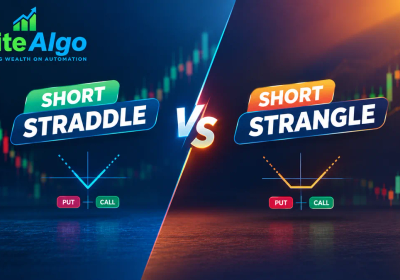
These two words travel together constantly, so here is the separation with nothing else attached: a straddle uses one strike for both legs; a strangle uses two different strikes, both out of the money. That is the entire mechanical difference. Everything people say about the pair follows from it — the straddle collects more because at-the-money options are the richest on the chain, the strangle gives the underlying more room because it starts with distance built in, the straddle's maximum profit is a single point and the strangle's is a plateau.
Which of the two suits a given week is a genuinely separate question with its own inputs, and it has its own page rather than being crowded in here. Short straddle vs short strangle on NIFTY runs the side-by-side comparison, works through how implied volatility should drive the choice, and ends in a decision checklist. If you came here to choose between them, that is the page to read next.
And if it is the straddle you actually wanted the reference for, it is the exact twin of this page: the short straddle explained covers the same ground — structure, payoff, risk, expiry behaviour — for the single-strike version. Read either one on its own; read both and you have the whole of the premium-selling core.
What the word gets confused with
Three other structures sit next to the strangle on the chain and are mistaken for it often enough to be worth naming.
The iron condor is a short strangle with a further-out call and put bought outside the legs you sold. The bought wings cost part of your credit and in exchange they put a hard floor under the loss on each side, converting the two cliffs into two steps. Same flat top, smaller credit, known worst case. If the unbounded tail is the thing you cannot carry, this is the structure that answers it, and the closely-related defined-risk route is worked through in credit spreads, the strangle's defined-risk sibling.
A credit spread is one side of that idea on its own — sell a leg, buy a further one beyond it, on the call side or the put side but not both. It is what you get if you convert a single wing of an existing strangle, and the same page above covers what that conversion costs and what it buys.
The iron butterfly is the single-strike cousin: a straddle with bought wings outside it. Narrower peak, bigger credit, fixed worst case. Butterflies and iron butterflies from the seller's side covers it.
If you want all of these placed against each other in one map rather than met one at a time, option selling strategies, structure by structure is the catalogue.
Six common misreadings
These are the ones we see most. Each is a specific error rather than general caution.
"It is safer than selling at the money." It is wider. Width is not safety. Moving the strikes out lowers how often you lose and raises how much you lose relative to what you were paid. Whether that trade is worth making depends entirely on the sizing behind it, and the word "safer" quietly skips the sizing question.
"The premium collected limits my risk." The premium limits your profit. It is the only fixed number in the trade and it is fixed on the wrong side. Above the call strike there is no corresponding number at all.
"It is a non-directional position." It is non-directional while the underlying stays between the strikes. The moment it approaches one, the tested leg's delta grows and the other leg's shrinks, and you are holding a one-sided directional position you never chose. Non-directionality is a starting condition, not a property of the trade.
"A high win rate means the structure works." A short strangle is designed to win often and lose large. A win rate well above 70% is the expected behaviour of the structure, not evidence of an edge, and it tells you nothing at all until you set the average win against the average loss. This is the most expensive misreading on this page, and it is the one the structure is best at hiding, because the first dozen outcomes will usually agree with you.
"Theta is the risk to manage." Theta is the income. Gamma is the risk. Confusing them is what leads people to hold into the last stretch before expiry, which is exactly where the income has nearly run out and the risk is at its peak.
"I can always roll the tested side." Rolling means transacting further legs in a fast market, in a book that is widening, at the moment you are least calm — and it usually means taking the realised loss on one side while adding new exposure somewhere else. Every adjustment is a new trade with its own cost and its own risk. Where a hedge is part of the plan from the beginning rather than improvised during the move, hedging an option-selling position covers what it costs and what it does not cover.
If you want to test this properly
Not a strategy — a process. And deliberately not a strike or distance rule, because we do not publish those.
- Write the rules down — entry condition, how both strikes get chosen, exit condition, stop, square-off time, position size. If it is not written, it is not a strategy, and a strangle with discretionary strike selection cannot be tested at all.
- Size against the tail, not against the margin available. Your broker permitting a size is not the same as that size being survivable. The test that needs no published figure: if one position's bad day consumes most of the account, the position is too large. Lot size and position sizing is the arithmetic, and current contract specifications come from the exchange rather than from any article.
- Backtest across regimes — quiet, volatile and trending, not a run of recent calm expiries, which is the sample a short strangle flatters itself on most. Include realistic slippage on each leg, remembering the position crosses four spreads over its life and that the out-of-the-money legs are the ones with the worst books. How to backtest an option-selling strategy covers the method and NSE historical options data covers where the inputs come from.
- Look at the loss distribution, not the win rate. For this structure the only informative numbers are the size of the worst outcomes and how often they cluster. A result summary that leads with win percentage is telling you about the structure, not about the strategy.
- Paper trade it through a bad week, with real timing and real fills, not end-of-day prices. Paper trading an option-selling algo covers doing it so the results mean something.
- Then start embarrassingly small, and increase only on measured results.
If you are earlier than all of this and the mechanics of placing and carrying a single short leg are the real gap, start at how to sell options, step by step. If you want a walked-through first NIFTY position rather than a structure reference, NIFTY option selling for beginners is written for that.
Frequently Asked Questions
What does strangle mean in options?
In options, a strangle means holding a call and a put at two different strike prices on the same underlying and the same expiry. The differing strikes are what make it a strangle — if both legs sat at the same strike it would be a straddle instead, and that is the only mechanical difference between the two words. By convention both legs are placed out of the money, the call above the current price and the put below it, with a gap of unsold strikes in the middle. The word describes a shape on the option chain rather than a trade, so it tells you nothing about the exposure until you add short or long in front of it.
What is a short strangle?
A short strangle is selling both legs of a strangle — writing an out-of-the-money call and an out-of-the-money put at two different strikes on the same expiry. You collect the combined premium of the two legs, and that credit is the most the position can ever make. You keep all of it if the underlying finishes anywhere between your two strikes, because both legs then expire worthless. Outside the break-evens the loss grows point for point with the underlying, with no ceiling above the call strike. Short option strangle, sold strangle and written strangle all describe the same position.
What are the break-even points of a short strangle?
The upper break-even is the call strike plus the total premium collected across both legs; the lower break-even is the put strike minus that same total. Note that the total premium is used on both sides, because you keep the credit from both legs no matter which one is tested. The whole profit zone is therefore the gap between the strikes plus twice the premium. Break-even on premium is not break-even overall: if the underlying finishes past a break-even the tested leg is in the money and is exercised, so a settlement-side charge lands on a settlement-derived base, and transaction costs on two legs in and two legs out sit on top of that.
What is the difference between a strangle and a straddle?
A straddle uses one strike for both legs; a strangle uses two different strikes, both out of the money. That is the entire mechanical difference, and everything else follows from it. A straddle collects more premium because at-the-money options are the richest on the chain, while a strangle has distance built in and so gives the underlying more room to move before either leg hurts. A straddle's maximum profit is a single settlement price, whereas a strangle's maximum profit is a flat band running between the two strikes. Which of the two suits a given week is a separate question with its own inputs, including where implied volatility sits relative to your expectation of realised movement.
What is the maximum loss on a short strangle?
There is no ceiling above the call strike. The short call's loss grows point for point as the underlying rises and there is no level the underlying is forbidden to reach. Below the put strike the short put's loss is bounded only by the underlying falling to zero, which on an index trading in the tens of thousands of points is not a meaningful constraint on any account. At most one leg can be in the money at expiry, since the underlying cannot settle both above the call strike and below the put strike, so the exposure is always one-sided at settlement — but which side is unknown when the position is opened, and that is the actual problem.
Is a short strangle safer than a short straddle?
It is wider, which is not the same thing. Placing both legs out of the money lowers the probability of finishing outside the break-evens, and it does nothing at all to the size of the loss if you do. Because a strangle collects less premium to begin with, a smaller excursion past a break-even wipes out a larger multiple of the credit, so the ratio of a typical loss to the premium received is worse rather than better. A structure that wins more often and loses bigger when it loses is the same risk with a different distribution, and it reports a flattering win rate while it waits.
What is the difference between a short strangle and a long strangle?
Same two legs at the same two strikes and expiry, opposite side. A short strangle sells both, takes in a credit, wants the underlying to sit inside the band, is helped by time passing, caps its profit at the premium collected and has no ceiling on its loss above the call strike. A long strangle buys both, pays a debit, needs a large move in either direction, loses a little each day the move does not arrive, has open-ended profit and a loss fixed at the premium paid. The long strangle is option buying and loses money on precisely the quiet sessions where the short strangle earns it, so getting the side backwards is not a minor error.
Is theta or gamma the real risk in a short strangle?
Gamma. Theta — the premium eroding per day — is the income, and in a strangle it is collected quietly while both legs stay out of the money. Gamma is the rate at which your directional exposure changes per point the underlying moves, and in a strangle it is not spread evenly: it concentrates around each short strike and grows sharply as expiry approaches. Deep inside the band you are nearly immune to movement; near a strike close to expiry the position's character can change within a few tens of points. Both theta and gamma grow near expiry, but on an out-of-the-money leg there is very little premium left to earn and a great deal of exposure left to lose.
Can a short strangle lose money if the underlying does not move?
Yes. A short strangle is short vega, so if implied volatility rises, both legs are repriced upward and the position loses on the mark even with the underlying sitting exactly where it was when you sold. The same volatility increase also raises the margin the exchange requires on the position, because that requirement is derived from the volatility of the underlying and the composition of your position. An adverse mark and a higher capital requirement therefore arrive together rather than one after the other, and if the combination exceeds your available funds your broker can square the position off at whatever the market happens to be at that moment.
How far out should the strikes be on a short strangle?
There is no published distance rule worth following, and we do not provide one, because the right answer is a function of how much movement the market is currently pricing for the period you intend to hold. What is reliable is the trade-off: further out means less premium, a wider band and a higher chance of staying inside it, with a smaller cushion relative to the loss if you do not; nearer in means more premium, a narrower band and more credit standing between you and the first rupee of loss. The distance decision should be made against a measured expectation of movement rather than a preference, and it should be set after the position size, not before it.
Do both legs of a strangle have to be the same distance from the price?
No. Equal distance on both sides is a convention rather than part of the definition — a strangle is defined only by the two strikes differing. Placing the call nearer than the put, or the other way round, is still a strangle, but it carries a directional lean, and that lean is an exposure you have taken on whether you intended it or not. It is also worth knowing that the premiums on the two legs are often unequal even at equal distance, because indices tend to fall faster than they rise and implied volatility typically rises as they fall, so the market has already priced the two sides differently.
What is an iron condor compared with a short strangle?
An iron condor is a short strangle with a further-out call and a further-out put bought outside the two legs you sold. Those bought wings cost part of your credit, and in exchange they put a hard floor under the loss on each side — the payoff keeps the same flat top between the short strikes, but the two open-ended cliffs become two steps with a known worst case. So an iron condor is the defined-risk version of the same idea: smaller credit, same profit band, a loss you can state before you place the trade. The same conversion applied to only one side of a strangle gives a credit spread.
The Bottom Line
A strangle is a call and a put at two different strikes on the same underlying and expiry, both normally out of the money. Sold, it becomes the premium-selling structure with the most room: four numbers describe it completely — maximum profit is the total premium, the full-profit band runs from the put strike to the call strike, and the break-evens sit at the call strike plus the premium and the put strike minus it. Its payoff is a table with two cliffs rather than a tent, which makes its advertised best case a realistic one, and which makes its worst case arrive suddenly rather than gradually. The income comes from theta; the danger comes from gamma, concentrated at each short strike and growing fastest exactly when the remaining premium is smallest. Being short volatility means a mark-to-market loss and a higher margin requirement can arrive together with the underlying sitting still. Moving the strikes further out changes how often you lose, not how much — so plan around the width of the band and the depth of the cliff, size against the tail rather than against available margin, treat the final stretch before expiry as its own risk regime, and test the whole thing across regimes with honest per-leg costs before any of it is live.
This article is for educational and informational purposes only and does not constitute investment advice. EliteAlgo is proprietary trading research and analytical software; it is not a SEBI-registered investment adviser and does not provide investment advice, strike or strategy recommendations, or trading tips. No strike, strike distance, expiry, structure or underlying mentioned or implied above is recommended, and the worked example uses illustrative round numbers rather than quoted prices. Writing a short strangle involves substantial risk of loss and is not suitable for all investors; the loss is not bounded above the call strike and can substantially exceed the premium received. Margin requirements, contract specifications, lot sizes, settlement procedures, tax rates and charges are set by the exchanges, SEBI, the government and your broker and are revised from time to time — verify all current figures from the exchange or the notification in force before trading. Backtested and logged results describe what our own data did over a specific sample and do not guarantee future outcomes or imply any expected return. Paper trade before deploying live capital and consult a SEBI-registered investment advisor before trading derivatives.