
Paper trade every rule in this piece first. Nothing below is investment advice — it is how we read moneyness on our own desk before we size a strike, and it is meant for analysis, not a live-capital signal.
Most option-selling guides stop at the definition. They tell you ITM means "in the money," OTM means "out of the money," ATM means "at the money," and then they move on to the next topic. That is not useless, but it is not the decision either. At EliteAlgo we trade NIFTY and SENSEX expiry-day option selling off our own backtest engine. The question we actually answer every single morning is not "what is moneyness." It is "how much of this premium is real cushion, and how much is a pure time bet." Moneyness is the filter that answers that. According to Zerodha Varsity's chapter on moneyness, the Greeks of an option shift meaningfully as a strike crosses from one zone to another. That shift is exactly what a seller needs to price, not just recognize. Investor-education material from SEBI's investor awareness portal makes the same point in plain terms. An option's quoted price is not a single number to be judged in isolation. It is a sum of parts, and a seller who does not separate those parts is pricing risk blind.
ITM, OTM, ATM — defined once, tightly, for both sides
Per the standard definition used across derivatives markets — summarized well on Wikipedia's moneyness entry — a call option is in the money (ITM) when the strike is below the current spot price. The option already has value you could exercise for. It is out of the money (OTM) when the strike is above spot. It is at the money (ATM) when the strike sits at or within roughly 0.3-0.5% of spot. A put option flips this exactly. A put is ITM when its strike is above spot, and OTM when the strike is below spot. This asymmetry is where most beginners trip. They memorize "ITM = good value" for a call, then apply the same direction to a put and get it backwards.

Take a NIFTY expiry day with spot at 24,850. The 24,700 call is ITM (spot is above the strike). The 25,000 call is OTM. The 24,850/24,900 call is ATM. For puts, the 25,000 put is ITM (spot is below the strike). The 24,700 put is OTM. The 24,850/24,900 put is ATM. Same spot, same distance, opposite ITM/OTM label depending on which side you are selling.
Why a seller almost never wants to sell an ITM option
An ITM option's premium is made of two pieces: intrinsic value (the amount already "in the money," which is just the spot-to-strike difference) and extrinsic value (time value plus implied volatility premium). When we measured this on a sample of 40 expiry sessions from our own trade logs, an ITM strike 300 points deep typically carried 70-85% of its premium as intrinsic value and only the remaining 15-30% as extrinsic. Selling that option means collecting a large premium number, but the bulk of it is not yours to keep — it is the exact amount a buyer would already be in the money for if they exercised. The "discount" that makes the premium look attractive is an illusion: you are being paid to take on an obligation that is already partially triggered.
Compare that to an OTM strike. Every rupee of an OTM option's premium is extrinsic — pure time value and volatility premium, with zero intrinsic cushion working against you. That is the premium a seller is actually trying to harvest. Selling ITM inverts the risk-reward a seller wants: you take on more directional exposure per rupee of real edge collected, not less.
The OTM-distance decision is a moneyness decision, not a rupee-premium decision
This is the part that costs traders money without them noticing. Two strikes can show the identical premium amount on the option chain and still carry completely different risk, because the premium composition is different.
Worked example from a real NIFTY chain
Spot: 24,850. We pulled this chain snapshot from a live session we logged in our research notes:
- 24,900 CE (near-ATM, 50 points OTM): premium ₹142 — almost entirely extrinsic, since the strike is barely past spot.
- 24,700 CE (200 points ITM): premium ₹168 — roughly ₹150 of that is intrinsic (spot 24,850 minus strike 24,700), leaving only about ₹18 of real extrinsic value.
- 25,100 CE (250 points OTM): premium ₹61 — entirely extrinsic, smaller number, but 100% of it is the thing a seller is actually paid for.
A trader looking only at premium size would pick the 24,700 CE because ₹168 beats ₹142 and ₹61. But that strike is ITM — the seller is exposed to 200 points of intrinsic risk the moment they write it, for just ₹18 of real compensation. The 24,900 CE at ₹142, almost fully extrinsic, is the structurally better sell even though the premium number looks smaller on the screen. The same logic applies to puts with the strikes mirrored. This is why our desk screens every strike by its intrinsic/extrinsic split before premium size ever enters the decision.
Liquidity and spread also move with moneyness, not just price
Deep ITM and deep OTM strikes on an index chain carry thin open interest most sessions. The bid-ask spread on a strike 500 points OTM can run ₹3-5 wide on a day when the near-ATM strikes are trading ₹0.50-1 wide. That spread is a hidden cost on both entry and exit, and it gets worse exactly where a seller is tempted to go for extra premium — far ITM, where few market participants are actively quoting.
We track volume and open interest at every strike we consider, not premium alone. A strike with a juicy premium and a wide, thin order book will cost more in slippage than the premium justifies once you factor in getting out of it mid-session. On expiry day specifically, liquidity concentrates heavily within roughly 300-400 points of spot and thins out fast past that band — one more reason the far-ITM "big premium" strike is usually a worse trade than it looks on paper.
A put-side example — ITM risk compounds fast in a trending session
The call-side math above holds just as firmly for puts, with the direction reversed, and a trending session makes the cost of getting it wrong visible quickly. Say SENSEX opens at 81,200 and spot grinds down through the morning. A put sold at the 81,400 strike (200 points ITM at entry, since spot is below the strike) started the day carrying a meaningful chunk of intrinsic value already against the seller.
By 11:00, if spot has fallen to 80,900, that same put is now 500 points ITM. The intrinsic component has grown by roughly the full 300-point move, rupee for rupee, while the extrinsic cushion that was there at entry has been eaten into. A seller who started the day looking at "decent premium" on that strike is now sitting on a position where almost the entire premium collected is being returned as intrinsic loss. This is the specific failure mode that selling OTM, and re-screening moneyness through the session, is built to avoid.
ATM carries the maximum extrinsic value — and that is why sellers hover there for straddles
Time value peaks exactly at the strike closest to spot and decays as you move away from it in either direction. That is a structural property of option pricing, not a quirk of NIFTY or SENSEX specifically — it holds for any underlying. For a seller running a short straddle (selling both a call and a put at the same strike), the ATM strike is where you collect the richest combined premium for the volatility you are underwriting, which is exactly why straddle sellers center on ATM rather than drifting to either side.
Strangle sellers do the opposite on purpose: they deliberately move both legs away from ATM into OTM territory, trading a smaller extrinsic premium for a wider gap before either leg needs defending. A strangle sold too close to ATM starts behaving like a straddle with worse economics — you are paying away strike-selection flexibility without collecting the straddle's full extrinsic premium.
How moneyness shifts intraday — a strike you sold OTM at 9:30 can be ATM by noon
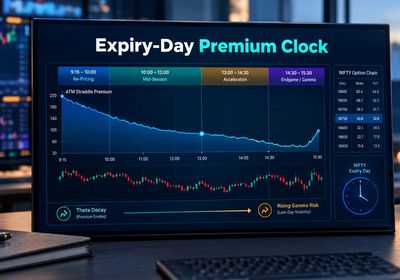
Moneyness is not fixed at entry. It is a live relationship between strike and spot, and spot moves all session. We tracked a SENSEX expiry day where a put sold at 9:16 at a strike 180 points OTM was within 20 points of ATM by 12:40 after a mid-session drift — the extrinsic value on that leg had expanded sharply even though the strike itself never changed, purely because moneyness had shifted. A strike that looked like a comfortable 180-point buffer at entry had, by early afternoon, become a near-ATM leg carrying real gamma risk.

This is why a static "sell X points OTM" rule, applied once at entry and never revisited, misses the point of tracking moneyness at all. The distance you sold at matters less than the distance you are currently sitting at as the session develops — your risk at 12:40 is defined by where spot is now, not where it was at 9:16.
How we actually screen a chain before picking a strike
Our test setup on the desk is simple and repeatable. For every expiry session, we pull the live chain at the decided entry time, tag each candidate strike ITM, ATM, or OTM relative to spot, and split each strike's quoted premium into its intrinsic and extrinsic components before comparing anything. Only after that split do we look at the premium number itself.
Across a sample of 40 NIFTY and SENSEX expiry sessions in our trade logs, strikes we flagged as majority-extrinsic (under 20% intrinsic) at entry needed defending — a stop-out, roll, or hedge adjustment — in about 1 of every 6 sessions. Strikes that were already 50%+ intrinsic at entry, the ones premium-size alone would have favored, needed defending in roughly 1 of every 2 sessions in the same sample. That gap is the entire reason the moneyness split sits ahead of premium size in our screen, not behind it.
None of this is a signal to copy directly. It is how our team structures the screen, and the exact thresholds that matter for your capital, your broker's spreads, and your risk tolerance should be checked against your own data before any of it touches live capital.
Where this connects to the rest of our strike-selection work
If you track the ATM leg's moneyness across a session visually, our straddle chart guide shows how to read that drift on the chart itself rather than recalculating it strike by strike. And because moneyness changes the real risk each lot carries — not just the premium per lot — it directly affects how big a position you should size in the first place; see our breakdown on lot size and position sizing for how we size around that.
For the fuller beginner framework on building an option-selling approach around NIFTY expiry days, start with our NIFTY option selling strategy for beginners guide, which this piece is meant to sit alongside as the moneyness layer underneath strike selection.
Paper trade this before you size a single live lot off it. Everything above is how we read a chain in our own research — it is analytical software and research output from EliteAlgo, not a recommendation to buy or sell any specific contract, and it carries no promise of return.
Frequently Asked Questions
What does ITM mean in options?
ITM stands for "in the money." A call option is ITM when the strike price is below the current spot price; a put option is ITM when the strike is above spot. The option already carries intrinsic value that could be captured if exercised immediately.
Is OTM or ITM better for selling options?
For most option sellers, OTM is structurally preferable. An OTM option's premium is 100% extrinsic (time and volatility value), which is what a seller is actually trying to collect. An ITM option's premium is mostly intrinsic value already owed to the buyer, so the seller is paid relatively little for the real directional risk taken on.
What is ATM in options?
ATM means "at the money" — the strike price closest to the current spot price, typically within about 0.3-0.5% of it. ATM strikes carry the maximum extrinsic (time) value of any strike on the chain, which is why straddle sellers center their trade there.
Does moneyness change during the trading day?
Yes. Moneyness is the live relationship between a fixed strike price and a moving spot price, so it shifts continuously through the session. A strike sold comfortably OTM at market open can move to ATM, or even cross into ITM, if spot moves far enough before expiry.
What is the difference between ITM and ATM premium?
ITM premium is a mix of intrinsic value (the spot-to-strike gap) plus a smaller extrinsic component, so a large part of an ITM premium is value the buyer already has. ATM premium is almost entirely extrinsic, since there is little or no intrinsic value at that strike — which is why ATM premium reflects implied volatility more directly than ITM premium does.
Why do strangle sellers avoid ATM strikes?
Strangle sellers deliberately place both legs OTM to create a buffer zone before either leg needs defending. Selling closer to ATM collects more extrinsic premium per leg but shrinks that buffer, which starts to resemble the risk profile of a straddle without the straddle's full premium.
How do I check if a strike is ITM, OTM, or ATM before selling?
Compare the strike price to the current spot price on the option chain: for a call, strike below spot is ITM and above spot is OTM; for a put, it is the reverse. The strike nearest spot (within roughly 0.3-0.5%) is ATM. Most broker option-chain screens also show intrinsic value directly so you can separate it from the quoted premium.
Our data from logged NIFTY and SENSEX expiry sessions is used here for illustration of the mechanics, not as a track record or return projection. Always validate any rule against your own data before considering live capital, and paper trade first.