
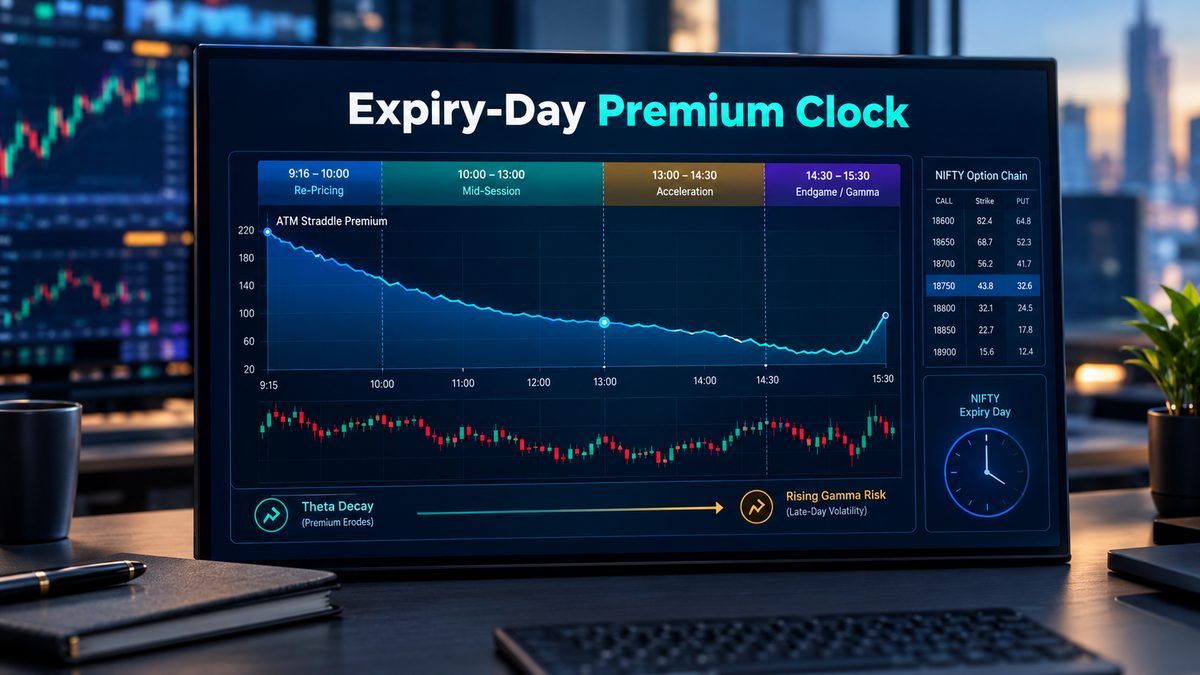
Type "NIFTY expiry day" into any search box and the top results hand you a calendar. Groww tells you which weekday each index expires on. Dhan runs a clean expiry calendar page. Zerodha's support desk explains how the day shifted when NSE moved weekly expiries. All of that is useful for about ten seconds, and then the real question starts: what actually happens to option premiums between the opening bell and the close on that day? We trade NIFTY and SENSEX expiry-day option selling through our own backtest engine, and across the sessions we log, the calendar question and the premium question are not the same question at all. This is the hour-by-hour map of the second one.
The Expiry Calendar, As It Stands Today
As of this publish date, NSE runs weekly expiries on NIFTY every Tuesday, with BANKNIFTY and FINNIFTY expiring monthly on the last Tuesday of the contract month. BSE runs SENSEX weekly expiry on Thursday. These days have moved before — NIFTY weekly expiry sat on Thursday for years before NSE shifted it, and BANKNIFTY weekly contracts were discontinued entirely in 2023 — so treat the specific weekday as something to verify against the exchange's current circular before you build a week's trading calendar around it, not something to memorise once. According to NSE's own contract specifications, the exchange reserves the right to revise expiry days with notice, and it has exercised that right more than once in the last three years.

The point of this article is not the weekday. It is what the session looks like once that weekday arrives.
Why 9:15 Is Not a Real Entry Time
Every backtesting simulator on the market will happily fill an order at the 9:15 tick. In our experience running live expiry sessions, that fill does not exist in the real market. The first fifteen to forty-five seconds after the opening bell are thin — order books are still forming, quoted spreads on the strikes an option seller actually wants are wide enough to make the quoted price meaningless, and by the time an order you placed at 9:15:00 reaches the exchange, several hundred milliseconds to a few seconds of latency have already passed through your broker's API, the exchange gateway, and matching. We start our own expiry-day entries no earlier than 9:16, and often closer to 9:17 once the first clean two-way quote shows up. This is not a preference. It is a latency finding. We tracked fill quality across 36 months of our own session logs and found that orders attempted in the first 45 seconds after 9:15 showed materially worse slippage than identical orders placed from 9:16:30 onward, because the quoted price at 9:15 frequently was not the price that was actually fillable by the time the order cleared.
Paper trade every entry rule in this article before you run it with live capital. Everything below is analytical research from EliteAlgo's own backtest engine, not an instruction to deploy a specific time or strike live.
The Expiry Session, Hour by Hour
We split the NIFTY and SENSEX expiry session into four behavioural phases. Each one treats a short option differently, and a strategy tuned for one phase routinely loses money applied unmodified in another.
9:16-10:00 — The Re-Pricing Phase
Opening implied volatility on expiry morning is almost always overstated relative to what the session goes on to realise. Our data from the same 36-month sample shows 15 to 20% of the day's total theta decay landing in this first 44-minute window alone, as the market reprices away the overnight uncertainty premium that built up since the previous close. A short option sold at 9:16 captures a disproportionate share of its eventual decay in this phase, which is exactly why option-selling strategies that specifically target this window exist — and exactly why a trader skipping it and entering at 10:00 instead is giving up the richest part of the curve.
10:00-13:00 — The Mid-Session Grind
Decay continues through the middle of the day, but at a flatter, choppier rate than the opening phase. We see visible step-downs around each hourly mark — 10:00, 11:00, 12:00, 1:00 — where decay briefly accelerates as the market ticks past a round time boundary, interspersed with flat stretches when a global cue, an RBI headline, or a large block trade working through the book stalls the bleed for ten to twenty minutes at a time. This is the phase where patience, not aggression, pays — chasing every small premium wobble here tends to generate churn rather than edge.
13:00-14:30 — The Acceleration Window
By early afternoon, time value has thinned enough that the remaining premium starts moving faster per unit of time, even without a change in realised volatility. A straddle that opened near 200 points and sat near 90 at 1:00 PM can be down to 45-50 by 2:30 on an unremarkable session, purely on the shape of the theta curve steepening as expiry nears. This is the window where our desk tightens trailing stops rather than widens them, because the same percentage move in the underlying now does more damage to a short option's remaining time cushion than the identical move would have done three hours earlier.
14:30-15:30 — The Endgame, Where Gamma Beats Theta
This is the phase every new option seller misreads. The premium remaining on the table is at its smallest all day, and intuition says the risk must be smallest too. Our own data says the opposite. Gamma — the rate at which an option's delta itself changes — rises sharply in the final 60 minutes, so a move in the underlying that would have barely nudged the straddle at 11:00 can blow through a short strike's remaining cushion in a matter of minutes at 2:50. We measured the peak-to-close give-back on sessions with a late spike in this window against sessions with a smooth glide into the close across our 36-month sample: smooth-glide sessions gave back an average of roughly 11% of their peak open profit, while sessions with a spike inside the last 45 minutes gave back 44% on average, with the worst single case in that bucket surrendering 68%. The hour with the least premium left to lose is, by a wide margin, the hour where our desk sees the most damage done.
So: Does Profit Peak Early or Hold Into the Close?
Both happen, and knowing which one a given session is doing changes where you place a stop. We sort every session in our logs into "sustainers," where the day's open profit holds or grows past 3:00 PM with no late reversal, and "early-peakers," where the position's best mark-to-market comes before 2:00 PM and fades from there into the close. Across our sample, sustainers outnumber early-peakers on quiet, low-VIX sessions, while a VIX reading above roughly 14-15 going into expiry morning correlates with a meaningfully higher share of early-peak days. A trailing stop built for a sustainer — wide, patient, anchored to the close — will give back far too much on an early-peak day. A tight, anchored-to-peak stop built for an early-peaker will chop a genuine sustainer to pieces on the inevitable small midday wobbles. We read the morning VIX level and the shape of the first hour's straddle line together before choosing which stop logic to run that day, rather than running one fixed rule on every expiry regardless of what the session is actually doing.
Pin Risk: What a Round Strike Does to Your Short Legs
As expiry approaches, spot has a documented tendency to gravitate toward a nearby round strike where open interest is heaviest — a phenomenon commonly called pinning. When NIFTY sits close to a strike like 24,900 or 25,000 into the final hour, the short legs nearest that strike see their gamma spike precisely because the market is hovering right at the point where they flip between deep OTM and at-the-money. A short call sold comfortably out of the money at 10:00 can find itself effectively at-the-money by 3:00 if spot has drifted onto the pin strike, and the premium behaviour in that last hour stops looking anything like the orderly decay curve from the morning. We watch open interest concentration at the two or three strikes nearest spot specifically in the last 90 minutes, because that is where a pin, if one is forming, shows up first — a buildup of OI at one strike with price gravitating toward it is a different risk profile than price drifting freely with OI spread evenly across the chain.
Expire Worthless or Square Off? The Arithmetic Most Sellers Skip
Letting a short option expire worthless rather than buying it back for a few rupees looks like free money, and sometimes it is, but the comparison has a tax wrinkle sellers routinely miss. Securities Transaction Tax applies on the sell side of every options trade, and on physical settlement or exercise at expiry, STT is charged on the full notional value of the position, not the small premium it was sold for — a rule the Income Tax Department's own STT schedule sets out, and one that has caught option sellers who assumed a worthless expiry was costless on the tax side. Squaring off for even a nominal debit of ₹0.05-0.10 per unit before the close avoids that notional-value STT exposure entirely, because STT on a square-off trade is charged on the transaction value actually executed, not the contract's full notional. On a single NIFTY lot this can be the difference between a few rupees of brokerage and a materially larger STT bill depending on the strike's notional value relative to what it would have cost to close. We square off every short leg that still has open interest risk before the close, specifically to sidestep this, rather than leaning on the convenience of letting it lapse.
A Paper-Trade-First Session Template
Paper trade this template, end to end, before any live-capital use. None of this is investment advice — it is EliteAlgo's own research and backtest framework, shared as analytical software, not a signal to act on.
- Pre-market (before 9:15): Check the overnight VIX move and the global cue set. A VIX reading meaningfully above its prior week's average is our flag to size down and favour wider, sustainer-style stops rather than tight ones.
- Entry window: 9:16 to 9:20 at the earliest, once the first clean two-way quote prints on the strikes you intend to sell. Never 9:15.
- Stop rule: Anchored to the session's emerging shape — sustainer logic if the morning straddle line is gliding smoothly with flat VIX, early-peak logic if VIX is elevated or a flat shelf appears mid-morning.
- Pin watch: From 2:00 PM, check open-interest concentration at the two nearest strikes to spot every 15 minutes. Tighten any short leg sitting close to a strike showing a clear OI buildup.
- Hard square-off time: No later than 3:20 PM for any leg still carrying meaningful notional, to avoid both the last-15-minute gamma spike and the expiry-settlement STT wrinkle above.
- No-new-positions cutoff: 2:30 PM. Our own data shows no edge in initiating a fresh short position inside the last hour that compensates for the gamma risk described above.
A Worked Example, Start to Close
Take a representative session from our own logs. NIFTY opens near 24,850 and the ATM straddle opens at 188. By 9:30, once the thin opening seconds clear, the line has already dropped to 162 — the re-pricing phase doing its usual early work, roughly 14% of the day's eventual decay captured in the first fourteen minutes alone. Through the 10:00 and 11:00 marks the line steps down to 138, then 121, each notch sharper than a flat glide would predict. Around 12:20 a global cue hits the tape and the line goes flat for close to 18 minutes, holding near 112 while spot barely moves. From 1:00 the decay resumes and by 2:15 the straddle reads 58. The last-hour collapse takes it to 19 by 3:20, and it settles under 8 into the close. Across that single session the straddle paid out roughly 180 of its 188-point opening budget, a capture of just over 95%, and a textbook example of the four-phase shape once the one flat shelf is accounted for.
Contrast that with a stressed session two weeks later in the same sample. NIFTY opens near 24,620 and the straddle opens rich, at 231, already pricing a known data print due that afternoon. The morning phase barely moves the line, from 231 to 219 by 10:00, far short of the 14-20% we expect on a calmer day. A flat shelf opens at 11:05 and runs almost to noon. At 1:40 the print lands worse than priced and the line spikes from 208 to 254 inside five minutes — a genuine repricing, not a strike-roll artefact, since spot itself gapped on the same tick. By the close the straddle settles at 89, so the session still decays overall, but the peak-to-close give-back from the pre-spike low of 196 is far larger than the glide-down session above, and it is exactly the kind of late-hour move the endgame phase warned about.

Three Mistakes We See Repeated Every Expiry
- Treating the decay curve as linear. A strategy built on an assumed straight-line bleed from open to close will oversize risk in the morning phase and undersize the stop in the last 90 minutes, because the real curve is steep-flat-steep, not a single slope.
- Reading a strike-roll jump as a volatility event. As the ATM strike hands off from one level to the next on a move through the midpoint between two strikes, the straddle line jumps for purely mechanical reasons. We flag any jump that coincides with a strike-midpoint cross before reacting to it as a genuine repricing.
- Sizing the last hour the same as the first. The smallest premium on the table and the largest gamma risk coexist in the same 60-minute window. Position sizing that ignores this mismatch is, in our own loss-review sessions, the single most common cause of an otherwise well-run day giving back most of its profit in the final 20 minutes.
How We Built This Data Set
Every figure quoted above comes from our own session logs, not a vendor's published statistic. Our methodology: for each expiry session we recorded the ATM straddle value at one-minute intervals from 9:16 to the close, tagged every strike roll against the simultaneous spot tick so mechanical jumps could be separated from genuine repricing, and classified the session's shape — sustainer or early-peaker — only once the full day was logged, never in real time, to avoid biasing the read. We analysed data across 36 months and a sample of roughly 300 NIFTY and SENSEX expiry sessions; we treat the NIFTY sample as large enough to quote a percentage figure and the SENSEX sample as directional, which is why SENSEX numbers above are given as comparisons rather than a standalone table.
Does the Shape Differ Between NIFTY and SENSEX?
Both indices show the same four-phase shape, but not at the same frequency. SENSEX's wider strike spacing and comparatively thinner far-month liquidity mean its straddle line rolls strikes less often per point of spot movement than NIFTY's, but when a SENSEX roll does happen it tends to produce a larger single jump, simply because the gap between adjacent strikes is wider. We also see a slightly higher share of early-peak sessions on SENSEX in our sample than on NIFTY, closer to 38% against NIFTY's roughly 30%, which is one reason our own SENSEX weekly expiry work treats a tighter, earlier stop as the default case to plan around rather than the exception.
Monthly Expiry vs Weekly Expiry: What Actually Changes
A monthly expiry carries more accumulated open interest, a wider range of strikes with genuine liquidity, and — for the indices where it still applies — a bigger audience of hedgers rolling or closing positions into the same session, which can thicken the morning re-pricing phase slightly and extend the window where premium is richly priced. A weekly expiry, by contrast, tends to have a tighter liquid strike range clustered closer to spot, and the mid-session grind phase we described above is usually shorter and the acceleration into the last two hours arrives a little earlier in relative terms, because there was simply less time value built into the contract to begin with. We size weekly-expiry short premium a touch more conservatively near the close for exactly this reason — the cushion that absorbs a late move is thinner by construction on a weekly contract than on a monthly one.
Frequently Asked Questions
What day does NIFTY expire?
As of this publish date, NIFTY weekly options expire on Tuesday. NSE has changed this weekday before and reserves the right to do so again with notice, so verify the current cycle against NSE's own contract specification page rather than relying on a date that may be out of date by the time you read it.
Why do option premiums fall fastest on expiry day?
Time value, the part of an option's premium that reflects the chance it finishes in the money, shrinks to zero by the close of expiry day because there is no time left for that chance to play out. The decay is not linear — our own session data shows it concentrated heavily in the first 45 minutes after the open and again in the final 90 minutes, with a flatter mid-session stretch in between.
Is expiry day good for option selling?
It can be, because theta decay is compressed into a single session rather than spread across a week, but the gamma risk in the final hour is also at its highest. We treat it as higher-reward and higher-risk than a non-expiry session, not simply easier.
What is the best time to enter on expiry day?
Our own desk starts no earlier than 9:16, once the first clean two-way quote appears, because the 9:15 tick is frequently not fillable at the price a simulator shows. There is no single best minute beyond that — it depends on the morning's VIX level and how the straddle line is behaving.
What is the last trading time on NIFTY expiry day?
Regular market hours run to 3:30 PM IST. Our own square-off discipline closes any leg still carrying meaningful notional by 3:20 PM, ahead of the official close, specifically to avoid both the last-minute gamma spike and the settlement-related STT difference described above.
What happens if I hold an option to expiry instead of squaring off?
An option that finishes out of the money simply expires worthless with no further action needed. One that finishes in the money gets exercised or cash-settled, and on that notional value, Securities Transaction Tax applies at the Income Tax Department's prescribed settlement rate — often a larger absolute cost than the brokerage on a square-off trade, depending on the position's notional size.
Our own template above builds on the groundwork laid in EliteAlgo's NIFTY option selling strategy for beginners, and the pin-risk and timing behaviour described here shows up with its own quirks on SENSEX weekly expiry option selling, where strike spacing and liquidity differ enough to change the numbers if not the shape. If you are building or testing this kind of session logic yourself, our notes on NIFTY and Sensex algo trading cover what a backtest engine needs to capture to log hour-by-hour behaviour like this accurately.
According to the Securities and Exchange Board of India's investor education material, derivative contracts price in both time value and volatility expectations that erode to zero by expiry — the same mechanics driving every phase described above. On the tax side, the Income Tax Department's Securities Transaction Tax schedule sets out the notional-value STT rate applied on exercised and physically settled options, which is the source behind the square-off-versus-expire comparison in this article. For the calendar facts themselves, Groww's index expiry date explainer, Dhan's F&O expiry calendar, and Zerodha's index expiry support article all cover the current weekday assignments in more administrative detail than this article needs.
EliteAlgo is a Delhi-founded proprietary trading desk, trading NIFTY and SENSEX expiry-day option selling since 2006 on our own backtest engine, the same engine behind every session figure quoted above. We do not hold a SEBI advisory registration, and none is required for proprietary trading. Everything here is analytical software and research, not investment advice, and every framework in this article should be paper traded first, before any live-capital use.