By the EliteAlgo research desk. We have been building and running systematic NIFTY option-selling strategies since 2006, across manual desks and automated execution.
Quick Answer
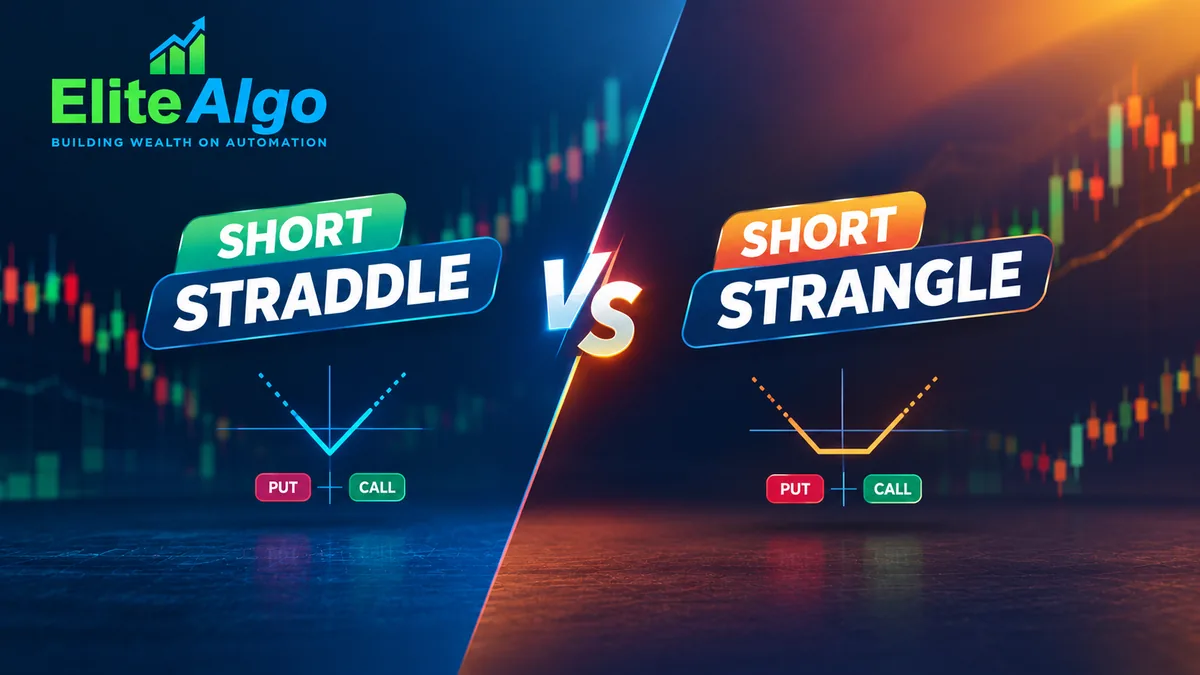
A short straddle sells the at-the-money call and put at the same strike, collecting more premium but exposing you to a tighter breakeven range. A short strangle sells an out-of-the-money call and put at different strikes, collecting less premium but giving you a wider cushion before losses begin. For NIFTY weekly expiry, straddles suit range-bound weeks with high implied volatility and tight stop-loss discipline, while strangles suit traders who want a larger margin of safety and are willing to accept a lower theta return per lot. Neither is "better" in isolation, the right choice depends on your volatility read for that specific week, your risk tolerance, and whether you can actively manage the position through the session.

This is not investment advice. Options selling carries theoretically unlimited risk on the short call side and substantial risk on the short put side, and every number in this article is for educational and analytical purposes only. Read our full disclaimer before trading any strategy discussed here.
Why This Question Matters Every Week for NIFTY Traders
NIFTY runs weekly expiry every Thursday (Tuesday during certain contract cycles as per NSE's published calendar), and that weekly cadence has turned option selling into one of the most searched, most debated strategies in Indian derivatives trading. Search interest around "short straddle vs short strangle," "NIFTY weekly expiry strategy," and "option selling strategies India" has grown steadily as more retail traders move from directional buying to premium selling, largely because SEBI's own analysis of retail F&O participation has repeatedly shown that a large majority of individual option buyers lose money, while sellers structurally benefit from time decay.
That does not mean selling premium is free money. It means the two most common ways to sell premium, the straddle and the strangle, behave very differently once volatility, time, and position sizing enter the picture. This article breaks both down mechanically, compares them side by side for NIFTY's weekly cycle, and gives you a framework for choosing between them instead of defaulting to whichever one is trending on social media that week.
What Is a Short Straddle
A short straddle means selling one at-the-money (ATM) call and one ATM put on the same underlying, same strike price, same expiry. For NIFTY, that means picking the strike closest to the current spot price, say NIFTY is at 24,800, you sell the 24,800 call and the 24,800 put.
Payoff mechanics. You collect the combined premium of both legs upfront. That combined premium is your maximum profit, realized if NIFTY expires exactly at the strike. Your breakeven points are the strike plus total premium collected (upside) and the strike minus total premium collected (downside). Move beyond either breakeven and losses begin, with the call side technically uncapped and the put side capped only at the strike value (since NIFTY cannot go below zero).
Why traders like it. Because both legs are ATM, they carry the highest extrinsic value and the highest theta (time decay) of any strikes on the chain. A straddle collects more premium per lot than a strangle built from the same underlying, which means a smaller move in your favor (specifically, no move at all, or a small one) delivers a full profitable outcome.
Why it demands discipline. The breakeven range on a straddle is narrower than on a strangle sold from the same starting point, because you are already sitting at the money with zero cushion built in before premium erosion. Any real intraday move, a gap, a policy headline, an FII/DII flow surprise, can push you through breakeven faster than a strangle would allow. Straddle sellers who do not hedge or use disciplined stop-losses are running an undefined-risk position that assumes low realized volatility for the remainder of the session or week.
What Is a Short Strangle
A short strangle means selling an out-of-the-money (OTM) call and an OTM put, at two different strikes, same expiry. Using the same NIFTY at 24,800 example, a strangle might sell the 25,000 call and the 24,600 put, both away from spot.
Payoff mechanics. Premium collected is lower per lot than a straddle because OTM options carry less extrinsic value. In exchange, the strangle has two breakeven points spread further apart, the call strike plus premium collected, and the put strike minus premium collected, giving NIFTY more room to move before the position turns unprofitable.
Why traders like it. The wider profit zone (the range between the two strikes plus the built-in OTM buffer) is the strangle's core appeal. If your view is "NIFTY probably stays in a broad range this week but I'm not confident enough to sell exactly at the money," a strangle expresses that view with a larger margin for being wrong on direction, at the cost of collecting less premium.
Why it is not automatically "safer." A strangle reduces the probability of an early stop-out from small moves, but it does not reduce the severity of a large move. If NIFTY breaks out of the range violently, on a percentage basis the strangle can lose a comparable or larger share of the premium collected because the return per lot was smaller to begin with, and gamma still accelerates sharply as spot approaches either short strike near expiry.
Side-by-Side Comparison for NIFTY Weekly Expiry
| Factor | Short Straddle | Short Strangle |
|---|---|---|
| Strikes used | Same strike (ATM call + ATM put) | Two different strikes (OTM call + OTM put) |
| Premium collected | Higher per lot | Lower per lot |
| Breakeven range | Narrower | Wider |
| Max profit condition | NIFTY expires exactly at strike | NIFTY expires anywhere between the two strikes |
| Theta (time decay) per lot | Highest available on the chain | Lower, but still meaningful |
| Sensitivity to a sudden move | High (breached faster) | Lower, but not immune |
| Margin required (broker-dependent) | Broadly similar to strangle for the same lot size, sometimes marginally lower | Broadly similar, varies by broker's SPAN/exposure model |
| Best suited for | Low expected realized volatility, active intraday management, tight stop-loss systems | Slightly wider expected range, traders wanting more room before adjustment |
| Risk if wrong | Theoretically unlimited on call side, large on put side | Same directional risk profile, cushioned by wider strikes |
Margin figures vary by broker and change with SEBI's peak margin and SPAN/exposure framework, so always confirm current requirements directly with your broker rather than relying on any fixed number, including ones published elsewhere online.
How Implied Volatility Should Drive Your Choice
The single biggest input into this decision is not "which strategy performed better last week." It is where implied volatility (IV) sits relative to your expectation of realized volatility for the coming session or week.
- When IV is elevated relative to your realized-volatility expectation (common ahead of RBI policy days, Budget sessions, or global macro events), straddles become more attractive because you are being paid a richer premium for taking on the same directional risk. This is the classic "sell volatility when it's expensive" setup.
- When IV is closer to fair or low, the extra premium a straddle offers over a strangle shrinks, and the strangle's wider safety margin becomes relatively more attractive per unit of risk taken.
- On genuinely quiet, low-movement weeks, which NIFTY weekly expiry data shows happens more often than headline volatility narratives suggest, both structures can work, but the straddle typically returns more theta per lot for the same quiet outcome.
None of this is a mechanical signal to trade blindly. IV can spike intraday on news, and a "quiet week" read can be invalidated within minutes on a policy surprise or a large FII derivatives flow shift. This is exactly why any systematic option-selling desk pairs the strike-selection decision with a hard stop-loss and position-sizing framework, not with strike selection alone.
Risk Management: The Part Most Retail Traders Skip
Whichever structure you choose, three risk controls matter more than the straddle-vs-strangle decision itself:
- Defined stop-loss on every leg, mechanically enforced. Manual discretion under pressure is where most option-selling accounts get damaged. A stop-loss that triggers on price or percentage-of-premium basis, without hesitation, is non-negotiable for undefined-risk structures like naked straddles and strangles.
- Position sizing relative to account capital, not relative to available margin. Just because your broker allows a certain lot size does not mean that size is appropriate for your capital base. Margin availability and prudent risk sizing are two different questions.
- Awareness of gamma risk in the final hour. As NIFTY weekly expiry approaches the last 60-90 minutes of the session, gamma accelerates sharply for strikes near the money. A position that looked comfortably safe at 2 pm can move meaningfully in-the-money by 3:15 pm on a fast intraday move. This is true for both straddles and strangles once spot approaches either short strike, and it is one reason many systematic desks (including our own expiry-day frameworks) treat the final hour as a distinct risk regime rather than a continuation of the morning session.
If you are naked-selling either structure without a hedge or a defined-risk overlay, understand that both carry theoretically unlimited loss potential on the call side. Traders who want the same directional thesis with capped downside typically convert a straddle or strangle into an iron butterfly or iron condor by buying protective wings further out. We cover that conversion and when it makes sense in our guide to building an option selling strategy for consistent monthly income.
A Simple Decision Framework
Use this as a starting checklist before choosing between the two on any given NIFTY weekly expiry, not as a guaranteed formula:
- Is implied volatility elevated relative to what you expect the week to realize? Lean straddle.
- Do you have a mechanical, tested stop-loss system you will follow without exception? Straddle becomes more viable; without one, lean strangle or a defined-risk structure instead.
- Is there a known event in the window (RBI policy, Budget, major global data, geopolitical headline risk)? Widen out, lean strangle, or reduce size, or sit out entirely.
- Are you managing the position actively through the session, or set-and-forget? Active management supports straddles; passive holding favors the wider cushion of a strangle, though neither should ever be truly "set and forget" without a stop-loss in place.
- What does your own backtested data say for this specific volatility regime? This is the step most retail traders skip and the one that matters most. A strategy's historical behavior in a comparable VIX regime is a far better guide than a general rule of thumb.
Why Backtesting Beats Guessing
Anecdotal claims about which structure "always works better" do not hold up across different volatility regimes. A straddle that performed well during a low-VIX quiet stretch can behave very differently during a high-VIX trending stretch, and the reverse is equally true for strangles. This is precisely why we built EliteAlgo around regime-aware backtesting rather than static rules: our platform lets you test both straddle and strangle configurations for NIFTY weekly expiry across historical volatility regimes, with realistic slippage and costs applied, before you risk a rupee live.
If you are evaluating platforms to do this kind of testing yourself, our comparison of algo trading platforms built for option sellers walks through what to look for beyond marketing claims, and our backtesting software guide explains why realistic cost modeling changes backtest outcomes more than most traders expect.

Greeks Behind the Two Structures
Understanding the Greeks side by side makes the practical differences between a straddle and a strangle much clearer than payoff diagrams alone.
Delta. A straddle sold exactly ATM starts close to delta-neutral, since the call and put deltas roughly offset. A strangle sold with symmetric OTM strikes around spot also starts close to delta-neutral, but the absolute delta of each individual leg is smaller because both options are further from the money. In practice this means a straddle's net delta shifts faster as NIFTY moves, because the ATM options it holds have delta closer to 0.5 on each side, versus an OTM strangle leg starting closer to 0.2-0.3 delta depending on how far out the strikes are placed.
Gamma. Gamma is highest at the money and decays as strikes move away from spot. A straddle therefore carries materially higher gamma than a strangle built from the same underlying at the same point in time. This is the technical reason straddles feel "twitchy" intraday, small spot moves produce outsized delta changes near the money, which is also why straddle positions typically require more frequent monitoring or adjustment than strangles during a fast-moving session.
Theta. Theta (time decay) is also highest at the money, which is precisely why straddles collect more premium and decay faster in rupee terms per lot than strangles, all else equal. This is the core trade-off of the entire straddle-vs-strangle decision: more theta income against more gamma risk for the straddle, versus less theta income against less gamma risk for the strangle.
Vega. Both structures are net short vega, meaning both benefit from implied volatility falling after entry and both lose value (all else equal) if IV rises after entry. ATM options generally carry higher vega in absolute terms than OTM options of similar days-to-expiry, so a straddle's PnL is typically more sensitive to a change in IV than a strangle's, in either direction.
Taken together, the Greeks explain why the straddle-strangle choice is really a choice about how much gamma and vega risk you are willing to hold in exchange for theta income, expiry after expiry.
Common Mistakes Traders Make With Both Structures
Sizing the same way regardless of the VIX level. A straddle or strangle sized for a VIX of 12 can be dangerously oversized if VIX jumps to 18-20 ahead of an event, because the same lot count now represents materially more risk per point of NIFTY movement in rupee terms. Position sizing should scale with the volatility regime, not stay fixed.
Ignoring correlated event risk. Selling premium into a week with an RBI policy announcement, a Union Budget session, or a major global data release changes the realized-volatility distribution versus a routine week. Losses attributed to "bad luck" are often a failure to account for known, calendared event risk visible in advance.
Treating margin availability as a risk limit. Brokers often allow larger positions than your account can comfortably absorb on an adverse move. Margin availability tells you what you are permitted to trade, not what you should trade. Confirm current margin requirements with your broker and size to your own capital-preservation rules independently.
No plan for adjustment or exit before entry. Entering a naked straddle or strangle without a predefined stop-loss, adjustment trigger, or time-based exit rule turns a probability-based strategy into a discretionary gamble under pressure.
Comparing single-week results instead of a full regime sample. One good week on a straddle, or one bad week on a strangle, tells you little about which structure suits your process. A meaningful comparison needs a backtested sample across low-VIX, high-VIX, and trending regimes, not a handful of recent expiries.
Straddle, Strangle, or a Defined-Risk Alternative
For traders who want the theta-collection logic of a straddle or strangle without carrying theoretically unlimited risk on the call side, converting to a defined-risk structure is worth understanding even if you ultimately choose to trade naked.
An iron condor buys a further OTM call and further OTM put against a short strangle, capping maximum loss at the width between the short and long strikes minus premium collected. An iron butterfly does the same against a short straddle. Both trade some premium income for a hard ceiling on loss, which changes the position-sizing math significantly since maximum loss is known at entry rather than theoretically open-ended.
This is not automatically the "correct" choice over naked selling. It depends on your account size, your conviction in your stop-loss execution, and how much of the ATM/near-ATM premium you are willing to give up for defined risk. But any trader running naked straddles or strangles regularly should at minimum understand the conversion, because it is the standard next step once position sizes grow to a level where a single tail event could meaningfully damage the account.
Frequently Asked Questions
Is a short strangle always safer than a short straddle?
Not automatically. A strangle gives you a wider breakeven range, which reduces the probability of an early stop-out from small moves, but it does not cap your maximum risk on a large adverse move, and it collects less premium per lot to begin with. "Safer" depends on position sizing and stop-loss discipline as much as strike selection.
Which one makes more money on NIFTY weekly expiry?
Neither one is unconditionally more profitable. A straddle collects more premium and performs best in low-realized-volatility weeks near the ATM strike; a strangle collects less premium but has a wider profitable range. The better performer in any given week depends on how NIFTY actually moves relative to what was priced into implied volatility at entry.
Can I lose more than my premium collected on a short straddle or strangle?
Yes. Both are undefined-risk structures on the call side (theoretically unlimited loss potential) unless you convert them into a defined-risk structure like an iron condor or iron butterfly by buying protective wings. This is a fundamental structural risk, not a rare edge case, and it is why stop-loss discipline is essential.
Do I need algo trading software to trade these strategies, or can I do it manually?
You can trade either structure manually, but weekly expiry moves fast, and mechanical execution removes the emotional hesitation that damages most manual option-selling accounts, particularly around stop-loss triggers in the final hour before expiry. Many traders start manually to understand the mechanics and move to systematic execution once they have a tested, repeatable process.
How does NIFTY's weekly expiry schedule affect straddle and strangle selection?
NIFTY's weekly expiry cadence, as published on the NSE website, means implied volatility and theta decay compress into a shorter window than monthly options. That faster decay benefits sellers of both structures, but it also means gamma risk accelerates faster in the closing sessions, making risk management timelines tighter than for monthly expiry strategies.
The Bottom Line
The straddle-versus-strangle decision for NIFTY weekly expiry is not a one-time rule you set and forget. It is a weekly read on implied volatility versus your realized-volatility expectation, filtered through your own risk tolerance, capital base, and whether you can actively manage a position through the session. Straddles pay more when you are right about a quiet week; strangles give you more room to be wrong about direction while paying less for it. Both carry real, potentially unlimited downside if traded naked without stop-loss discipline.
If you want to move past guesswork and test both structures against actual NIFTY historical data across different volatility regimes, that is exactly what a rigorous backtesting workflow is built for, and it is the approach our desk has used since 2006 before deploying any structure with real capital.
This article is for educational and informational purposes only and does not constitute investment advice. Options trading, including short straddles and short strangles, involves substantial risk of loss, including potentially unlimited loss on undefined-risk positions, and is not suitable for all investors. Past performance and backtested results do not guarantee future outcomes. Please consult a SEBI-registered investment advisor and review NSE and SEBI guidelines before trading derivatives.