
Quick Answer
The Greeks are sensitivities. Each one answers the question "if this one thing changes by one unit, how much does the option's price change?" Delta answers it for a move in the underlying. Gamma answers it for delta itself — it is the rate at which your directional exposure changes. Theta answers it for the passage of one day. Vega answers it for a one-point change in implied volatility. Rho answers it for interest rates, and for Indian index options traded intraday it is noise.
They are not predictions and they are not rules. They are partial derivatives of a pricing model, which means each one holds everything else still and tells you about one axis only. The single most useful thing to understand about them is that they are not stable: the Greeks of a position change as price moves, as volatility moves and as the calendar advances, which is precisely what gamma exists to describe. A seller's position is conventionally short delta risk in one direction, short gamma, long theta and short vega — paid daily for carrying two exposures that get worse when the market moves hard.
Paper trade before any of this touches live capital. This page is a reference, not advice. It recommends no strike, no expiry and no structure, and it is analysis rather than a signal.

What "the Greeks" actually are, and what they are not
The word is unhelpful. "Greeks" sounds like a system, and people treat the numbers as instructions — buy when delta is this, exit when gamma is that. They are nothing of the kind.
Every Greek is a sensitivity, in the ordinary sense of the word. An option's price depends on a handful of inputs: where the underlying is, how long until expiry, how volatile the market is assumed to be, the strike, and the interest rate. Change one input, hold the rest fixed, and the price moves. The Greek is the size of that move. That is the whole concept.
Three properties follow from that definition, and all three are routinely ignored.
- Each Greek holds the others still. Delta tells you what happens if the underlying moves and nothing else does. In a real session, the underlying moving is usually accompanied by implied volatility moving, which means the actual price change is delta plus a vega effect plus whatever gamma did on the way. Reading delta alone and being surprised by the fill is the most common beginner error in options.
- Each Greek is only locally true. A delta of 0.30 describes the next small move, not the next 300 points. Over a large move the delta itself has changed — which is gamma — so the linear estimate falls apart exactly when the move is big enough to matter.
- They are model outputs, not measurements. You cannot observe the gamma of an option the way you observe its last traded price. The Greeks are computed from a pricing model, and the model needs an implied volatility, which is itself backed out of a market price. Two platforms can show you slightly different Greeks for the same contract and neither is wrong — they have made different assumptions about inputs. For the Greeks on a chain this rarely changes a decision, but it should stop you treating the third decimal place as fact.
What they are good for is naming your exposure. Before the Greeks, "this position will lose if the market moves a lot" is a feeling. After, it is "this position is short gamma, so my loss accelerates rather than accumulating linearly" — which is a statement you can size against.
The five Greeks at a glance
| Greek | Sensitivity to | Reads as | Typical seller exposure |
|---|---|---|---|
| Delta | A one-point move in the underlying | 0 to 1 for calls, 0 to −1 for puts | Directional. Short call = negative delta; short put = positive delta |
| Gamma | A one-point move in the underlying, measured on delta | Always positive for a long option; the number is small and strike-dependent | Short. The seller's delta moves against them in both directions |
| Theta | One day passing | Negative for a long option; quoted per day | Long. This is the seller's income line |
| Vega | A one-point change in implied volatility | Positive for a long option; largest at the money and with time left | Short. Rising IV marks the position down |
| Rho | A one-percent change in interest rates | Small, and smallest on short-dated contracts | Negligible for intraday index option selling |
The convention worth fixing in your head: the signs above are from the buyer's side. A long option has positive gamma, negative theta and positive vega. Sell it, and every sign flips. "Short gamma, long theta, short vega" is not jargon for its own sake — it is a three-word description of the entire premium-selling trade, and the rest of this page is an unpacking of those three words.
Delta — your directional exposure, in units you can use
Delta is the amount the option's price changes for a one-point move in the underlying. A call with a delta of 0.35 gains about ₹0.35 if the index rises by one point. A put with a delta of −0.35 loses about ₹0.35 on the same move.
Two readings of the same number, both useful:
As an exchange rate. It converts index points into option rupees. If you want to know what a 100-point move does to your position, delta is the first-order answer: 100 × delta × lot size, before anything else kicks in.
As equivalent position size. A short call with a delta of 0.40 behaves, for small moves, like being short 0.40 units of the index per unit of option. Add the deltas of every leg and you have your net directional exposure for the whole book in one number. This is why desks talk about being "delta neutral" — not because direction does not matter, but because they have deliberately set that sum near zero.
The third reading, the popular one, needs a warning attached. Delta is often described as the probability the option expires in the money. It is approximately that under the model's assumptions, and it is a genuinely handy intuition — a 0.15-delta option is roughly a "15% chance" contract. But it is a model-implied figure resting on the same volatility assumption as everything else here. It is not a measured frequency, and selling 0.15-delta options is not an 85% strategy. It is an 85% win rate strategy, which is a different and much less interesting thing. We work through why that distinction decides profitability in option buying vs option selling, settled with arithmetic.
What moves delta:
- The underlying moving. Delta rises toward 1 as a call goes deeper in the money and falls toward 0 as it goes further out. The rate of that change is gamma.
- Time passing. With less time left, an in-the-money option's delta pushes toward 1 and an out-of-the-money option's delta collapses toward 0. The same strike, the same spot, a different day, and a materially different delta. Our page on the same strike on a different day covers that effect on price; the delta effect is its mirror.
- Volatility changing. Higher assumed volatility pulls deltas toward the middle — an out-of-the-money option looks more reachable, so its delta rises.
Note what that list means together: a position you set up at a comfortable delta does not stay at that delta. Nobody has to trade for your exposure to change.
Gamma, in depth — the Greek that decides whether a bad day is bad or ruinous
Gamma gets the longest section here because it is the least understood and the most consequential for anyone short options.
What gamma measures
Gamma is the rate of change of delta per one-point move in the underlying. Delta tells you your current directional exposure. Gamma tells you how fast that exposure changes as the market moves. It is the second derivative of the option price with respect to the underlying, which is a precise way of saying: it is the curvature.
Concretely. Suppose you are short a call with delta 0.30 and gamma 0.004. The index rises 20 points. Your delta is now roughly 0.30 + (20 × 0.004) = 0.38. You did nothing, and your short position is now 27% more directionally exposed than it was. Another 20 points and it is more exposed again, and the increments are getting larger relative to where you started. That compounding is the whole phenomenon.
The names people use for this all describe the same mechanic:
- "Gamma in options" — the general concept above.
- "Gamma of an option" — the specific number for one contract, which depends on its strike, its time to expiry and the prevailing volatility.
- "The gamma Greek" — its place in the family, as the derivative of delta.
Where gamma lives
Gamma is not spread evenly across the chain. It concentrates, and knowing where is most of the practical value.
- Highest at the money. An at-the-money option is the one whose delta has the furthest to travel — it sits near 0.50 and could end at 0 or 1. Maximum uncertainty about the final delta means maximum curvature now. Move away from the money in either direction and gamma falls off.
- Highest with the least time left. This is the part that catches people. A far-dated at-the-money option has a delta that will wander for weeks; a one-day at-the-money option has a delta that must resolve to 0 or 1 within hours. The same strike has dramatically more gamma on its last day than it had a month earlier.
- Lowest where both effects are weak. A far-out-of-the-money option with weeks to run has very little gamma. Its delta is near zero and will stay near zero through ordinary movement.
Those two facts interact to produce the single most important structural feature of short option positions, which is that the position with the most attractive-looking theta is also the position with the most gamma. They are not two choices. They are the same choice, read from two sides.
What being short gamma actually does to you
A long option holder is long gamma. Movement helps them: the more the market moves, the better their delta gets, in whichever direction it went. Their losses decelerate and their gains accelerate.
The seller has the opposite. Short gamma means:
- Your delta always moves against you. Market up, and a short call's delta grows more negative — you are shorter into a rising market. Market down, and a short put's delta grows more positive — you are longer into a falling market. There is no direction in which movement improves your position. This is the defining feature and it is worth sitting with.
- Losses are convex. A 100-point move costs you something; the next 100 points cost more than the first 100 did. Linear thinking about a short option position systematically understates the tail, which is why "the market would have to move 2% to hurt me" is a sentence that gets people into trouble — it is true about the first 2% and says nothing about what the 2% does to the position's exposure on the way.
- Hedging into it loses money by construction. If you neutralise delta after an adverse move, you are buying high and, after a reversal, selling low. Every delta hedge on a short-gamma book is a realised cost. That cost is, in a real sense, what the premium you collected was paying for.
- It gets worse with time, not better. Theta and gamma both grow as expiry approaches. The income and the hazard arrive together, from the same source.
That last point has a tactical dimension — when in a session the handover happens, what it feels like at the screen, how to size around it — and that is deliberately not this page's job. The expiry-day behaviour of this trade-off, including the crossover point and how our own desk tracks it, is covered in option Greeks on expiry day: theta stops, gamma starts. Read this section for what gamma is; read that page for what to do about it on the day.
The gamma misreadings we see most
"Gamma is small, so it does not matter." The number is small because of its units — it is a change in delta per single point of index movement. Multiply it by a realistic daily range and by your lot size and it stops being small. Judging gamma by the size of the printed decimal is a unit error, not a risk assessment.
"I sold far out of the money, so I have no gamma." You have little gamma at the current spot. Gamma is a function of where price is relative to your strike, and price moves. A strike that is 2% away with negligible gamma becomes an at-the-money strike with maximum gamma if the market travels 2%. Your gamma exposure is not a fixed property of the position you opened; it is a map, and the market decides where on the map you are standing.
"A spread removes gamma." It caps the loss, which is a different and very valuable thing. Between the strikes, a vertical spread still has gamma; what it has done is bound the convexity rather than eliminate it. We cover what capping does and does not buy you in vertical spreads: capping risk instead of selling naked.
"Gamma only matters on expiry day." It is largest then, which is why that page exists. But a short-dated position carries real gamma for its whole life, and a gap through your strike on any morning is a gamma event.
Theta — the number sellers are paid, and the one that flatters them
Theta is the change in the option's price for one day passing, with everything else held still. It is quoted as a per-day figure and it is negative for a long option: the holder of an option loses value simply by waking up.
For a seller, theta is the income line. Collect the premium, let the extrinsic component decay, keep what has decayed. It is directionless, which is the attraction — you can be wrong about where the market goes and still be paid, so long as it does not go far. Where that extrinsic component comes from in the first place is covered in how option premium is actually priced, strike by strike.
Three things about theta that the number itself does not tell you:
- It is not linear across the option's life. Decay accelerates as expiry approaches, and it accelerates hardest at the money. A chart of extrinsic value against time is a curve, not a slope, which is why "I will sell weekly and collect a bit every day" misdescribes the cash flow.
- The quoted figure assumes nothing else changes. It is a one-day-forward estimate with the underlying frozen and implied volatility frozen. On a real day, neither is. A positive theta position can easily lose money on a day the theta was paid in full, because vega and gamma did more than theta did.
- It is the most psychologically dangerous Greek on the screen. Theta accrues in small, frequent, reliable increments, and the gamma loss arrives in one lump on an unusual day. The timing difference makes the income feel like an edge and the loss feel like bad luck. It is the same trade. Our measured record on exactly this point is in is algorithmic trading profitable — our own data, where across 163 logged expiry sessions the median session gave back 42.8% of its intraday profit peak by the close and roughly 30% of sessions turned a peak profit into a loss by the end of the day. Theta on the screen is not theta in the account.
Vega — your exposure to the market changing its mind
Vega is the change in the option's price for a one-point change in implied volatility. If an option has a vega of 8 and implied volatility rises by one point, the option's price rises by about ₹8, with the underlying and the calendar held still.
A long option has positive vega. A seller is short vega, and that means: if the market starts assuming more future movement, your short position is marked down even if the market has not moved at all. This is the exposure that surprises people most, because nothing visible happened. Spot is where it was. Your position is worse.
Where vega lives
- Largest at the money. The at-the-money strike has the most extrinsic value to be revalued, so a change in the volatility assumption moves it most in absolute terms.
- Largest with more time to expiry. Vega and gamma are opposites on the time axis. A monthly option has far more vega than a one-day option, because a change in the assumed rate of movement applies over far more remaining time. Near expiry vega shrinks toward irrelevance — which is why vega is a weekly-and-beyond problem and gamma is a final-session problem.
- Not uniform across strikes. Each strike carries its own implied volatility, and they do not move in lockstep. A one-point move "in volatility" is a convenient fiction; what actually happens is that the whole surface shifts and twists.
On "the vega formula"
People search for a vega formula expecting an equation to plug numbers into. The honest answer is that vega, like every Greek, is an output of an option pricing model — it is the model's own statement of how sensitive its price is to its volatility input. Your platform computes it; the chain displays it.
We are not going to print an equation here and imply you should be evaluating it by hand before a trade, because that is not how the number gets used and it would be a worse use of your attention than the three things that actually matter:
- Read vega as rupees per volatility point, multiplied by your lot size. That converts an abstract volatility worry into a number in your own account currency.
- Know its sign on your book. Net short vega means rising volatility hurts, regardless of how the structure is described.
- Know that the input it is sensitive to is itself inferred, not observed. Implied volatility is backed out of market prices, so vega is a sensitivity to a quantity that is itself a derived number.
What vega is not is a view on volatility. It tells you the size of your exposure, not whether volatility is high, low, cheap or expensive. That assessment — what implied volatility is, how to judge whether it is rich relative to its own history, and the India-specific instruments for reading it — belongs to implied volatility explained: it is a price, not fear, and we have deliberately not duplicated it here. Vega is the exposure; IV is the thing you are exposed to.
Rho, briefly, and why we are not going to dwell on it
Rho measures sensitivity to interest rates. For long-dated options on individual stocks it has a role. For weekly and monthly Indian index options, with holding periods measured in days or hours, the interest-rate component of the price is small and it does not change over the life of your trade. It is on the list for completeness. If rho is deciding your outcome, something else has gone unusually right.
Reading an option chain with the Greeks switched on
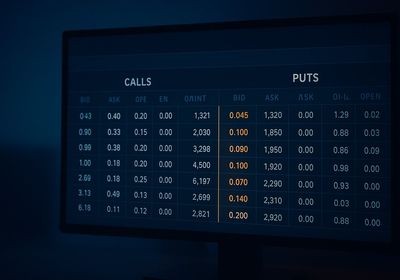
Most Indian broker platforms will show Greeks on the option chain, either as additional columns or in a separate Greeks view, and many default to hiding them. Turn them on. The chain stops being a price list and becomes a risk map.
What to look at, in order:
- Find the at-the-money row. It is the one with call delta near 0.50. Everything else reads relative to this row — gamma and vega both peak here and fall away in both directions.
- Read delta across the strikes to locate yourself. Scanning the delta column tells you how far from the money each strike really is, in a way that the strike number alone does not, because it already accounts for time left and prevailing volatility. A 0.10-delta strike is a 0.10-delta strike whether that is 1% away or 3% away. Our page on ITM, OTM and ATM as a filter covers the moneyness frame this sits inside.
- Read gamma to find the hazard band. The strikes with the largest gamma are where your delta will move fastest if price arrives there. For a short position, that is a map of where it stops being comfortable.
- Read theta and vega together, not separately. High theta and high vega appear on the same rows, because both scale with extrinsic value. The row that pays you most per day is the row that reprices most when the volatility assumption shifts.
- Sum your own position's Greeks. This is the step people skip and the only one that describes your actual risk. Net delta, net gamma, net theta, net vega across every open leg. A book that looks hedged leg by leg frequently is not once you add it up.
Two cautions on chain-displayed Greeks. First, they are computed from an implied volatility that is itself derived from a market price, so in a thin or stale book the Greeks inherit that thinness — far-out-of-the-money strikes with no recent trades can show numbers that look precise and are not. Second, they are a snapshot. Refresh the chain after a move and they are different numbers, which is exactly what this page has been saying throughout: the Greeks are the position's current sensitivities, not its properties.
What a seller's whole position looks like in Greek terms
Strip away the structure names and almost every premium-selling trade reduces to the same four-line description:
| Greek | Seller's sign | What it means day to day |
|---|---|---|
| Delta | Depends on structure | A straddle or strangle starts near neutral; a single short leg is directional from the first minute |
| Gamma | Short | Every move makes the position's direction worse. Losses accelerate |
| Theta | Long | The daily income, largest where gamma is largest |
| Vega | Short | Rising implied volatility marks you down with no movement required |
Read as a sentence: you are paid a small, steady amount each day to carry a position that loses more the more the market moves, and loses additionally if the market merely starts expecting to move. That is premium selling, completely described. Everything else — which strikes, which structure, which expiry — is a choice about how much of each exposure to take, not a way to avoid them.
This is also why the Greeks are the right vocabulary for comparing structures. A short strangle and an iron condor are not "aggressive" and "conservative"; they are different gamma and vega profiles with different caps on the tail. We compare specific structures through that lens in short straddle vs short strangle and butterfly and iron butterfly for option sellers, and the hedging question in hedging an option-selling position.
The four mistakes that cost the most
1. Treating the Greeks as static. They are a snapshot of sensitivities that the next move invalidates. Position sizing done on opening Greeks is sizing done on the most favourable reading the position will ever show.
2. Optimising theta on its own. Rank strikes by theta and you have ranked them by gamma and vega too. The "best" theta row is the most dangerous row. There is no free decay anywhere on the chain, which is the single most useful thing the Greeks tell you.
3. Mistaking delta for probability, then for edge. A 0.10-delta short option has a high model-implied chance of expiring worthless. That is a statement about frequency, not about expectancy — the 10% pays for the 90%, which is the design. High win rate is the product of selling low-delta options, not evidence that doing so works.
4. Ignoring vega because the position is short-dated. Vega does shrink near expiry. "Short-dated" covers a lot of ground, though, and a position with days rather than hours left carries real vega. A volatility expansion can mark you down well before any of your strikes are threatened.
How we use the Greeks on our own desk
Honestly: as a risk vocabulary and a sizing input, not as entry signals.
Our strategies are rule-based, and the rules are written in terms of prices, times and conditions rather than Greek thresholds. Where the Greeks do the work is in deciding how much of a position to carry and when a position has become something other than what we intended. Net gamma tells us whether our worst plausible day is survivable at current size. Net vega tells us how much of our result is riding on the volatility assumption holding. Theta tells us what we are being paid for both.
And the honest limitation, which we would rather state than leave you to discover: the Greeks are an excellent description of a position's risk and not a source of profit. Knowing your net gamma does not make a losing strategy profitable. When we tested a technical-signal-driven option-selling engine across 438 trading days, selling a short strangle on the signal lost on the order of ₹499 per lot per day at zero slippage; the defined-risk version lost more, not less; and across eighteen structure-and-parameter combinations, none passed our acceptance gate. Every one of those positions had perfectly legible Greeks throughout. Risk measurement and edge are separate problems, and this page only helps with the first.
Frequently Asked Questions
What is the meaning of the Greeks in options?
The Greeks are sensitivities. Each one answers the question: if this single input changes by one unit, how much does the option's price change? Delta answers it for a one-point move in the underlying, gamma for the rate at which delta itself changes, theta for one day passing, vega for a one-point change in implied volatility, and rho for a one-percent change in interest rates. They are partial derivatives of a pricing model, which means each one holds every other input still. That is why reading one Greek alone and being surprised by the actual price change is so common — in a real session several inputs move at once.
What is gamma in options?
Gamma is the rate of change of delta per one-point move in the underlying. Delta tells you your current directional exposure; gamma tells you how fast that exposure changes as the market moves. If you are short a call with delta 0.30 and gamma 0.004 and the index rises 20 points, your delta becomes roughly 0.38 without you doing anything — about 27 percent more directionally exposed than when you opened. That compounding is why losses on a short option position accelerate rather than accumulating in a straight line. Gamma is largest at the money and largest with the least time to expiry.
What does it mean to be short gamma?
Being short gamma means your delta always moves against you. If the market rises, a short call's delta grows more negative, so you are shorter into a rising market. If the market falls, a short put's delta grows more positive, so you are longer into a falling market. There is no direction in which movement improves your position. Three consequences follow: losses are convex, so the second hundred points cost more than the first; neutralising delta after an adverse move realises a cost by construction, because you are buying high; and the exposure grows as expiry approaches, at the same time and from the same source as the theta you are collecting.
Where is gamma highest on an option chain?
At the money, and with the least time remaining. The at-the-money option is the one whose delta has the furthest still to travel — it sits near 0.50 and must end at either 0 or 1 — so it carries the most curvature. Move away from the money in either direction and gamma falls off. The time effect compounds it: a far-dated at-the-money option has a delta that can wander for weeks, while a one-day at-the-money option has a delta that must resolve within hours, so the same strike carries dramatically more gamma on its final day than it did a month earlier. The practical consequence is that the strike offering the most attractive theta is also the strike carrying the most gamma. They are the same choice read from two sides.
Does selling far out-of-the-money options mean I have no gamma?
No — it means you have little gamma at the current spot price. Gamma is a function of where the underlying sits relative to your strike, and the underlying moves. A strike two percent away with negligible gamma today becomes an at-the-money strike with maximum gamma if the market travels two percent. Your gamma exposure is not a fixed property of the position you opened; it is a map, and the market decides where on that map you are currently standing. This is the most common reason a position that looked safe at entry becomes uncomfortable without the trader having done anything.
What is vega in an option?
Vega is the change in an option's price for a one-point change in implied volatility, with the underlying and the calendar held still. If an option has a vega of 8 and implied volatility rises one point, its price rises by about 8 rupees. A buyer is long vega and a seller is short vega, which means that if the market starts assuming more future movement, a short position is marked down even though the underlying has not moved at all. Vega is largest at the money and largest with more time to expiry, so it shrinks toward irrelevance very close to expiry — the opposite of how gamma behaves on the time axis.
Is there a formula for vega I should be using?
Vega, like every Greek, is an output of an option pricing model rather than something you compute by hand before a trade — it is the model's own statement of how sensitive its price is to its volatility input, and your platform calculates it and the option chain displays it. What matters in practice is reading it correctly: treat vega as rupees per volatility point, multiply by your lot size to express it in your own account currency, know its sign across your whole book rather than leg by leg, and remember that the input it is sensitive to is itself inferred from market prices rather than directly observed. Vega tells you the size of your exposure; it does not tell you whether volatility is currently high or low.
What is the difference between delta and gamma?
Delta is your directional exposure right now; gamma is how fast that exposure changes. Delta converts index points into option rupees for the next small move — a call with delta 0.35 gains about 0.35 for a one-point rise. Gamma describes why that estimate stops being accurate over a larger move, because the delta itself has changed on the way. Put another way, delta is the slope and gamma is the curvature. For a short option position the relationship is the whole risk: delta tells you where you stand, and gamma tells you that wherever the market goes, you will be standing somewhere worse.
Is delta the same as the probability of expiring in the money?
Approximately, under the pricing model's assumptions — a 0.15-delta option is loosely a 15 percent contract, and the intuition is genuinely useful. But it is a model-implied figure resting on the same volatility assumption as every other Greek, not a measured frequency. The more important caution is what people do with it: selling 0.15-delta options is not an 85 percent strategy, it is a strategy with an 85 percent win rate, which is a different and much less interesting claim. A high win rate is the product of selling low-delta options, not evidence that doing so is profitable. The 15 percent is what the 85 percent is paying for.
Which Greeks matter most for an option seller?
Gamma and theta first, vega close behind, delta as the running tally of where you stand, and rho effectively not at all for short-dated Indian index options. The reason to pair gamma with theta is that they are the same trade-off: both are largest at the money and both grow as expiry approaches, so the position paying the most decay per day is the position whose direction deteriorates fastest when the market moves. Vega matters whenever meaningful time remains, because a volatility expansion can mark a short position down before any strike is threatened. Delta matters, but as a measurement of current exposure rather than as something to optimise.
How do I read an option chain with the Greeks displayed?
Start by finding the at-the-money row — the one with call delta near 0.50 — because gamma and vega both peak there and fall away in both directions, so everything else reads relative to it. Then scan the delta column to see how far from the money each strike really is, since delta already accounts for time remaining and prevailing volatility in a way the strike number does not. Read the gamma column as a map of where your delta would move fastest if price arrived there. Read theta and vega together rather than separately, because both scale with extrinsic value and peak on the same rows. Finally, sum the Greeks across your own open legs — a book that looks hedged leg by leg frequently is not once you add it up.
Why do the Greeks on my position keep changing when I have not traded?
Because they are sensitivities computed at a moment, not fixed properties of the contract. Three things change them without any action from you. The underlying moving changes delta, at a rate given by gamma. Time passing pushes an in-the-money option's delta toward 1 and an out-of-the-money option's delta toward 0, while raising gamma and lowering vega. And a change in implied volatility pulls deltas toward the middle and reprices the whole position through vega. This is why sizing a position on its opening Greeks is sizing it on the most favourable reading it will ever show.
Does rho matter for Indian index options?
Practically, no. Rho measures sensitivity to a one-percent change in interest rates, and for long-dated options on individual stocks it has a genuine role. For weekly and monthly Indian index options held for days or hours, the interest-rate component of the price is small and does not change meaningfully over the life of the trade. It belongs on the list of Greeks for completeness and it is reasonable to ignore it in day-to-day risk management of short-dated index positions.
Can knowing the Greeks make my option selling profitable?
No, and it is worth being direct about that. The Greeks are an excellent description of a position's risk and are not a source of edge. They tell you how much exposure you are carrying so you can size it; they do not tell you whether the trade has positive expectancy. Our own record makes the point: when we tested a technical-signal-driven option-selling engine across 438 trading days, the short strangle version lost on the order of 499 rupees per lot per day at zero slippage, the defined-risk version lost more rather than less, and across eighteen structure and parameter combinations none cleared our acceptance gate. Every one of those positions had perfectly legible Greeks throughout. Risk measurement and edge are separate problems.
The Bottom Line
The Greeks are sensitivities, one per input: delta for a move in the underlying, gamma for the rate at which delta itself changes, theta for a day passing, vega for a one-point shift in implied volatility, rho for interest rates and effectively irrelevant on Indian index options. Each one holds everything else still, each is only locally true, and all of them are model outputs rather than observations. Gamma and vega both peak at the money; gamma grows as expiry approaches while vega shrinks. A premium seller is short gamma, long theta and short vega, which in plain words means being paid a small steady amount to carry a position that loses faster the more the market moves and loses additionally if the market merely starts expecting to move. The practical use is not signal generation — it is naming your exposure precisely enough to size it. Turn the Greeks on in your chain, add them up across your open legs rather than reading them leg by leg, and treat the row with the most attractive theta as the row with the most risk, because it is the same row.
This article is for educational and informational purposes only and does not constitute investment advice. EliteAlgo is proprietary trading research and analytical software; it is not a SEBI-registered investment adviser and does not provide investment advice, strike or strategy recommendations, or trading tips. No strike, expiry, structure or platform mentioned or implied above is recommended. Option Greeks are outputs of a pricing model and depend on its assumptions; different platforms may compute slightly different values for the same contract. Selling options involves substantial risk of loss and is not suitable for all investors; the loss on a written option can substantially exceed the premium received and is not bounded on a naked short call. Margin requirements, contract specifications, lot sizes, settlement procedures, tax rates and charges are set by the exchanges, SEBI, the government and your broker and are revised from time to time — verify all current figures from the source before trading. Backtested and logged results describe what our own data did over a specific sample and do not guarantee future outcomes or imply any expected return. Paper trade before deploying live capital and consult a SEBI-registered investment advisor before trading derivatives.