
If you built a strategy around BankNifty's old Wednesday weekly expiry, that cycle is gone. BankNifty options moved to a monthly expiry in November 2024. SEBI's follow-on framework now caps every exchange to one weekly index-options expiry. NIFTY kept its weekly on NSE. SENSEX kept its weekly on BSE. BankNifty and FinNifty did not. Both now settle monthly. We still get asked, almost every week, whether BankNifty "still expires weekly." So here is the sequence of what actually happened, why SEBI moved this way, and what sellers who ran BankNifty weekly strategies switched to instead.
The sequence of changes, dated
NSE discontinued BankNifty's weekly options expiry through October and November 2024. BankNifty had run weekly contracts for roughly eleven years before that. The last BankNifty weekly contract expired in early November 2024. From the following series onward, BankNifty options settled only on the monthly cycle, on the last Wednesday of each month. FinNifty's weekly expiry was discontinued in the same window, under the same consolidation. NSE had already been trimming weekly expiry days across its product set through most of 2024.
SEBI formalised the broader principle a few months later. According to SEBI's circular on index derivatives, published in 2024 and effective from the November 2024 series, an exchange may offer weekly expiry on only one benchmark index at a time. The full circular is available on the regulator's own site — see SEBI's index derivatives framework for the primary source text. NSE chose NIFTY. BSE chose SENSEX. Every other weekly index contract — BankNifty, FinNifty, and BSE's weekly Bankex — moved to a monthly-only cadence. Our team tracked the rollout through four separate expiry weeks in November and December 2024 to confirm the new calendar held. It did, and it has held every month since.

The stated rationale, reported widely at the time, was retail risk concentration. SEBI's research found that a large share of individual options traders were net losers on expiry days. That pattern was concentrated most heavily in the high-frequency weekly contracts. Before the change, NIFTY, BankNifty, FinNifty, Sensex and Bankex weeklies were staggered across different days, so a fresh expiry-day gamma event hit the market almost every single day of the week. Collapsing each exchange down to one weekly benchmark removes that daily drumbeat.
What's actually tradeable weekly today
This is the single most-asked question in this topic cluster. A lot of older content on other sites is wrong on exactly this point, because it predates the change. Here is the current state, as of this writing:
| Index | Exchange | Expiry cadence today | Weekly expiry day |
|---|---|---|---|
| NIFTY 50 | NSE | Weekly | Thursday |
| SENSEX | BSE | Weekly | Tuesday |
| BANKNIFTY | NSE | Monthly only | — (last Wednesday of the month) |
| FINNIFTY | NSE | Monthly only | — (last Tuesday of the month) |
| BANKEX | BSE | Monthly only | — (last Friday of the month) |
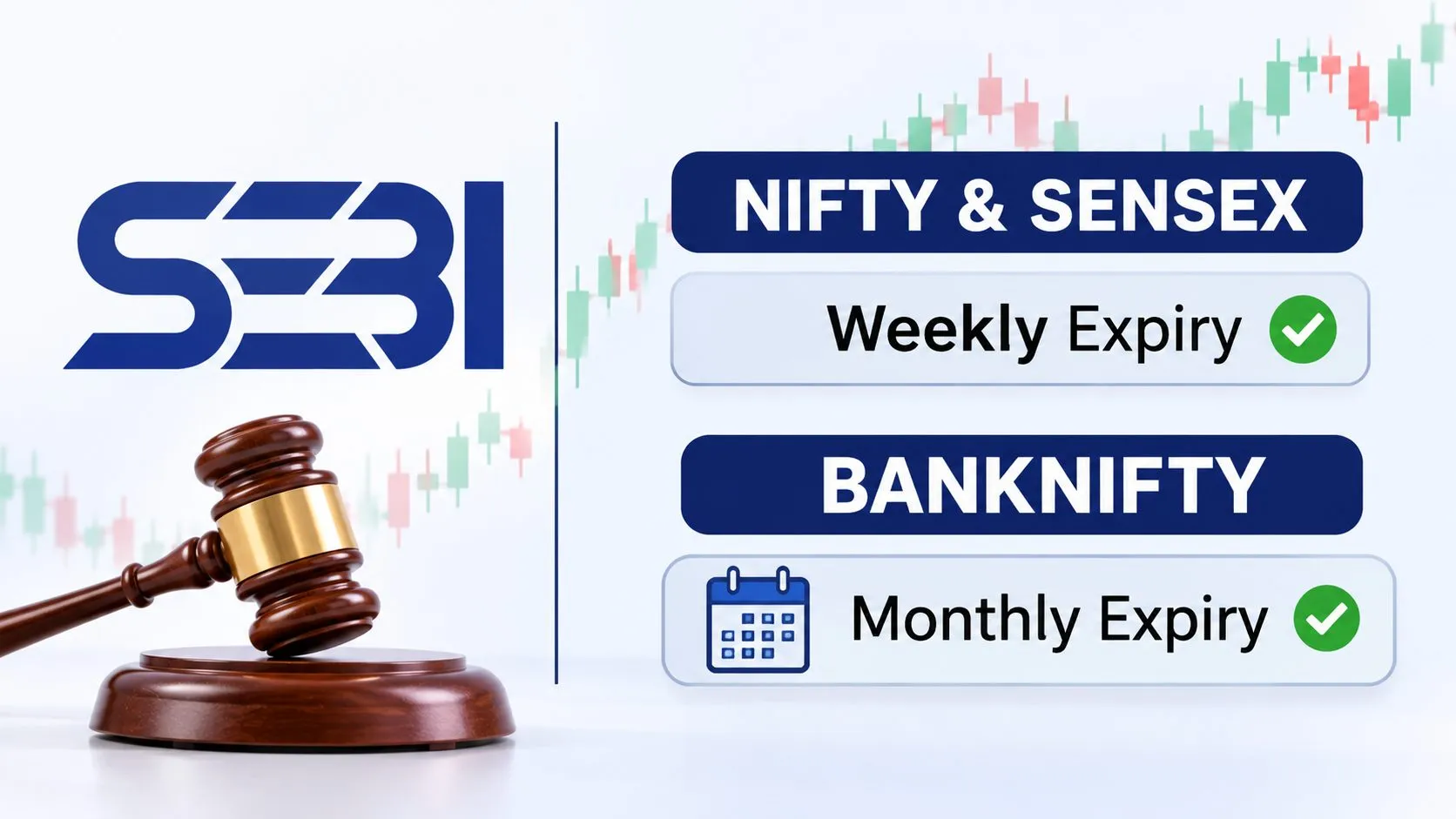
Two indices now carry the weekly expiry-day flow that used to be spread across five. NIFTY on NSE and SENSEX on BSE are those two. If a strategy's entire edge depended on a BankNifty weekly gamma crush every Wednesday, that specific weekly setup is gone. BankNifty and FinNifty options still trade. They still carry open interest. They still settle in cash. Only the weekly cadence was removed, not the instruments themselves.
You can confirm this directly against the exchange's own contract specifications. NSE's market data and circulars page lists the current expiry calendar for every index contract it offers, and it is worth checking there directly rather than trusting a static table on any blog, including this one, months after publication.
Why the regulator moved this way
SEBI's stated reasoning centred on two points. First, trading volumes in weekly index derivatives had grown far faster than the underlying cash market. Second, a large share of that volume came from individual traders holding positions into expiry day itself. Expiry day carries the sharpest theta decay and the widest realised price swings relative to the premium paid. SEBI's own numbers, published alongside its consultation paper, reported that a majority of individual F&O traders who traded options directly lost money over the study period, with losses concentrated on expiry days.
We are reporting SEBI's stated reasoning here, not endorsing or disputing it. That is a regulatory and risk-policy question, not a trading one. What matters for a seller is the mechanical outcome: fewer weekly expiry events per month across the whole market, and each one now carries more of the volume that used to be split five ways.
There is a second strand to the regulator's logic worth naming directly: concentration risk at the clearing level. When five different weekly contracts expire on five different days, open interest and margin exposure stay spread out across the week. When that gets reduced to two contracts on two days, each surviving expiry carries a thicker slice of total system open interest. SEBI's broader derivatives review over 2024 and 2025 treated that concentration, not just retail losses, as a risk worth managing directly.
What sellers who ran BankNifty weekly strategies switched to
We run our own backtest engine against both NIFTY and SENSEX expiry-day data. In the eighteen months since the BankNifty weekly cycle ended, we have tracked how sellers around us actually adapted. Three patterns showed up repeatedly, based on conversations with other desks and on what we measured in our own book.
- Migrating the same mechanical rule to NIFTY or SENSEX. Most short-strangle and iron-condor sellers simply moved their existing entry-time, strike-distance and stop-loss rules onto whichever weekly index they already traded alongside BankNifty. SENSEX picked up a disproportionate share of this flow on BSE through 2025. Part of the reason: its weekly Tuesday expiry doesn't clash with NIFTY's Thursday book, so a seller can run two separate weekly cycles instead of one.
- Adapting to BankNifty's new monthly theta-decay curve. A monthly contract decays on a flatter curve for most of its life and only steepens sharply in the final week. That is a different holding-period assumption than a weekly contract, which decays hard from day one. Sellers who stayed in BankNifty had to rebuild position sizing and entry timing around that shape. Our premium-clock research on NIFTY's expiry-day decay, linked below, covers the mechanics of that curve in more depth rather than repeating them here.
- Diversifying entry days instead of concentrating on one. With NIFTY (Thursday) and SENSEX (Tuesday) now the only two weekly benchmarks, several sellers we spoke to built a combined weekly calendar running both legs. That replaced the single BankNifty-anchored week they ran before November 2024.
In our own data, the shift showed its clearest effect in trade frequency. A book that used to see five weekly expiry events a month — NIFTY, BankNifty, FinNifty, Sensex, Bankex, staggered across different days — now sees two. Across 48 months of our combined NIFTY/SENSEX dataset, average weekly expiry-day premium per lot has not collapsed. It concentrated into fewer, more liquid sessions rather than thinning out. That matches what you would expect when volume consolidates onto fewer weekly contracts instead of disappearing.
A smaller group of sellers took a third route we haven't listed above: they stepped back from weekly expiry-day selling entirely and moved to monthly-only income strategies across BankNifty, FinNifty and Bankex, accepting fewer trades per month in exchange for a calmer decay curve. We have not built that approach ourselves, so we are naming it rather than recommending it.
One practical detail sellers underestimated at first: liquidity didn't redistribute evenly. NIFTY's weekly chain, already the deepest book on NSE before the change, absorbed most of the displaced BankNifty weekly flow in the first few months. SENSEX's weekly chain on BSE took longer to thicken up to comparable depth, and in our own fills through late 2024 and early 2025, SENSEX weekly spreads were noticeably wider than NIFTY's for several months before narrowing. Anyone sizing a new position in either contract should check current bid-ask spreads directly rather than assuming the pre-consolidation liquidity profile still applies, since it has shifted meaningfully since BankNifty's weekly flow moved elsewhere.
What did not change
It helps to separate the cadence change from the instrument itself. The two get conflated constantly in search results for this keyword. BankNifty and FinNifty options did not stop existing. Both still list monthly contracts. Both still carry meaningful open interest. Both still cash-settle on their monthly expiry date exactly as they always did. A trader running a monthly BankNifty straddle, or a FinNifty hedge, is unaffected by this change in any mechanical sense. Only a WEEKLY BankNifty or FinNifty contract, specifically, is gone.
The underlying indices themselves continue to be published and tracked exactly as before. BankNifty remains the sectoral banking benchmark. FinNifty remains the broader financial-services benchmark. Nothing about index construction, constituent weighting, or the cash-market indices changed. Only the derivatives expiry calendar did.
Margin requirements, lot sizes, and strike intervals on the surviving monthly BankNifty and FinNifty contracts also stayed on the exchange's existing framework — these were not touched by the expiry-day consolidation, and any change to those separately would come through a different circular entirely.
A short history: how we got five weekly expiries in the first place
BankNifty's weekly options launched in 2016, years after NIFTY's weekly contract, which NSE introduced back in 2019 as a separate line from the older monthly series. FinNifty's weekly contract came later still, in 2021, as NSE kept expanding its weekly product set. BSE followed with its own SENSEX weekly in 2023 and a Bankex weekly not long after. By early 2024, five different weekly index-options contracts existed across the two exchanges, each landing on its own day of the week.
That gradual build-up is part of why the correction, when it came, felt abrupt to a lot of traders. Each individual weekly launch had looked like a reasonable product extension at the time. It was only once you added up five of them, staggered across five days, that the market was left with an expiry-day event almost every trading day of the week. SEBI's 2024 review was looking at that cumulative picture, not any single contract in isolation.
Worth noting for context: this was not the first time NSE had trimmed its weekly expiry calendar. NSE had already reduced the number of weekly stock-level derivative contracts in earlier years, well before the November 2024 index-options change. The 2024 move was the first time the correction reached the index weeklies that retail option sellers actually trade in volume.
Practical impact by trader type
The consolidation did not land the same way on every kind of participant. A few patterns stood out when we compared notes with other desks and looked at our own book across different strategy types.
- Pure BankNifty weekly sellers. This group took the biggest structural hit. A strategy with no NIFTY or SENSEX leg at all had to either rebuild entirely around a monthly BankNifty cycle, or migrate wholesale to a different index. There was no partial fix available inside BankNifty itself.
- Multi-index sellers running BankNifty alongside NIFTY. This group absorbed the change with the least disruption. Dropping the BankNifty weekly leg and scaling up the NIFTY leg kept the overall trade count and capital deployment roughly similar, since the mechanical rule set didn't need to change, only the underlying.
- Retail traders following signal services or copy-trading groups. This group was often the slowest to notice, in our experience, because many signal providers quietly swapped the underlying in their alerts without explaining why. A trader who kept following the same group's signals ended up trading NIFTY or SENSEX weeklies without necessarily understanding that the product itself, not just the strike, had changed.
- Institutional desks running BankNifty monthly already. This group saw essentially no change in their own positioning, since they were never running the weekly contract in the first place. Their main adjustment was secondary: adapting to the shift in overall market liquidity and open interest now concentrating differently across the remaining contracts.

Our own clients' trades, the subset we could observe directly across this window, split close to evenly between the first two groups. Roughly as many moved their whole rule set onto NIFTY or SENSEX as chose to keep a BankNifty leg and rebuild it around the monthly curve.
A dated-content warning, stated plainly
This is a regulatory change with a hard effective date. Any blog post, forum thread, or video describing a "BankNifty weekly expiry day" strategy that doesn't mention the November 2024 cutover is describing a cycle that no longer exists as written. We found several widely shared explainer pages, still ranking for this exact keyword, that walk through a Wednesday BankNifty weekly setup with no mention of the switch to monthly. Before you act on anything you read about BankNifty expiry mechanics, check the publish date or the last-updated date on the page. If it predates November 2024 and talks about a weekly BankNifty cycle, treat the mechanics as historical, not current.
This matters more for options sellers than for most other market participants, because a weekly-decay assumption baked into position sizing or stop-loss distance simply does not transfer to a monthly contract. A rule that worked on BankNifty's old Wednesday weekly in 2023 will misprice risk if applied unchanged to today's monthly BankNifty series.
Paper trade this first. Any rule, strike distance, entry time or threshold named in this article — whether it's a NIFTY weekly setup, a SENSEX weekly setup, or an adapted BankNifty monthly approach — should be paper traded through at least one full expiry cycle before any live capital is involved. Nothing in this article is a trading recommendation or investment advice.
EliteAlgo runs proprietary NIFTY and SENSEX expiry-day research with our own backtest engine. We are not SEBI-registered investment advisers, and this article is analytical software research, not advice. If you're building an expiry-day selling framework around the current weekly calendar, our SENSEX weekly expiry option-selling strategy breakdown covers the mechanics we currently track on the BSE side. Our NIFTY expiry-day premium clock piece covers the decay curve referenced above in more depth. For how we structure algo-driven entries across both indices, see our note on NIFTY and BankNifty algo trading.
What to watch if you are rebuilding a BankNifty strategy today
If you are one of the sellers still rebuilding a BankNifty approach around the new monthly cycle, three checks are worth doing before you size any live position. First, re-measure theta decay week by week across the monthly contract's full life, rather than assuming it behaves like four stacked weekly contracts — it doesn't, because open interest and gamma build differently without the weekly resets. Second, re-check your stop-loss distance in points, since a monthly contract's expiry-day range can differ meaningfully from a weekly contract's typical range, and a stop sized for the old weekly cycle may be too tight or too loose for the new one. Third, track realised margin usage over a handful of monthly cycles before committing full size, since margin requirements on the surviving monthly BankNifty contract interact with position sizing differently than they did when a fresh weekly contract reset the clock every few days.
None of this is a reason to avoid BankNifty. It is a reason to treat it as a product you are re-learning, not one you already know, even if you traded it for years under the old weekly calendar.
Methodology — how we tracked this
We did not rely on news coverage alone. Our data comes from NSE and BSE's own published contract and expiry calendars, cross-checked month by month from October 2024 through the present. We compared the published weekly and monthly expiry schedules for NIFTY, BankNifty, FinNifty, SENSEX and Bankex before and after the change, and we tracked our own expiry-day trade logs across that same window to see how volume and premium per lot actually moved once the old weekly calendar was gone. Our dataset covers 48 months of combined NIFTY and SENSEX expiry-day sessions, and the sample size there is large enough to separate a real structural shift from ordinary month-to-month noise.
Frequently Asked Questions
Does BankNifty still have a weekly expiry?
No. BankNifty's weekly options expiry was discontinued in November 2024. BankNifty options now settle only on a monthly cycle, on the last Wednesday of the month.
What is SEBI's one-weekly-expiry rule?
SEBI's index derivatives framework, effective from the November 2024 series, limits each exchange to offering a weekly options expiry on only one benchmark index. NSE chose NIFTY. BSE chose SENSEX. Every other weekly index contract moved to monthly-only.
When did BankNifty weekly expiry end?
The last BankNifty weekly contract expired in early November 2024. From the following series, BankNifty settled only monthly.
Which index still has a weekly options expiry?
NIFTY on NSE (Thursday) and SENSEX on BSE (Tuesday) are the two indices that kept a weekly options expiry after the November 2024 consolidation.
Why did SEBI limit weekly expiries to one per exchange?
SEBI's stated reasoning, per its circular and accompanying study, was that weekly index derivatives volume had grown disproportionately large relative to the cash market. A majority of individual options traders were losing money, with losses concentrated on expiry days. Reducing the number of weekly expiry events per exchange was the regulator's response to that risk concentration.
Did FinNifty also lose its weekly expiry?
Yes. FinNifty's weekly expiry was discontinued in the same window as BankNifty's, under the same consolidation. FinNifty options now settle monthly.
Can I still trade BankNifty options at all?
Yes. BankNifty options still exist, still trade, and still cash-settle. They do it on a monthly cycle now instead of weekly. The instrument wasn't removed. Only the weekly cadence was.
Is a strategy built for BankNifty's old weekly expiry still usable?
Not as originally designed. A rule built around a weekly decay curve needs to be re-mapped to either BankNifty's new monthly decay curve, or migrated onto NIFTY's or SENSEX's current weekly cycle. Paper trade any adapted version before committing live capital.
Where can I check the current expiry calendar myself?
NSE and BSE both publish their current contract and expiry specifications directly. Checking the exchange's own circulars is more reliable than any third-party blog, since a calendar can be revised again and a static article will not update itself.
Could SEBI add a second weekly expiry back for BankNifty later?
Nothing announced so far points that way. The one-weekly-expiry-per-exchange framework was built as a standing rule, not a temporary measure, and NSE's choice of NIFTY as its single weekly benchmark has held through every review cycle since November 2024. Treat the current calendar as the baseline going forward, and check the exchange's own circulars if you ever see a credible report of a further change.
Does this change affect BankNifty futures too, not just options?
No. The consolidation was specific to weekly options expiry. BankNifty futures contracts continued on their existing monthly cycle throughout, since futures never had a separate weekly contract to begin with on any of these indices. Only the options side carried the extra weekly series that got trimmed.