Quick Answer
A straddle is a call and a put at the same strike and the same expiry on the same underlying. Sell both and you have a short straddle: you collect the combined premium, which is the most the position can ever make, and you profit if the underlying finishes near that strike. Your two break-evens sit at the strike plus the total premium and the strike minus the total premium. Outside them the loss grows point for point — with no ceiling above, and a very large one below. Because both legs are at the money, a straddle collects more premium and carries more time decay than any other structure on the chain, and it starts with zero cushion: the underlying is already sitting on your strike. The risk in a short straddle is not that the market moves the wrong way. It is that it moves far, in either direction, and that near expiry it only needs to do so for a few minutes.
Paper trade this before it touches live capital. Nothing below is investment advice, and nothing below recommends a strike, an expiry or an underlying. EliteAlgo is proprietary trading research and analytical software, not an advisory service. This page is a reference for how the structure behaves, not a signal to trade it.

What a straddle is, leg by leg
Three conditions define it, and all three have to hold:
- One call and one put.
- The same strike price on both.
- The same expiry on both.
That is the whole definition. Nothing about quantity, nothing about which strike, nothing about direction. If the strikes differ it is not a straddle — it is a strangle, and that distinction is the only thing separating the two words.
In practice sellers build the straddle at the strike nearest to spot, because that is where the structure's characteristic behaviour comes from. An at-the-money option has almost no intrinsic value and almost all of its premium is extrinsic — the part that reflects the possibility of future movement, and the part that decays to nothing by expiry. The at-the-money strike is where that component is largest on the entire chain. Selling both legs there is the maximum-decay position available to a premium seller. Our page on how option premium is priced, strike by strike covers where that number comes from, and ITM, OTM and ATM covers the moneyness vocabulary this depends on.
Two naming notes, because both show up on broker screens and in strategy builders:
- "Straddle" on its own tells you nothing about the side. A straddle is a shape, not a trade. You need "short" or "long" in front of it before the word describes an exposure.
- Selling, writing and shorting are the same act. A short straddle, a written straddle and a sold straddle are one position described three ways. What that act obligates you to is the subject of being the option writer.
Short straddle vs long straddle — the sign flip
Same three legs-and-strike conditions, opposite cash flow, opposite everything else. Worth sixty seconds because getting it backwards is not a small mistake.
| Short straddle | Long straddle | |
|---|---|---|
| You | Sell both legs | Buy both legs |
| Cash at entry | Credit — you receive | Debit — you pay |
| You want | The underlying to sit still | The underlying to move a long way |
The long straddle is option buying — a bet on a large move in an unknown direction, paid for upfront, losing a little every day the move does not arrive. It is a legitimate position and it is not what this site is about; our work is on the selling side, so we mention it here only so you can tell which one you are looking at and move on. The buying side in full — what you pay, the break-evens derived, and the long strangle alongside it — is on long straddle vs long strangle, and option buying vs option selling, settled with arithmetic is where we lay out why we sit on the side we do.
Everything from here down describes the short straddle.
The payoff arithmetic, derived once
Four numbers run the whole structure. Call the strike K and the total premium collected across both legs P (per unit, not per lot).
| Quantity | Formula | What it means |
|---|---|---|
| Maximum profit | P | Realised only if the underlying settles exactly at K. Nothing can increase it. |
| Upper break-even | K + P | Above this, the short call's intrinsic value exceeds everything you collected. |
| Lower break-even | K − P | Below this, the short put's intrinsic value exceeds everything you collected. |
| Profit zone width | 2P | The entire distance the underlying may travel before you are losing. |
Those formulas carry three consequences that matter more than the formulas do.
1. The premium you collect is your cushion, and it is the only one you have. On a strangle, the distance from spot to the short strikes gives you room before the premium is even touched. A straddle has no such distance by construction. This is why "collect more premium" and "have more protection" are the same sentence on a straddle and not on anything else — and why the straddle is both the highest-credit and the least-forgiving structure on the chain.
2. Only one leg can be in the money at expiry. Not both. The underlying finishes above K or below it, so exactly one of the two short legs has intrinsic value and the other is worthless. People new to the structure read "two uncapped legs" and assume double exposure; the exposure is one-sided at any moment. Which side is unknown in advance, which is the actual problem.
3. The loss function is linear and the profit function is not. Past either break-even, every point the underlying travels costs you a point. Inside the zone, your result improves as the underlying approaches K, but it improves at a decreasing rate and tops out at exactly one price. A small fixed gain against an unbounded linear loss is the shape of the trade, and no choice of strike changes that shape.
A worked example
Illustrative round numbers. Spot at 24,800. This is arithmetic to show the formulas working — it is not a quoted chain, not a strike recommendation and not a trade idea.
You sell the 24,800 call at ₹110 and the 24,800 put at ₹100. Total premium P = ₹210 per unit.
- Maximum profit: ₹210, if the underlying settles at exactly 24,800.
- Upper break-even: 25,010. Lower break-even: 24,590.
- Profit zone: 420 points wide, which on this underlying is about 1.7%.
Now read the outcomes:
- Settles at 24,800 — both legs expire worthless, you keep ₹210. This is the one price that pays in full.
- Settles at 24,900 — the call is worth ₹100, the put is worthless. You keep ₹110.
- Settles at 25,010 — the call is worth ₹210. You break even on premium. But the call finished in the money, so it is exercised and a settlement-side charge lands on top, which puts you behind. "It expired at my break-even" is not break-even.
- Settles at 25,400 — the call is worth ₹600. You lose ₹390 per unit, nearly twice the best possible outcome of the trade, on a move of about 2.4%.
Multiply by the current lot size for rupee figures, and take that lot size from the exchange's contract specifications on the day rather than from memory, because it is revised. The settlement-side charge in the third bullet is computed on a settlement-derived base rather than on the premium, which is why it is so much larger than people expect; the mechanism, and why we publish no rates for it, is in how options trading is taxed in India.
Hold that fourth bullet next to the first. A 2.4% move — which is not a rare event on an index — costs almost twice what a perfect outcome pays. That ratio is the structure, stated honestly.
Why maximum profit effectively never happens
Every description of a straddle leads with "maximum profit if the underlying expires at the strike," and it is true and it is almost useless, because the probability of settling at one exact price is close to nothing.
The useful version is that your realised result is a point on a tent, not a coin flip between the peak and a loss. Finish anywhere inside the two break-evens and you keep some of the premium; the closer to K, the more of it. The tent's peak is a reference point for drawing the diagram, not an outcome to plan around.
This matters because it kills two common errors in opposite directions. People who fixate on the peak oversize the position, reasoning from a number they will never collect. People who dismiss the structure as needing a pin underestimate it, because a wide-enough tent does not need a pin at all. Plan around the width of the zone, not the height of the peak.
There is a related piece of folklore worth setting aside: that the underlying reliably gets pinned at the strike with the most open interest, and that a straddle can be placed there to collect the peak. We tested it on our own data and it did not hold up — see max pain on NIFTY, testing the pin everyone quotes.
Where the risk actually lives
This is the section the structure deserves, because the risk is routinely described in the wrong place.
A short straddle is usually explained as a bet on time decay, and its theta — the amount the premium erodes per day, all else equal — is the highest on the chain. That is true and it is the return. It is not where the danger sits.
The danger sits in gamma: the rate at which your directional exposure changes per point the underlying moves. A freshly sold at-the-money straddle is close to delta-neutral — the short call's negative delta and the short put's positive delta roughly cancel, so small moves barely register. That neutrality is the structure's selling point and it is also the thing that does not persist. Move the underlying away from K and the straddle stops being neutral: the in-the-money leg's delta grows, the out-of-the-money leg's shrinks, and you are left holding a one-sided directional position you never chose to take. The further it travels, the more one-sided it becomes.
Three things follow, and together they are the whole risk picture:
- Theta and gamma grow together, and they are not symmetric. As expiry approaches, decay accelerates in your favour and gamma accelerates against you. The second effect is larger and it is faster. The structure gets more profitable per day and more dangerous per point at the same time.
- Volatility expansion hurts before the price does. A short straddle is short vega. If implied volatility rises, both legs are repriced upward and the position loses on the mark even if the underlying has not moved at all. The underlying can sit exactly where you sold it and the position can still be down. Implied volatility explained as a price, not fear is the fuller treatment, and same strike, different day, different price shows this happening on real quotes.
- Margin rises exactly when the position is losing. The exchange's requirement is computed from the volatility of the underlying and your position's composition, so the same volatility spike that marks your position down raises the capital you must hold against it. Adverse price and rising margin arrive together, not one after the other. If the mark-to-market debit and the increased requirement together exceed your available funds, your broker can square the position off at whatever the market happens to be — not at a price you chose.
So the honest sentence about a short straddle is this: you are paid a known amount for time passing, and you are charged an unknown amount for the market travelling. The first is reliable and small. The second is rare and not bounded. Everything about managing the structure is managing the second.
The Greeks handover near expiry is walked through in the option Greeks on expiry day, and this is why many desks — ours included — treat the final hour of an expiry session as a separate risk regime rather than a continuation of the morning.
How the position behaves into expiry
Three phases, and the structure is a different trade in each one.
Early in the contract's life — several sessions from expiry — the extrinsic value is large, decay per day is modest, and gamma is low. The position is slow in both directions. A move against you costs you on the mark but there is time for it to come back, and that is a real property rather than hope.
The middle — decay picks up measurably, and so does gamma, but the position is still manageable. This is where most of the collectible premium actually accrues if the underlying cooperates.
The last session, and particularly the last hour — the extrinsic value remaining is small, which means there is little left to collect, while gamma is at its maximum. The asymmetry has inverted completely from where it started: you are now risking a lot for a little. The underlying approaching your strike in the final minutes can move the position more than the whole of the preceding week did.
Two observations from our own logged sessions, both of which bear on this phase rather than on structure selection.
Across 163 logged expiry sessions on our own book, the median give-back from the session's intraday profit peak to its close was 42.8%, and roughly 30% of sessions turned a position that had been profitable at its peak into a loss by the close. Premium visible on the screen is not banked. It is banked when the position is closed, and a substantial share of what appears does not survive to the close. The timing behaviour underneath that is in the NIFTY expiry-day premium clock, and if you want to watch the decay happening on a live line rather than in a table, the ATM straddle chart as a decay clock is the page for it.
Our second observation is an execution rule rather than a trading decision: square off short legs rather than let them run to settlement. It removes the in-the-money settlement charge and the settlement-price uncertainty in one step. The settlement-price mechanics are in the closing auction session and expiry settlement.
Index straddles and stock-option straddles are not the same trade
The structure is identical. What happens around it is not, and the differences are large enough to change how the position should be sized.
| Index options (NIFTY, SENSEX) | Stock options | |
|---|---|---|
| Settlement | Cash against the settlement price | Delivery obligations on exercise |
| Gap risk source | Broad macro, policy, global risk-off | Company-specific: results, guidance, news |
| Liquidity away from the money | Generally deeper | Often much thinner, widening the spreads you cross |
| Strike availability near spot | Dense, so a true ATM strike is usually available | Sparser, so the "ATM" strike may sit some distance from spot |
| Event calendar | Known and scheduled | Results dates, and unscheduled announcements |
The one that catches people is the results calendar. A stock-option straddle held through an earnings announcement is not a volatility-selling position any more — it is a bet on the magnitude of a scheduled event whose distribution has two fat tails, and the implied volatility you sold was pricing exactly that. Writing a straddle into results is a materially different trade from writing one into a quiet week, and the premium looking generous beforehand is the market telling you so rather than an opportunity.
The sparse-strike point matters more than it sounds too. If the nearest available strike sits well away from spot, what you have built is a skewed position carrying a directional view, and it should be sized as the directional position it is rather than as a neutral one.
Straddle and strangle are the same idea at two different strikes
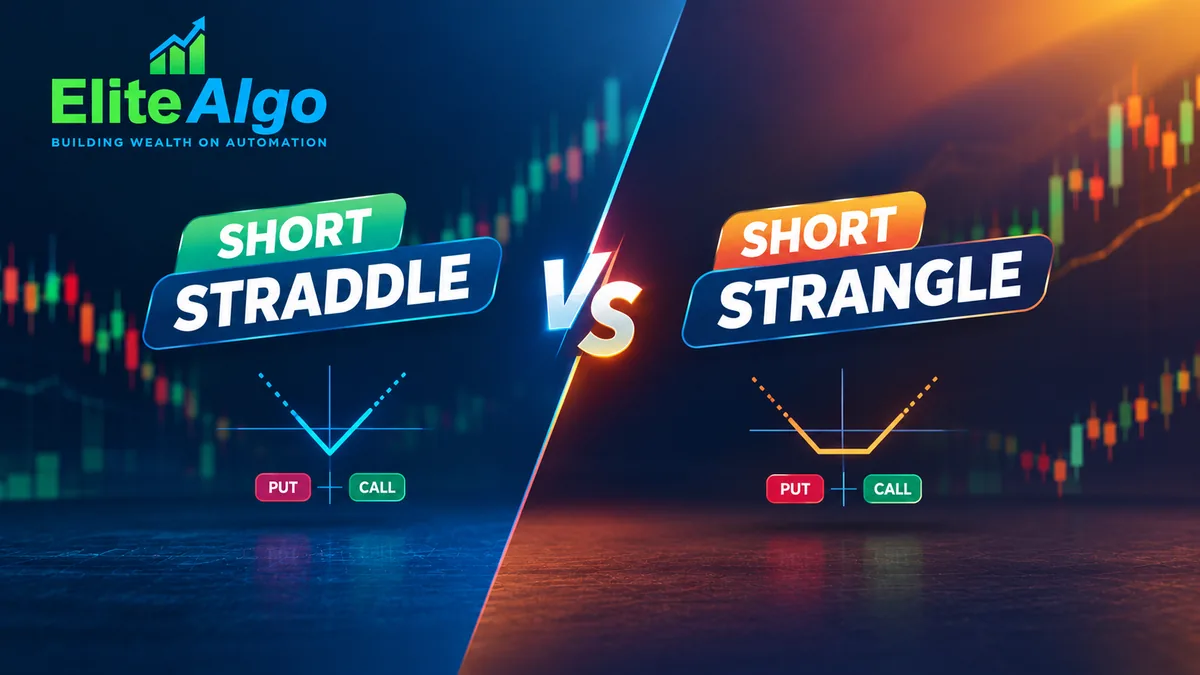
Since the two words travel together constantly, the separation in one line: a straddle uses one strike for both legs; a strangle uses two different strikes, both out of the money. That is the entire mechanical difference, and everything else — the straddle collecting more, the strangle giving more room — follows from it.
The strangle has its own reference page, built to mirror this one section for section: the short strangle explained covers its payoff arithmetic, its flat top, where its risk lives and how it behaves into expiry.
Which one to use for a given week is a genuinely separate question with its own inputs, and we have given it its own page rather than crowding it in here. Short straddle vs short strangle on NIFTY works through the comparison, how implied volatility should drive the choice, and a decision checklist. If you came here to choose between them, that is the page to read next; this one is the straddle reference.
Two other structures sit next to the straddle on the chain and are worth naming so you can tell them apart. An iron butterfly is a short straddle with a call and a put bought equidistant outside it, which fixes the maximum loss and costs part of the credit — see butterflies and iron butterflies from the seller's side. And the full catalogue, with every selling structure placed against the others, is in option selling strategies, structure by structure.
Five common misreadings
These are the ones we see most, and each is a specific error rather than general caution.
"It is a neutral position." It is neutral at entry and it stops being neutral the moment the underlying moves. Neutrality is a starting condition, not a property of the trade.
"The premium collected limits my risk." The premium limits your profit. It is the only number in the trade that is fixed, and it is fixed on the wrong side. On the loss side there is no corresponding number at all above the strike.
"A high win rate means the structure works." A short straddle is designed to win often and lose large. A win rate above 70% is the expected behaviour of the structure, not evidence of an edge, and it tells you nothing until you have set the average win against the average loss. This is the single most expensive misreading on the page, and is algorithmic trading profitable — our own data is where we take it apart with our own record.
"Theta is the risk to manage." Theta is the income. Gamma is the risk. Confusing them leads people to hold the position into the last hour — exactly where the income has nearly run out and the risk is at its peak.
"I can always adjust it." Adjusting a straddle means transacting further legs in a market that is moving fast, in books that are widening, at the moment you are least calm. Every adjustment is a new trade with its own cost, and the plan for a bad move has to be written before the move rather than improvised during it. Where a hedge is part of the plan from the start, hedging an option-selling position covers what it costs and what it does not cover.
If you want to test this properly
Not a strategy, a process — and deliberately not a strike rule, because we do not publish those.
- Write the rules down — entry condition, strike selection rule, exit condition, stop, square-off time, position size. If it is not written, it is not a strategy.
- Size against the tail, not against the margin available. Your broker permitting a size is not the same as that size being survivable. The test that needs no published figure: if one position consumes most of your account, it is too large. Lot size and position sizing is the arithmetic.
- Backtest across regimes — low volatility, high volatility and trending, not a run of recent quiet expiries — with realistic slippage on each leg, remembering that a straddle crosses two spreads in and two out. Options backtesting software in India covers the tooling.
- Paper trade it through a bad week, with real timing and real fills. Paper trading an option-selling algo covers doing it so the results mean something.
- Then start embarrassingly small, and increase only on measured results.
If you are at the beginning of all this and want a walked-through first NIFTY trade rather than a structure reference, NIFTY option selling for beginners is written for exactly that. And if the mechanics of placing and carrying a single short leg are the gap, start at how to sell options, step by step.
Frequently Asked Questions
What is a straddle in options?
A straddle is a call and a put at the same strike price and the same expiry on the same underlying. All three conditions have to hold — one call, one put, same strike, same expiry. If the strikes differ it is a strangle instead, and that is the only mechanical difference between the two. The word straddle describes a shape rather than a trade, so it tells you nothing about the exposure until you add short or long in front of it. Sellers normally build it at the strike nearest to spot, because at-the-money options carry the most extrinsic value and the most time decay on the chain.
How does the short straddle strategy work?
You sell the call and the put at the same strike and collect the combined premium, which is the most the position can ever make. You keep all of it only if the underlying settles exactly at the strike, and you keep part of it anywhere between the two break-evens — the strike plus the total premium and the strike minus the total premium. Outside those levels the loss grows point for point with the underlying, with no ceiling above the strike and a very large one below. Because both legs are at the money, the premium you collected is the entire cushion the position has.
What are the break-even points of a short straddle?
The upper break-even is the strike plus the total premium collected across both legs; the lower is the strike minus that total. The distance between them — twice the premium — is the whole range the underlying may travel before the position is losing. Note that break-even on premium is not break-even overall: if the underlying finishes past a break-even the relevant leg is in the money, so it is exercised and a settlement-side charge lands on a settlement-derived base rather than on the premium. Transaction costs on two legs in and two legs out sit on top of that as well.
Is a short straddle a neutral strategy?
Only at the moment you place it. A freshly sold at-the-money straddle is close to delta-neutral because the short call's negative delta and the short put's positive delta roughly cancel, so small moves barely register. That neutrality does not persist. As the underlying moves away from the strike, the in-the-money leg's delta grows while the out-of-the-money leg's shrinks, and you are left holding a one-sided directional position you never chose. Neutrality is a starting condition of the structure, not a property of the trade.
What is the maximum loss on a short straddle?
There is no ceiling above the strike. The short call's loss grows point for point as the underlying rises, and there is no level the underlying is forbidden to reach. Below the strike the short put's loss is bounded only by the underlying reaching zero, which on an index trading in the tens of thousands of points is not a meaningful constraint on an account. Only one leg can be in the money at expiry, so the exposure is one-sided at any moment — but which side is unknown in advance, and that is the actual problem.
Why do short straddles collect more premium than other structures?
Because both legs sit at the money, where extrinsic value is largest on the entire chain. An at-the-money option has almost no intrinsic value and almost all of its premium is the extrinsic component that reflects the possibility of future movement and decays to nothing by expiry. Selling both legs there is the maximum-decay position available. The same fact is also the structure's drawback: the premium is the only cushion it has, because the underlying is already sitting on your strike with no distance built in.
What is the difference between a straddle and a strangle?
A straddle uses one strike for both legs; a strangle uses two different strikes, both out of the money. That is the entire mechanical difference, and everything else follows from it — a straddle collects more premium because at-the-money options are richer, while a strangle gives the underlying more room to move before either leg hurts. Which one suits a given week is a separate question with its own inputs, including where implied volatility sits relative to your expectation of realised volatility, and we cover that comparison on its own dedicated page rather than here.
Is theta or gamma the real risk in a short straddle?
Gamma. Theta — the premium eroding per day — is the income, and it is the highest available on the chain for this structure. Gamma is the rate at which your directional exposure changes per point the underlying moves, and it accelerates sharply as expiry approaches. Both grow near expiry, but gamma grows faster and larger, so the position becomes more profitable per day and more dangerous per point at the same time. Confusing the two is what leads people to hold into the final hour, where the income has nearly run out and the risk is at its maximum.
Can a short straddle lose money if the underlying does not move?
Yes. A short straddle is short vega, so if implied volatility rises, both legs are repriced upward and the position loses on the mark even with the underlying sitting exactly where you sold it. The same volatility increase also raises the exchange's margin requirement on the position, because that requirement is computed from the volatility of the underlying and your position's composition. Adverse marks and rising margin therefore arrive together rather than one after the other, and if the combination exceeds your available funds, your broker can square the position off at whatever the market happens to be.
What is the difference between a short straddle and a long straddle?
Same two legs at the same strike and expiry, opposite side. A short straddle sells both, collects a credit, wants the underlying to sit still, is helped by time passing, caps its profit at the premium collected, and has no ceiling on its loss above the strike. A long straddle buys both, pays a debit, needs a large move in either direction, loses a little each day the move does not arrive, has open-ended profit and a loss fixed at the premium paid. The long straddle is option buying, which is not the side our own work is on.
Does a stock option straddle work the same way as an index straddle?
The structure is identical but what happens around it is not. Index options such as NIFTY and SENSEX settle in cash against a settlement price, while stock options bring delivery obligations on exercise. Stock gap risk is company-specific rather than macro, liquidity away from the money is often much thinner so the spreads you cross are wider, and strikes near spot are sparser, which means the nearest available strike may sit some distance from spot and leave you with a skewed, directional position. The one that catches people is the results calendar: a straddle held through an earnings announcement is a bet on the magnitude of a scheduled event, not a volatility-selling position.
Do I need the underlying to expire exactly at the strike to profit?
No, and planning around that price is a common error. Settling exactly at the strike is what pays the full premium, and the probability of any one exact price is close to nothing. The realistic way to read the position is as a point on a tent: finish anywhere between the two break-evens and you keep part of the premium, with more of it the closer the underlying lands to the strike. Plan around the width of the profit zone rather than the height of the peak — fixating on the peak leads to oversizing against a number you will never collect.
The Bottom Line
A straddle is a call and a put at the same strike and the same expiry. Sold, it becomes the highest-credit, highest-decay and least-forgiving structure a premium seller can build, because both legs sit at the money and the premium collected is the entire cushion. Four numbers describe it: maximum profit is the total premium, the break-evens are the strike plus and minus that premium, and the profit zone is twice it. Only one leg can finish in the money, maximum profit requires an exact settlement price you will effectively never get, and the loss above the strike has no ceiling. The income comes from theta; the danger comes from gamma, which accelerates faster than decay does as expiry approaches, so the structure becomes more profitable per day and more dangerous per point at the same time. A volatility spike can mark it down with the underlying sitting still, and it raises your margin requirement at the same moment. Plan around the width of the profit zone rather than the height of the peak, size against the tail rather than against available margin, treat the final hour as its own risk regime, and test it across regimes with honest per-leg costs before any of it is live.
This article is for educational and informational purposes only and does not constitute investment advice. EliteAlgo is proprietary trading research and analytical software; it is not a SEBI-registered investment adviser and does not provide investment advice, strike or strategy recommendations, or trading tips. No strike, expiry, structure or underlying mentioned or implied above is recommended, and the worked example uses illustrative round numbers rather than quoted prices. Writing a short straddle involves substantial risk of loss and is not suitable for all investors; the loss is not bounded above the strike and can substantially exceed the premium received. Margin requirements, contract specifications, lot sizes, settlement procedures, tax rates and charges are set by the exchanges, SEBI, the government and your broker and are revised from time to time — verify all current figures from the exchange or the notification in force before trading. Backtested and logged results describe what our own data did over a specific sample and do not guarantee future outcomes or imply any expected return. Paper trade before deploying live capital and consult a SEBI-registered investment advisor before trading derivatives.