Written by Rajeev Gupta, founder of EliteAlgo. Our desk has been building and running systematic NIFTY and SENSEX option-selling strategies since 2006.
Paper trade before any of this touches live capital. This page explains two option-buying structures and the arithmetic that governs them. It recommends no strategy, no strike, no expiry and no structure, it reports no expected return, and it is analysis rather than advice.
Quick Answer
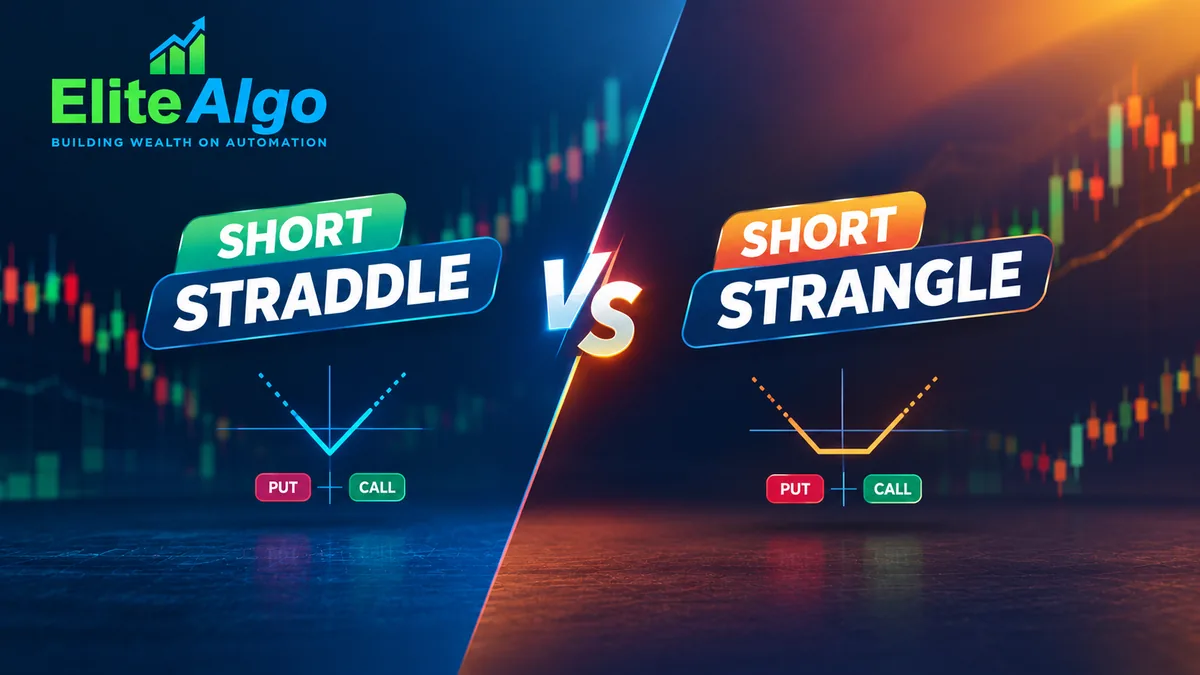
A long straddle buys a call and a put at the same strike and same expiry. A long strangle buys a call and a put at different strikes, both away from the money, same expiry. Both are bets on a large move in either direction, paid for upfront. The straddle costs more and needs a smaller move to break even; the strangle costs less and needs a bigger one. That is the entire trade-off between them, and it is a trade-off rather than a choice between a good structure and a bad one.
The hard part is not picking between them. It is that both need the move to be large enough and to arrive fast enough, and you are paying rent every day while you wait. A long straddle can be right about direction and still lose, three separate ways: the move is too small, the move is too slow, or the move was already priced into what you paid. That third one catches the most people, because it is the one that feels like bad luck rather than bad arithmetic.
We sell premium rather than buy it, and we are not going to pretend that is a neutral position. But the honest case for our side is about odds and the cost of being wrong on timing — not a claim that option buying never works. We lay out that argument properly, with our own measured numbers, in option buying vs option selling, and we would rather you read it there than take an assertion from us here.

What you are actually buying
Both structures have two legs and both are debits. You pay, on day one, and that payment is the most you can lose.
| Long straddle | Long strangle | |
|---|---|---|
| Legs | Buy 1 call + buy 1 put | Buy 1 call + buy 1 put |
| Strikes | Same strike, usually at the money | Different strikes, both out of the money |
| Expiry | Same for both legs | Same for both legs |
| Cash at entry | Debit — you pay | Debit — you pay, and less than the straddle |
| Maximum loss | The debit, fixed and known | The debit, fixed and known |
| Maximum profit | Open-ended either way | Open-ended either way |
| Time passing | Works against you | Works against you |
| Volatility rising | Works for you | Works for you |
| Break-evens | Two, strike ± debit | Two, and further apart |
| Move needed | Smaller | Larger |
Notice that the last two rows are the only ones that differ in substance. Everything else about these two positions is the same shape. That is why treating them as rival strategies is a category error — they are one idea at two price points, and the price point you pick decides how big a move you are requiring of the market.
The fixed maximum loss is the genuine attraction and it should not be dismissed. You know your worst case on the day you enter it, in a way a premium seller never does. Whether the structure is cheap at that price is a different question entirely, and that is what the arithmetic below is for.
The break-evens, derived
This is worth doing by hand once, because the result is usually wider than people's intuition.
Take an index at a round 25,000 — an illustrative number to show the arithmetic, not a level or a view. Say the at-the-money call costs 150 and the at-the-money put costs 140. Your debit is 290.
- Upper break-even = strike + debit = 25,000 + 290 = 25,290
- Lower break-even = strike − debit = 25,000 − 290 = 24,710
So at expiry, the index has to finish outside a band 580 points wide for you to make anything at all. On a 25,000 index that is roughly 1.16% in either direction just to get back to zero, and well beyond that to be worth having done. If the index finishes anywhere between those two numbers, you lose — and if it finishes exactly at the strike, which is the single most likely individual outcome by expiry, you lose the entire debit, because both legs expire worthless.
Now the strangle on the same day. Say you buy the 25,200 call at 70 and the 24,800 put at 65. Debit is 135, less than half the straddle.
- Upper break-even = call strike + debit = 25,200 + 135 = 25,335
- Lower break-even = put strike − debit = 24,800 − 135 = 24,665
The band is now 670 points wide instead of 580. You paid 53% less and you widened the requirement by about 16%. Whether that is a good exchange depends entirely on the distribution of moves you actually expect, and here is the uncomfortable part: the market has already formed a view on that distribution, and it is the price you just paid.
There is one more structural difference that the break-even arithmetic hides. The straddle has a single point of maximum loss, at the strike. The strangle has a range of maximum loss — anywhere between the two strikes, both legs finish worthless and you lose the whole debit. The strangle's worst case is cheaper in rupees and more likely in probability. That is the same trade-off again, stated in the other direction.
The required move is the whole position
Here is the framing we think is most useful, and it is the one that is missing from most explanations of these structures.
When you buy a straddle or a strangle, you are not making a bet on volatility in the abstract. You are stating a specific, falsifiable claim: the index will move more than X% within Y days. Both numbers come out of the arithmetic above, and the market has priced its own answer into the debit.
So the only question that matters before entering is: do I have a reason to believe the realised move will exceed the priced move? Not "do I think the market will move" — of course it will move. Specifically more than the amount already paid for. If you cannot state why your estimate of the coming move differs from the market's, you are not making a volatility bet. You are paying the market's price for the market's view and hoping.
Converting the debit into a percentage of spot is the fastest discipline we know for this. 290 points on a 25,000 index is 1.16%. Ask yourself how often, over the days remaining, that index has historically moved more than 1.16% — then ask whether the move needs to be a net move by expiry or whether you intend to sell the position earlier, because the answers are very different. Doing that one calculation before entry filters out a large share of long straddles that were never going to work.
Three ways to be right and still lose
This is the section we would most want a prospective straddle buyer to read, because each of these is an independent failure mode and people usually only know about the first.
1. Right direction, move too small
The obvious one. You bought the straddle, the index went your way, and it went 300 points when you needed 580. Both legs move, one gains more than the other loses, and you are still down. The position was directionally correct and financially wrong, and nothing about your reasoning was at fault except the size of the requirement you accepted at entry.
2. Right direction, right size, too slow
The one that is genuinely painful. The move arrives — but it arrives over three weeks instead of three days, and by the time it gets there the time value you paid for has gone. You bought a call and a put with time premium in both; every day that passes removes some of it from both legs simultaneously. A long straddle is short time on two legs at once, which is why the decay is faster than straddle buyers expect, and the decay accelerates as expiry approaches. The mechanics of what exactly is decaying are covered in intrinsic value vs time value, and on an expiry-day timescale the effect is extreme, which we chart in the NIFTY expiry day premium clock.
The practical implication is that a long straddle has a shelf life, and it is shorter than the time to expiry. Being right eventually is not the same as being right in time.
3. Right about the move, but it was already priced
The most expensive one, and the least intuitive. You buy a straddle because you expect a big move around a known event. The event arrives, the move happens — and you lose money anyway.
What happened is that implied volatility was elevated going into the event precisely because everyone expected the move, so you paid an inflated price for both legs. Once the event passed and the uncertainty resolved, implied volatility collapsed, and that collapse took value out of both your legs at the same time. The realised move was real; it was simply not larger than the move you had already paid for.
This is the volatility-crush problem, and it is structural rather than unlucky. Buying a straddle into a known, scheduled, widely anticipated event is buying at the point where the premium is most inflated. The mechanism — why implied volatility rises before an event and falls after it, and what vega does to a long option position when it does — is in implied volatility explained and what the Greeks actually measure. The one-line version: a long straddle is long vega on both legs, which means a fall in implied volatility hurts you twice.
Put the three together and the honest summary is this: a long straddle requires you to be right about magnitude, timing and the market's pricing of both. Three conditions, all at once, paid for in advance. That is a harder test than "the market will move", and the gap between those two sentences is where most of the money goes.
The long strangle, specifically
The long strangle deserves its own treatment rather than being a footnote to the straddle, because the reason people choose it is usually not the reason that makes sense.
The common reason is cost — it is cheaper, so it feels like a smaller bet. In the illustration above the debit fell by more than half. But look at what that bought: the required move went up, and the range over which you lose everything went from a single point to a 400-point band. You did not reduce the risk. You reduced the outlay and increased the probability of losing all of it. For a fixed amount of capital, the strangle is the higher-variance expression of the same idea, not the more conservative one.
The reason that does make arithmetic sense is different: a strangle is the right structure when your view is specifically about a very large move rather than merely a large one. If you genuinely expect a dislocation well beyond either break-even, you would rather not pay for the at-the-money premium that only matters for moderate moves. In that specific case, the strangle is buying exposure to the part of the distribution you actually have a view on, and declining to pay for the part you do not.
Two further structural notes, which are symmetrical with the selling side:
- Strike width is a continuous dial, not a setting. As you move the strikes closer to the money, the strangle converges on the straddle — more expensive, narrower break-evens. As you widen them, it gets cheaper and more demanding. Straddle and strangle are the same structure at two settings of one dial. The selling-side version of that same observation is in short straddle vs short strangle.
- Liquidity gets worse as you widen. Further out-of-the-money options have wider bid-ask spreads, and you cross that spread entering and again exiting. On a cheap strangle, the spread can be a material fraction of the debit, which means your effective break-evens are worse than the ones you calculated from the mid-price. Calculate them from what you would actually pay, not from the mid.
For the mirror image of this structure — the same two strikes, sold rather than bought — see the short strangle explained. Every property above flips sign, which is exactly the point of reading both.
When the buying case is structurally real
We are not going to tell you option buying never works, because that is not true and we would be arguing against arithmetic to say it. The buying side has a genuine structural case in specific situations, and it is worth naming them honestly — as descriptions, not as recommendations, and none of these is a trade we are suggesting you take:
- When implied volatility is genuinely low relative to what the next period delivers. This is the real case and it is the hard one, because it requires a defensible estimate of future realised movement that differs from the market's. It is hard, not impossible. But "IV looks low" is not that estimate — it is the starting point of the work, not the conclusion.
- As a defined-risk leg inside a larger position. A long option bought to cap the risk on something else is not a directional bet at all; it is insurance, and the right question about insurance is whether the premium is worth the cover, not whether the insurance will "win". This is the use we have most sympathy with, and it is covered on the selling side in hedging an option selling position.
- When the maximum loss is the point. Fixed, known, capped downside has real value to some people in some circumstances, and paying for it is a legitimate choice rather than a mistake. Just be clear that you are paying for it, and how much.
What is not a case, and is the commonest reason people actually buy straddles: the feeling that something big is about to happen. That feeling is widely shared, which is precisely why it is already in the price. See the third failure mode above.
Why this desk sells instead
Four paragraphs, because the full argument lives elsewhere and we would rather point you at it than summarise it badly.
We sell premium rather than buy it, systematically, on Indian index options. The reasoning is set out with the arithmetic and our own numbers in option buying vs option selling, which also deals with the high-win-rate fallacy that makes the selling side look better than it is. That page is the argument; this one is not.
What we will say here is the shape of it. The buyer needs magnitude, timing and pricing to all come good. The seller needs none of them to come good — the seller needs the move to stay inside a band, and gets paid by the passage of time, which is the one thing that happens reliably. That is a structural difference in how many conditions have to be met, and it is the reason we sit where we sit.
And the honest cost of that position, which we publish rather than hide: being on the selling side does not make the outcome easy. Across 163 logged expiry sessions our median peak-to-close give-back was 42.8% — nearly half the intraday peak profit handed back by the close, as a median rather than a worst case. Separately, when we built an engine to test a widely recommended signal-driven premium-selling idea across 438 trading days, none of eighteen structure and parameter combinations cleared our acceptance gate. Those are our measured results on our own data, stated as ours, with the full account in is algorithmic trading profitable, our own data. We are not offering you the selling side as an easy alternative to the buying side.
So the claim is narrow, and it is the only one we will make: the buyer has to be right about more things at once, and pays in advance for the privilege. That is a statement about odds and about the cost of being wrong on timing. It is not a claim that nobody should ever buy an option.
Before you buy either structure
A checklist, not a recommendation. If you cannot answer all seven from your own work, the position is a hope rather than a thesis.
- What are my two break-evens, in index points? Calculated from what you would actually pay including the spread, not from the mid-price.
- What is that as a percentage of spot? This is the number to think in. Points flatter the position; percentages do not.
- How often has this index moved more than that, over the days I am holding for? Answered from data, not from recollection.
- Why do I think the coming move exceeds the priced move? If there is no answer to this, there is no trade — only a purchase.
- Is implied volatility elevated or depressed right now, and why? If it is elevated because of a known upcoming event, you are buying into the crush. See failure mode three.
- What is my exit if the move does not arrive? A long straddle has a shelf life. Decide the date before you enter, because the decay will not wait for you to decide later.
- Am I prepared to lose the entire debit? Not as an abstraction. It is the most likely single outcome if the index finishes near the strike, and with a strangle it is likely across an entire range.
Frequently Asked Questions
What is a straddle in options?
A straddle is a two-leg position in a call and a put at the same strike and the same expiry. If you buy both, it is a long straddle: you pay a debit, your maximum loss is that debit, your profit is open-ended in either direction, and you need the underlying to move a long way for it to pay. If you sell both, it is a short straddle: you receive a credit, your profit is capped at that credit, and your loss has no ceiling. The word straddle describes the structure, not the direction of the bet, which is why it is always worth establishing which side of it is being discussed before anything else. A long straddle is a bet on a large move of unknown direction, arriving soon enough to matter. A short straddle is a bet that the underlying stays within a band.
What is the difference between a long straddle and a long strangle?
The strikes, and everything that follows from them. A long straddle buys the call and the put at the same strike, usually at the money. A long strangle buys them at different strikes, both out of the money. Everything else about the two positions is the same shape: both are debits, both cap your loss at what you paid, both have open-ended profit, both are hurt by time passing and helped by implied volatility rising. The real trade-off is price against required move. The straddle costs more and breaks even on a smaller move; the strangle costs less and needs a larger one. There is also a difference people miss: the straddle has one point of maximum loss, at the strike, whereas the strangle loses its entire debit anywhere between the two strikes. The strangle's worst case is cheaper in rupees and more likely to happen.
How do I calculate the break-even on a long straddle?
Add the two premiums to get your debit, then take the strike plus the debit for the upper break-even and the strike minus the debit for the lower one. Using illustrative round numbers to show the arithmetic: on an index at 25,000, with the at-the-money call at 150 and the at-the-money put at 140, the debit is 290, so the break-evens are 25,290 and 24,710. The index has to finish outside a band 580 points wide for you to make anything at all, which on that level is about 1.16% in either direction just to return to zero. For a long strangle, use each leg's own strike: upper break-even is the call strike plus the total debit, lower is the put strike minus the total debit. Calculate from what you would actually pay including the bid-ask spread rather than from the mid-price, because on a cheap position the spread can be a material part of the debit.
Is a long straddle a good strategy?
It is a legitimate structure with a clearly defined risk, and whether it is a good position on any given day depends entirely on whether the move you expect is larger than the move already priced into the debit. That is the question, and it is not a question about the structure. What makes it demanding is that it requires three things to come good at once rather than one: the magnitude of the move, the timing of it, and the market's pricing of both. You can be directionally right and still lose because the move was too small, because it arrived too slowly and the time value you paid for had already decayed, or because implied volatility was elevated when you bought and collapsed once the event resolved. We sell premium rather than buy it and our reasoning is set out with our own data elsewhere on this site, but we are not claiming option buying never works. The honest point is that the buyer has to be right about more things, paid for in advance.
Why does my long straddle lose money even when the market moves?
Three independent reasons, and it is usually one of them rather than bad luck. The move was too small — the index went your way by 300 points when your break-evens required 580, so the position was directionally right and financially wrong. Or the move was too slow: you bought time premium in both legs, every passing day removes some of it from both at once, and a move that arrives over three weeks instead of three days arrives after what you paid for has gone. Or, most commonly and least intuitively, the move was already priced in. Implied volatility was elevated going into a known event precisely because everyone expected the move, so you paid an inflated price for both legs, and when the uncertainty resolved implied volatility collapsed and took value out of both at the same time. A long straddle is long vega on two legs, so falling implied volatility hurts you twice.
Is a long strangle cheaper and therefore safer than a long straddle?
Cheaper, yes. Safer, no — and this is the most common misreading of the structure. A lower debit feels like a smaller bet, but look at what the saving buys: the required move goes up, and the range over which you lose the entire debit goes from a single point at the strike to a band spanning both strikes. For a fixed amount of capital, the strangle is the higher-variance expression of the same idea, not the more conservative one. The reason that does make arithmetic sense for choosing a strangle is different: it is the right structure when your view is specifically about a very large move rather than merely a large one, because then you would rather not pay for at-the-money premium that only matters for moderate moves. Also note that wider strikes mean wider bid-ask spreads, which you cross both entering and exiting, so your effective break-evens are worse than the calculated ones.
When should you not buy a straddle?
The clearest case to avoid is buying into a widely anticipated, scheduled event because you feel something big is about to happen. That feeling is widely shared, which is exactly why it is already in the price — implied volatility is elevated going in precisely because the move is expected, so you are buying at the most inflated point and are exposed to the collapse once the uncertainty resolves. More generally, do not buy either structure if you cannot state why your estimate of the coming move exceeds the move the market has priced. Without that, you are not making a volatility bet; you are paying the market's price for the market's view. Two further filters: if you have no planned exit date for the case where the move does not arrive, the decay will make that decision for you on worse terms; and if you are not genuinely prepared to lose the whole debit, you should not enter, because finishing near the strike is the single most likely individual outcome.
Does a long straddle have unlimited profit?
In the sense that the payoff formula has no ceiling, yes — above the upper break-even the call leg keeps gaining as the underlying rises, and below the lower break-even the put leg keeps gaining as it falls, with no cap written into either. In practice that phrase does more harm than good, because it draws attention to the tail of the distribution and away from the middle, which is where the position actually resolves most of the time. The useful framing is the opposite one: the maximum loss is fixed, known on day one, and is the most likely single outcome if the underlying finishes near the strike. Open-ended upside with a capped and probable downside is a perfectly coherent bet, and plenty of people make it deliberately. It just should not be described in a way that makes the capped, probable part sound like the unlikely one.
Is a long straddle the opposite of a short straddle?
Yes, exactly — same two legs at the same strike and expiry, with every sign flipped. The short straddle sells both legs for a credit, wants the underlying to sit still, is helped by time passing, caps its profit at the premium collected, and has no ceiling on its loss. The long straddle buys both for a debit, needs a large move in either direction, is hurt by time passing, has open-ended profit, and has its loss fixed at the premium paid. They are the two sides of one contract, so one party's gain is the other's loss, and reading both is the fastest way to understand either. We cover the selling side in full depth separately, including why maximum profit on a short straddle effectively never happens and where its risk actually lives, and we set out why our own desk sits on the selling side in our page comparing option buying with option selling.
Why does EliteAlgo sell options instead of buying them?
Because of how many conditions have to be met. The buyer needs magnitude, timing and the market's pricing of both to come good together, and pays for the position in advance. The seller needs the move to stay inside a band and gets paid by the passage of time, which is the one thing that happens reliably. That is a structural difference in the number of things that must go right, and it is the whole of our reasoning. We are not claiming option buying never works, and we are not offering the selling side as an easy alternative — we publish what it costs us. Across 163 logged expiry sessions our median peak-to-close give-back was 42.8%, meaning nearly half the intraday peak profit handed back by the close as a median rather than a worst case. And when we tested a widely recommended signal-driven premium-selling idea across 438 trading days, none of eighteen structure and parameter combinations cleared our acceptance gate. Those are our measured results on our own data.
The Bottom Line
A long straddle buys a call and a put at the same strike; a long strangle buys them at different out-of-the-money strikes. Both are debits, both have a fixed maximum loss equal to what you paid, both have open-ended profit, and both are hurt by time passing and helped by implied volatility rising. The only substantive difference is price against required move: the straddle costs more and asks for a smaller move, the strangle costs less and asks for a bigger one, and the strangle loses its entire debit across a whole range of outcomes rather than at a single point. Derive the break-evens by hand and convert them to a percentage of spot, because that percentage is the actual claim you are making about the market. Then understand that you can be right and still lose three different ways — the move is too small, the move is too slow and the time value you paid for has gone, or the move was already priced in and implied volatility collapsed around you when the uncertainty resolved. That third one is structural, not unlucky, and it is why buying into a widely anticipated event is buying at the most inflated point. The buyer needs magnitude, timing and pricing to come good together; the seller needs the move to stay inside a band and gets paid by the passage of time. That is the whole of why we sell, and we have published what it costs us to sit here — a median 42.8% peak-to-close give-back across 163 logged expiry sessions, and eighteen structure combinations over 438 days that cleared no gate at all. The buying side is not a mistake. It is simply a harder test, paid for in advance.
This article is for educational and informational purposes only and does not constitute investment advice. EliteAlgo is proprietary trading research and analytical software; it is not a SEBI-registered investment adviser and does not provide investment advice, strike or strategy recommendations, or trading tips. No strategy, strike, expiry, structure, index level or platform mentioned or implied above is recommended, and no structure is ranked. All index levels, premium figures and strike numbers used above are illustrative round figures chosen to demonstrate arithmetic; they are not market data, not a view and not a recommendation. Logged and backtested results described above are what our own data did over specific samples; they do not guarantee future outcomes and imply no expected return. Lot sizes, freeze quantities, margin requirements, brokerage, statutory charges, securities transaction tax, expiry calendars and settlement procedures are set by the exchanges, SEBI, the government and your broker and are revised from time to time — take all current figures from the source before relying on them. Buying options involves the risk of losing the entire premium paid, and selling options involves substantial risk of loss; neither is suitable for all investors. Paper trade before deploying live capital and consult a SEBI-registered investment advisor before trading derivatives.