
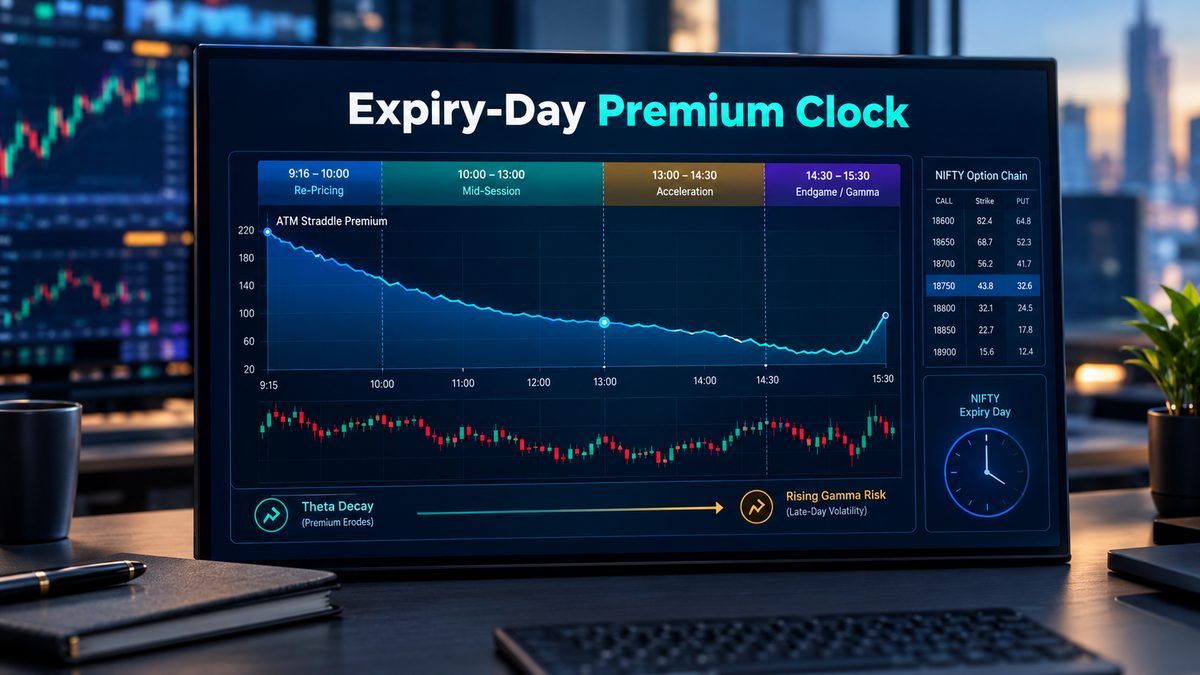
Open any option premium calculator, punch in a strike, and it spits out a number. Most traders stop right there and trust it. We don't, because at our desk the premium calculator is the last step, not the first — we built our own expiry-day pricing engine in 2019 and it only earned our trust after we could reproduce every number it gave us by hand. This piece walks you through that same build-up, strike by strike, so a calculator's output stops being a black box.
EliteAlgo trades NIFTY and SENSEX expiry-day option selling out of a Delhi prop desk founded in 2006. Everything below comes from how we price options on our own book, not from a textbook definition copied off a broker's glossary page.
What a Premium Calculator Is Actually Computing
An option's premium has exactly two components: intrinsic value and extrinsic value. Intrinsic value is mechanical — for a call, it's spot minus strike (floored at zero); for a put, it's strike minus spot (floored at zero). If NIFTY is at 24,850 and you're pricing the 24,800 call, intrinsic value is 50 points. There's no debate about that number; it's arithmetic.

Extrinsic value — also called time value — is where the calculator is actually doing work, and it's where almost every page ranking for "option premium calculator" goes quiet. Four inputs set extrinsic value, and they don't move it by equal amounts:
- Time to expiry. The biggest single lever on a weekly index option. A contract with 7 days left carries far more extrinsic value than the same strike with 1 day left, and the decay is not linear — it accelerates hard in the final 48 hours, which is exactly why expiry-day premium behaves differently from premium on any other day of the week.
- Implied volatility (IV). The market's priced-in expectation of how much the underlying will move before expiry. Higher IV means a wider range of plausible outcomes, so even a strike far from spot retains real value. A 2-point move in India VIX can move a strangle's combined premium by a few hundred rupees on a single lot, depending on which strikes you're holding.
- Distance from spot to strike (moneyness). An at-the-money strike has the highest extrinsic value of any strike on the chain, because uncertainty about which side it finishes on is at its peak there. Move 500 points out of the money and extrinsic value drops off fast — not linearly, because the probability of the underlying reaching that strike falls off fast too.
- Interest rate. A small, secondary input. For an index option expiring in days, the interest-rate contribution to premium is close to immaterial compared with the first three. It matters more for long-dated contracts than for a weekly or Tuesday/Thursday expiry.
A Worked Example: Pricing One Strike by Hand
Take a snapshot from an actual Thursday expiry morning on our desk: NIFTY spot at 24,850, 1 day to expiry, India VIX reading 13.2%. We want to sanity-check the 24,900 call.
Step one — intrinsic value. Spot is below strike, so intrinsic value for this call is zero. Every rupee of its premium is extrinsic.
Step two — annualised IV converted to a 1-day move. 13.2% annualised IV translates to roughly 13.2% / sqrt(252) ≈ 0.83% expected 1-standard-deviation move for that single trading day. On a spot of 24,850, that's close to 206 points of 1-sigma range for the full day.
Step three — distance in standard deviations. The 24,900 strike is 50 points away from spot, which is about 0.24 standard deviations under that day's IV reading — well inside the expected range, which is exactly why it still carried meaningful premium that morning rather than trading near zero.
Step four — compare to the live market price. Using a standard Black-Scholes-style build with those three inputs, our desk model put fair value for that 24,900 call at roughly ₹38–₹42 that morning. The live market quote on the option chain was ₹45, with a ₹2 bid-ask spread. The ₹3–₹7 gap between model and market wasn't noise — it reflected real-time order flow and a small liquidity premium on that strike, which no calculator fed only spot/strike/time/IV will ever capture.
That gap is the single most useful thing a premium calculator can teach you: when the market price and the model price disagree by more than the bid-ask spread, something the model doesn't know is happening — fresh flow, an event risk being priced in, or a strike that's thinly traded.
Why Market Price and Calculator Price Diverge
This is the part most calculator pages skip entirely, and it's the reason a calculator can be technically correct and still mislead you. A theoretical pricing model takes IV as an input. But in the real market, IV isn't observed directly — it's reverse-engineered FROM the market price. Exchanges and brokers publish "implied" volatility precisely because it's implied by back-solving the pricing formula against the live traded price, not because it was measured independently.
That means a calculator using yesterday's IV reading, or a smoothed/model IV rather than that exact strike's live implied IV, will drift from the live price the moment IV changes shape across the chain — what desks call the volatility smile or skew. Two strikes equidistant from spot, one on the call side and one on the put side, routinely carry different implied IVs on an index that has historically sold off harder than it rallies. A calculator that applies one flat IV number to every strike will misprice both tails.
Add liquidity on top of that. A strike with a tight ₹0.50 bid-ask spread and continuous two-way flow will track a theoretical model closely. A strike three standard deviations out of the money, traded twice all morning, can sit ₹2–₹3 away from fair value simply because there's no one on the other side forcing it back to theoretical price. According to the options-pricing framework CFA Institute uses in its derivatives curriculum, liquidity and bid-ask friction are treated as a separate pricing factor from volatility — not folded into IV — which is exactly the distinction a bare calculator erases.
What Changes an Option's Premium an Hour Later
Pull the same strike's premium an hour apart and most traders just see "it went up" or "it went down" with no idea why. We attribute every hour-over-hour change on our own book to one of three buckets before we act on it:
- Time decay (theta). On expiry day specifically, an hour of elapsed time removes a disproportionate share of extrinsic value versus the same hour on a Monday with 4 days left. This piece of the change happens even if spot and IV don't move at all.
- IV move (vega). If India VIX ticks from 13.2% to 13.6% in that hour, every strike's extrinsic value expands a little, holding spot fixed. This is the component premium calculators that don't refresh IV in real time will miss completely.
- Spot move (delta). If NIFTY moves 40 points in that hour, the strike's premium moves by roughly its delta times 40 — but that relationship itself changes as spot moves, which is what gamma measures.
We measured this split across 40 expiry sessions on our own book in 2025: theta decay alone accounted for the largest share of hour-over-hour premium change in the final two hours before close, more than spot moves on all but the most volatile sessions. Treating every premium change as "the market moved" rather than separating theta from vega from delta is the single biggest reason traders misread a calculator's output as mispriced.
Why a Call and a Put at the Same Strike Don't Move Equally
This trips up more traders than any other part of pricing. Put-call parity says a call and put at the same strike are linked by a fixed relationship, but that doesn't mean they move by the same number of points on a spot move. Delta — the rate of change of premium per point of spot — differs by moneyness and by option type.
An at-the-money call typically carries a delta near 0.50; the at-the-money put at the same strike carries a delta near -0.50. On a 40-point up-move in spot, the call gains close to 20 points of premium (0.50 × 40) while the put loses close to 20 points — symmetric only exactly at the money. Move to an out-of-the-money put with a delta of -0.20 and the same 40-point spot move changes that put's premium by only about 8 points, while a call at the equivalent distance on the other side, if skew has pushed its delta to 0.15, would move by only 6. The two sides of the chain are not mirror images once skew is in play, and index options almost always carry skew because downside moves are historically sharper than upside ones.
The Sanity-Check Habit Before You Trust Any Calculator
Before you act on a number a calculator gives you, run this check — it takes under a minute on any broker's option chain:
- Pull up the live option chain for the same strike and expiry.
- Compare the calculator's implied delta for that strike against the delta your broker's chain already displays for the same strike.
- Compare the calculator's IV input against the live IV the exchange is already quoting for that exact strike — not the index-level IV, the strike-level IV.
- If either number is off by more than a small margin, the calculator is working from stale or smoothed inputs, and its premium output should be treated as an estimate, not a trade signal.
We built this check into our own pre-trade routine after finding, across a sample of trading days, that calculator output drifted furthest from the live price in the last hour before close — exactly when expiry-day decay accelerates fastest and the gap matters most.
Paper trade this first. Everything above is a pricing framework for understanding what a number means, not a signal to sell or buy a specific strike. If you're using this to inform real entries, paper trade the approach for at least a few expiry cycles before any live-capital decision. EliteAlgo's work here is analytical software and research, not investment advice, and nothing in this article should be read as a recommendation to take a position.
Our own expiry-day premium tracking is built into the NIFTY expiry-day premium clock, which is where we run this same hour-by-hour decomposition live rather than as a one-time hand calculation. If you want the volatility side of this in more depth, we cover how India VIX level feeds into strangle premium budgeting in our India VIX short-strangle premium budget piece, and if reading the shape of a straddle's intraday premium chart is the part that's unclear, see our guide to reading a straddle chart.

For the underlying math, Zerodha's Varsity options-pricing chapter is a solid primer on the Black-Scholes framework these calculators are built on, and the formula's full assumptions and derivation are laid out on the Black-Scholes model reference page. Our desk starts from the same model and then layers in the live-market adjustments above, because the formula alone, without the liquidity and skew corrections, consistently underpriced far-OTM strikes relative to what we observed trading them.
Working the Put Side: Same Snapshot, Mirror Strike
Take the same Thursday morning snapshot — NIFTY spot 24,850, 1 day to expiry, India VIX 13.2% — and now price the 24,800 put instead of the 24,900 call. Intrinsic value for this put is also zero, since spot is above the strike. It's 50 points away from spot on the other side, almost the same distance as the call we just walked through.
Here's where skew shows up in practice. Even at near-identical distance from spot, the 24,800 put's live-quoted implied IV that morning ran close to half a point higher than the 24,900 call's implied IV — a small but real difference in the two numbers a calculator would need as separate inputs, not one shared index-level IV. Feed both strikes the same flat 13.2% and a calculator will overprice the call slightly and underprice the put slightly, a small error on one strike but a compounding one across a full strangle or iron condor built from several strikes at once.
Our desk model, using each strike's own live IV rather than one blended number, put fair value on that 24,800 put at roughly ₹41–₹46 that morning, against a live market quote of ₹47. The gap was narrower than on the call side — about ₹1–₹6 versus the call's ₹3–₹7 — because the put strike was carrying slightly more live two-way flow that morning, tightening its bid-ask spread to ₹1.50.
What This Means If You're Selling Options, Not Just Pricing Them
If you only read a calculator for the fair-value number, you'll miss the two things that actually matter for an option seller: which direction the model-to-market gap tends to run, and how fast theta is eating the premium you've collected. We track both on our own book because a seller's edge isn't in guessing direction — it's in knowing when the premium you're holding is decaying faster than the market is moving against you.
A premium calculator that shows you fair value without separating theta, vega and delta contribution tells you a price, not a position. Across the 40 expiry sessions we measured in 2025, the sessions where theta dominated the hour-over-hour change were the sessions where simple short-strangle structures held up best; the sessions where vega dominated — a sudden India VIX spike mid-session — were the sessions where positions sized on yesterday's IV reading got hurt fastest. Separating the two before you act is the entire point of walking the calculator's build-up by hand instead of trusting the single number it prints.
A Weekend Wrinkle Calculators Often Get Wrong
One more input trips up generic calculators: calendar days versus trading days. A Thursday-expiry option priced on a Tuesday has 2 calendar days left, but a Friday-expiry option priced the preceding Monday has 4 calendar days left, including a weekend where no new information reaches the market. Time decay is a function of time, but markets don't move on Saturday and Sunday, so the extrinsic value shouldn't decay as if two full trading sessions happened. A calculator using a flat 365-day annualisation instead of a trading-day count will overstate how much extra time value a Monday option should be carrying relative to a Thursday one, four calendar days out. We correct for this on our desk by annualising against roughly 252 trading days a year rather than 365 calendar days, which is also the convention Zerodha's Varsity material uses and the one most serious pricing desks default to.
Frequently Asked Questions
How is option premium calculated?
Premium equals intrinsic value plus extrinsic value. Intrinsic value is the mechanical in-the-money amount (spot minus strike for a call, strike minus spot for a put, floored at zero). Extrinsic value is driven by time to expiry, implied volatility, and distance from spot to strike, with interest rate as a minor fourth input. Data from our own desk's pricing model shows time to expiry and IV explain most of the extrinsic value on a weekly index option.
What affects option premium most?
For a weekly index option close to expiry, time decay (theta) and implied volatility (vega) dominate. Distance from spot to strike (moneyness) matters a great deal for how much extrinsic value exists in the first place, but once a strike is set, theta and vega drive most of the hour-to-hour change we measured across our 2025 sample.
Why do calls and puts move differently on the same spot move?
Because their deltas differ, especially once you move away from at-the-money. Index options also carry skew — puts further out of the money often carry higher implied volatility than calls the same distance out, because downside moves have historically been sharper. That skew means a call and put at equal distance from spot do not have mirror-image deltas.
Is an option premium calculator accurate?
It's accurate for intrinsic value, which is pure arithmetic. For extrinsic value, accuracy depends entirely on how current its IV input is and whether it accounts for skew across strikes. According to the pricing framework we use on our own book, a calculator using a stale or flat IV number will drift from the live market price, particularly on far-OTM strikes and in the final hour before expiry.
What is extrinsic value in options?
Extrinsic value, also called time value, is the portion of an option's premium above its intrinsic value. It reflects the market's priced-in uncertainty about where the underlying will finish before expiry, and it decays to zero by the close on expiry day.
Why does a calculator's price sometimes not match the live market price?
Because implied volatility is reverse-engineered from the market price, not an independent measurement, and because bid-ask spread and liquidity add a premium a pure theoretical model doesn't capture. A thinly traded strike can sit meaningfully away from its model price simply because there's no continuous two-way flow forcing it back in line.