On October 15, 2026, SEBI issued a circular that quietly moves the single most important minute of an option seller's week. If you sell NIFTY or SENSEX expiry-day options, the clock you have built every strategy around — enter in the morning, manage through the afternoon, let the 3:30 pm close decide the outcome — is being rewritten in two stages, on December 7, 2026 and February 8, 2027.
The circular is titled "Review of certain aspects of the Closing Auction Session, market timings and settlement methodology for derivatives contracts," addressed to all recognised Stock Exchanges and Clearing Corporations. It carries reference number HO/47/11/11(3)2025-MRD-POD2/I/23843/2026 and is signed by the Deputy General Manager, Market Regulation Department. You can pull the original from SEBI's own website under "Legal → Circulars" — and you should, because the version of it circulating on trading groups is already being summarised badly.
We have traded NIFTY and SENSEX expiry-day option selling out of our Delhi desk since 2006, and we rebuild our backtest assumptions every time the exchange moves a session boundary. This circular moves three of them at once. Below is what the document actually says, which parts hit an expiry-day option-selling book hardest, and what an algo desk has to check before December 7.

Paper trade every change in this article against your own strategy before you let it run live after December 7. EliteAlgo builds analytical software, not investment advice — we hold no SEBI registration as a research analyst or investment adviser, and nothing below is a recommendation to buy or sell anything. It is a reading of a public regulatory document so you can re-test your own rules against it.
What the October 15 circular actually changes
Start with the history, because the circular only makes sense as a correction to an earlier one. SEBI's circular of January 16, 2026 introduced the Closing Auction Session (CAS) in the equity cash segment, with the stated objective of "facilitating transparent and efficient price discovery of the closing price of securities." That same January circular also specified that settlement prices for stock and index derivative contracts on expiry day would be determined by the Clearing Corporations based on the closing prices thrown up by the CAS framework.
That is the part now being undone. After CAS went live, SEBI reviewed how it was functioning, issued a Consultation Paper on September 12, 2026, took public comments, consulted its Secondary Market Advisory Committee (SMAC) and the exchanges, and has now modified the framework in four places:
- CAS timings and operations — a defined 10-minute session with a randomised close.
- Market timings — when index and stock derivatives stop trading, including the expiry-day carve-out.
- Transition of unexecuted iceberg orders from the Continuous Trading Session (CTS) into CAS.
- Expiry settlement methodology — moved off the CAS closing price and onto a volume-weighted average price (VWAP) window.
For an option seller, the fourth item is the headline and the second is the one that will break your automation first.
The new 3:30 pm to 4:00 pm clock, minute by minute
CAS becomes a separate 10-minute session from 3:30 pm to 3:40 pm on all trading days, structured in three sub-sessions:
| Session | Particulars | Start | Duration |
|---|---|---|---|
| 1 | Reference price calculation / transition from CTS to CAS | 3:30 pm | 1 minute |
| 2 | Order entry — both limit and market orders | 3:31 pm | 5 minutes |
| 3 | Order entry for limit orders only. No modification or cancellation of market orders. Random close in the last 2 minutes. | 3:36 pm | 4 minutes |
The detail that matters operationally: the order entry session closes randomly, at a system-driven moment anywhere between 3:38 pm and 3:40 pm. You cannot know in advance which second the book freezes. Any logic that depends on being the last order in — a pattern that works in a deterministic close — has no deterministic version of itself here. Once order entry shuts, the exchanges run the match and disseminate the CAS closing price and executed quantity "as soon as practicable."
Around that session, the rest of the end-of-day clock under the new framework looks like this:
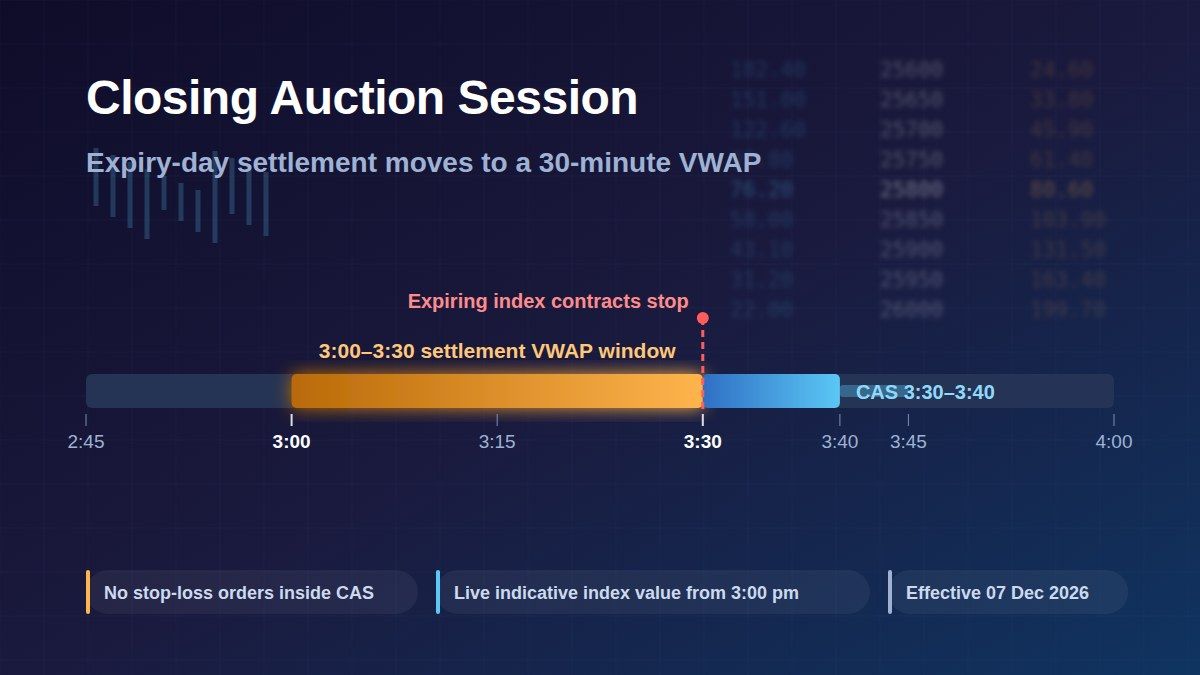
- Index derivatives continue trading until 3:45 pm on all trading days — except on expiry days, where trading in the expiring index derivatives contracts ceases at 3:30 pm.
- Stock derivatives continue trading until 3:45 pm on all trading days, including expiry days. There is no expiry-day carve-out for single stocks.
- The cash post-close session runs 3:50 pm to 4:00 pm, with trades executed at the closing price of the security.
On special trading sessions — the muhurat-style or disaster-recovery sessions exchanges occasionally run — CAS applies too, for the same duration as above. The derivatives segment closes 5 minutes after CAS ends, and a 10-minute post-close session begins 5 minutes after the derivatives segment closes. Same shape, shifted to that day's boundaries.
One honest caveat before you hard-code any of this. The circular gives exchanges and Clearing Corporations 7 days from issuance to jointly modify their Standard Operating Procedures in consultation with SEBI, and instructs them to publish guidelines. The operational fine print — order-entry API behaviour, feed sequencing, exactly how your broker's terminal handles a rejected order type — will arrive in those exchange notices on NSE and BSE, not in the SEBI circular. Read both before go-live.
Expiry day is the exception: expiring index contracts stop at 3:30 pm
This is the asymmetry to internalise. On a normal trading day, index derivatives get an extra 15 minutes past the cash CTS close, running to 3:45 pm. On expiry day, the contracts that are expiring get the opposite treatment — they stop dead at 3:30 pm, while non-expiring index contracts and all stock derivatives carry on to 3:45 pm.
If your expiry-day book is a short straddle or short strangle on the expiring weekly series, your tradeable window ends at 3:30 pm. There is no 3:30–3:45 pm management window for that position. No last-minute roll of a threatened leg, no closing out a winner to bank it, no stop-loss fill in that quarter hour. Whatever position you are holding at 3:30 pm is the position that goes to settlement.
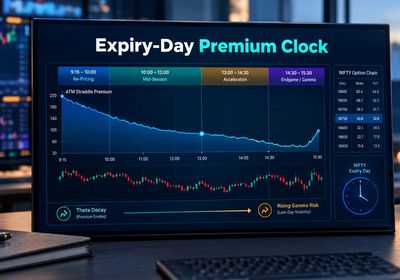
Most desks we see have at least one rule that assumes otherwise — a hard square-off a few minutes before the close, an emergency exit that triggers on a late adverse move, a trailing stop that is still live in the final minutes. Those rules do not fail loudly on December 7. They fail quietly, by never getting a fill, because the contract they are pointed at is no longer trading. Go find them in your strategy configuration now. Our own expiry-day premium clock work maps how much of the day's premium decay actually lands in the final 30 minutes, and that is precisely the stretch whose mechanics are changing.
How the expiry settlement price is now calculated
Here is the clause that matters most. The circular modifies para 1.1.9 of Chapter 5 of the Master Circular for Stock Exchanges and Clearing Corporations to read:
"On the expiry day, the settlement price of the expiring index derivatives contracts shall be determined on the basis of the value of the underlying index calculated using the volume-weighted average prices (VWAP) of the constituent securities during the last 30 minutes of the Continuous Trading Session (CTS) in the equity cash segment."
Note the construction carefully, because it is not the same thing as "the VWAP of the index." The settlement value is built bottom-up: each constituent security's VWAP is computed over the last 30 minutes of cash-segment CTS, and the index value is then calculated from those constituent VWAPs. For a 50-stock index, that is 50 separate volume-weighted averages feeding one number.
Expiring stock derivatives get a parallel treatment under the modified para 3.1.2.7: settlement price is determined by the Clearing Corporations on the basis of the VWAP of the underlying stock during the last 30 minutes of CTS in the cash segment, across all Stock Exchanges. Each exchange supplies the Clearing Corporation with the VWAP and the quantity traded in that window.
Since the cash segment's Continuous Trading Session ends at 3:30 pm when CAS takes over, "the last 30 minutes of CTS" is the 3:00 pm to 3:30 pm window. Confirm that boundary against your exchange's SOP when it publishes, but that is the plain reading of the circular.
The practical consequence: your expiry settlement price is now an average over a half-hour of cash-market trading, not a single closing print and not the CAS auction result. A violent 3:25 pm spike that would have dominated a point-in-time close gets diluted across thirty minutes of volume. Equally, a slow grind from 3:05 pm onward now counts for more than it used to, because every minute of it is in the average.
Why the 3:00 to 3:30 pm window now decides your expiry P&L
Think about what this does to the shape of expiry-day risk for a seller. Under a point-in-time close, the whole day funnels into one number at one instant, and the tail risk is concentrated there — one bad print, one closing auction imbalance, and a strike you were comfortably short of is suddenly in the money. Averaging over thirty minutes trades that concentrated tail for a smoother, more path-dependent outcome.
Smoother is not the same as safer. Two changes follow directly:
Pin risk gets measured over a window, not a moment. If you size strikes against "how far can spot travel in the last few minutes," you are now sizing against the wrong question. The right question is "where can the volume-weighted average of the last thirty minutes land," which is a different distribution with a different width. Any strike-selection rule calibrated on close-print data needs re-testing against a 3:00–3:30 pm VWAP series instead.
Your final management decision moves earlier. Because expiring index contracts stop at 3:30 pm, and because the settlement average is already half-built by 3:15 pm, the last genuinely useful decision point on an expiry-day book shifts well before the old close. By 3:15 pm, fifteen of the thirty minutes that will set your settlement price have already happened and cannot be undone. That is a real structural change to when an algo should be making its final call, and it interacts with everything in how the Greeks behave on expiry day, where gamma in the last hour is already the dominant term.
If you run SENSEX weekly expiry strategies alongside NIFTY, re-test both separately. Index constituent counts, liquidity profiles and closing-window volume distributions differ, so a constituent-VWAP settlement will not behave identically across the two.
The live indicative index value is a new data feed — and a new dependency
The circular does not just change the calculation; it requires the exchanges to show their work in real time. For index derivatives, during the last 30 minutes of CTS the Stock Exchanges "shall on a real-time basis, compute the indicative value of the underlying index and disseminate the same continuously to the market participants." For stock derivatives, the exchanges must likewise compute and continuously disseminate the indicative VWAP of the underlying security.
For a systematic desk this is genuinely useful. From 3:00 pm onward on expiry day you get a running estimate of the number that will settle your contracts, updated live, rather than guessing from spot. A rule like "if the indicative settlement value crosses my short strike, reduce" becomes expressible for the first time.
It is also a new dependency, and new feeds are where automation breaks. Before you write a rule against the indicative value, answer three questions: does your data vendor carry this field from day one, what does your strategy do if the field is missing or stale for ninety seconds, and does your fallback path behave sanely when it has to use spot instead? A strategy that silently falls back from indicative-settlement logic to spot logic is running a different strategy than the one you backtested. Build the fallback explicitly, log every time it fires, and paper trade the whole path across at least a few expiry cycles before it touches real capital.
What order types stop working inside CAS
Three restrictions apply to orders placed during the Closing Auction Session:
- Only limit orders and market orders are allowed, and both count toward computation of the equilibrium price.
- New iceberg orders cannot be placed in CAS. Orders entered during CAS must disclose their full quantity.
- Stop-loss orders cannot be placed in CAS at all.
That third one deserves a pause. Stop-loss orders are the default risk primitive for most retail and semi-automated books, and inside the closing auction they simply do not exist. If any part of your end-of-day process relies on placing a protective stop in the final minutes of the cash session, that process needs a different mechanism — a limit order at a defined price, or a decision taken before 3:30 pm. "I will put a stop in near the close" is no longer an available plan.
The disclosure point is worth noting too, if you work size. An iceberg order exists to hide quantity. In CAS, hiding is off: whatever you enter shows in full, and it shows to everyone computing the equilibrium price. Size your participation in that session with that in mind.
Carried-forward CTS orders, time priority, and the February 2027 date
The transition rules — para 4.8 of the modified framework — are the part with the later implementation date, and they are more intricate than they first look.
All unexecuted limit orders pending at the end of CTS are carried forward into CAS, with two exceptions: stop-loss orders, and orders priced beyond the price bands applicable in CAS. Unexecuted iceberg orders pending at the end of CTS, priced within the CAS bands, are also carried forward — but converted into fully disclosed limit orders, unless the market participant opted out of that transition at the time of placing the original iceberg order. That opt-out is set when you place the order, not later, so it is a decision your order-routing layer has to make up front.
Time priority then stacks in a specific order:
- Limit and iceberg orders carried over from CTS rank above limit orders placed during CAS.
- Among carried-over orders, transitioned iceberg orders rank below other carried-forward limit orders.
- Among transitioned iceberg orders themselves, priority is set by the time of the original iceberg order.
- Carried-over orders can be modified during CAS — but modifying one changes its time priority.
Read that last point as a trap for automated order management. A routine tweak to a resting order — the kind of adjustment a strategy might make dozens of times a session without thinking — costs you your inherited queue position inside the auction. If your system reprices resting orders on a timer, it will be giving away priority in CAS every single time it fires.
These transition provisions come into effect on February 8, 2027, two months after everything else.

Margin at order level, and stock futures price bands
Two more clauses that affect capital and risk plumbing.
Margin. Orders in CAS are subject to applicable margin requirement at the order level — except for the limit and iceberg orders carried over from CTS, which are exempt. But if those carried-over orders are modified during CAS, order-level margin applies to them too. So modification is doubly expensive: it costs you time priority and it pulls the order into order-level margining. If your account runs close to full margin utilisation at the close, a burst of routine order modifications inside CAS can block margin you were not planning for. Our note on lot size and position sizing makes the broader point that margin has an intraday range rather than a fixed value, and this is one more input into that range.
Stock futures price bands. Between 3:30 pm and 3:45 pm, the price band for stock futures is aligned with the band applicable during CAS. The existing framework for dynamic flexing of stock futures price bands — para 2.5.3 of Chapter 1 of the SECC Master Circular — does not apply during that 3:30–3:45 pm window, and instead applies in the corresponding duration within CTS. If you trade single-stock futures into the close, your band behaviour in that final quarter hour is governed by the CAS band, not by dynamic flexing.
Two implementation dates to put in your calendar
- December 7, 2026 — everything in the circular except the para 4.8 order-transition rules. That means the new CAS timings and random close, the revised market timings and the expiry-day 3:30 pm cutoff for expiring index contracts, the reference-price method, the CAS order-type restrictions, the margin treatment, the stock futures price band change, and — critically — the new expiry settlement methodology.
- February 8, 2027 — the para 4.8 provisions on carrying unexecuted limit and iceberg orders from CTS into CAS, and the associated time-priority rules.
The staging matters for testing. Between December 7 and February 8 you are running under the new settlement and timing regime but the old order-transition behaviour. Do not validate your February configuration against December data and assume it holds.
The circular also notes that the reference price for a security in CAS is the VWAP of trades executed in that security during the last 15 minutes of CTS — a different and shorter window than the 30-minute settlement window, so do not conflate the two. Where no trade occurred in the last 15 minutes, the day's Last Traded Price is used; where there was no trade at all during the day, the previous trading day's closing price; and in case of corporate action, the previous day's adjustable closing price or base price.
A pre-December checklist for an algo desk
Paper trade every one of these before December 7, not after.
- Find every rule that fires after 3:30 pm on expiry day against an expiring index contract. Square-offs, trailing stops, emergency exits, roll logic. Each one needs to move earlier or be removed.
- Re-test strike selection against a 3:00–3:30 pm constituent-VWAP settlement series, not against closing prints. If your backtest engine only stores closes, this is a data problem before it is a strategy problem.
- Audit every stop-loss order your system can place in the final half hour. Inside CAS they are rejected outright. Decide now what replaces them.
- Check whether your order manager reprices resting orders on a timer. After February 8, 2027 that behaviour forfeits inherited time priority in CAS and triggers order-level margin.
- Decide the iceberg transition opt-out at order placement, per strategy, and document which setting each strategy uses and why.
- Confirm your data vendor will carry the indicative index value and indicative stock VWAP feeds from go-live, and write an explicit, logged fallback for when they are stale or absent.
- Re-measure margin headroom at the close with order-level CAS margining in the picture, especially if you modify orders late in the session.
- Read the exchange SOPs and guidelines when they publish, and treat them — not any summary, including this one — as the operative spec for implementation details.
- Re-test NIFTY and SENSEX separately. Different constituents, different closing-window liquidity, different settlement behaviour.
What this circular does not change
Three things worth stating plainly, because the loudest summaries are already overreaching.
It does not change the retail algo trading framework itself. Broker approvals, Strategy IDs, static IP registration and the rest of that structure sit in a different set of rules, covered in our note on SEBI algo trading regulations. Nothing here alters your obligations under that framework.
It does not change the cash segment's morning timings, lot sizes, margin percentages or product specifications. The modifications are confined to CAS mechanics, end-of-day timings, order transition and expiry settlement methodology.
And it does not make any strategy more or less profitable by itself. It changes the mechanics your strategy runs against. Whether your particular rule set survives that change is an empirical question about your rules, answerable only by re-testing them — which is the entire reason we are publishing a clause-by-clause reading rather than a verdict.
If you want a second pair of eyes on how a specific expiry-day configuration behaves under the new settlement window, that is the kind of work our managed algo trading desk does day to day — modelling and measuring, on your own rules, with no advisory overlay. Talk to our team about re-testing your book before December 7.
Frequently Asked Questions
When do the new Closing Auction Session rules come into effect?
In two stages. Everything except the order-transition provisions takes effect on December 7, 2026 — the new CAS timings, the revised market timings, the expiry-day cutoff for expiring index derivatives, the CAS order-type restrictions, the margin treatment and the new expiry settlement methodology. The provisions on carrying unexecuted limit and iceberg orders from the Continuous Trading Session into CAS take effect on February 8, 2027.
What time does the Closing Auction Session run?
CAS is a separate 10-minute session from 3:30 pm to 3:40 pm on all trading days. The first minute (3:30 pm) is reference price calculation and transition from CTS. Order entry for both limit and market orders runs from 3:31 pm for 5 minutes. From 3:36 pm, only limit orders can be entered, with no modification or cancellation of market orders. Order entry closes at a system-driven random moment between 3:38 pm and 3:40 pm.
Do NIFTY options stop trading at 3:30 pm on expiry day?
Under the new framework, trading in expiring index derivatives contracts ceases at 3:30 pm on expiry days. Non-expiring index derivatives continue until 3:45 pm, as they do on every other trading day. So the expiring weekly series stops at 3:30 pm while other series keep trading for another fifteen minutes.
How will the NIFTY expiry settlement price be calculated now?
The settlement price of expiring index derivatives contracts is determined from the value of the underlying index, calculated using the volume-weighted average prices of the constituent securities during the last 30 minutes of the Continuous Trading Session in the equity cash segment. Because cash-segment CTS ends at 3:30 pm, that is the 3:00 pm to 3:30 pm window. It is built from each constituent's VWAP, not from a single index print or from the CAS closing price.
What happens to expiring stock derivatives?
Stock derivatives continue trading until 3:45 pm on all trading days, including expiry days — there is no 3:30 pm carve-out for single stocks. Their settlement price is determined by the Clearing Corporations from the VWAP of the underlying stock during the last 30 minutes of CTS in the cash segment, across all Stock Exchanges.
Can I place a stop-loss order during the Closing Auction Session?
No. The circular allows only limit orders and market orders during CAS. Stop-loss orders cannot be placed in CAS, and stop-loss orders pending at the end of CTS are not carried forward into it either. Any risk process that depends on placing a protective stop in the final minutes of the cash session needs a different mechanism.
Will my pending orders carry over into CAS?
From February 8, 2027, all unexecuted limit orders pending at the end of CTS are carried forward into CAS, except stop-loss orders and orders priced beyond the CAS price bands. Unexecuted iceberg orders within the CAS bands are carried forward as fully disclosed limit orders, unless you opted out of that transition when placing the original order. Carried-over orders rank above orders placed during CAS in time priority — but modifying a carried-over order during CAS changes its time priority and makes it subject to order-level margin.
Is there a live feed showing the settlement value before the close?
Yes. The circular requires the Stock Exchanges, during the last 30 minutes of CTS, to compute the indicative value of the underlying index on a real-time basis and disseminate it continuously to market participants. The same requirement applies to the indicative VWAP of underlying securities for stock derivatives. Confirm with your data vendor that these fields will be available from go-live, and build an explicit fallback for when they are stale or missing.
Does this circular change SEBI's algo trading rules for retail traders?
No. This circular covers the Closing Auction Session, market timings and derivatives settlement methodology. The retail algo trading framework — broker approvals, Strategy IDs, static IP registration and related obligations — sits in a separate set of rules and is unaffected by these modifications.
Where can I read the original circular?
It is available on SEBI's website under "Legal → Circulars," reference number HO/47/11/11(3)2025-MRD-POD2/I/23843/2026, dated October 15, 2026. The exchanges and Clearing Corporations were also directed to disseminate it on their own websites and to publish implementation guidelines, so check NSE and BSE circulars for the operational detail that the SEBI document deliberately leaves to them.