
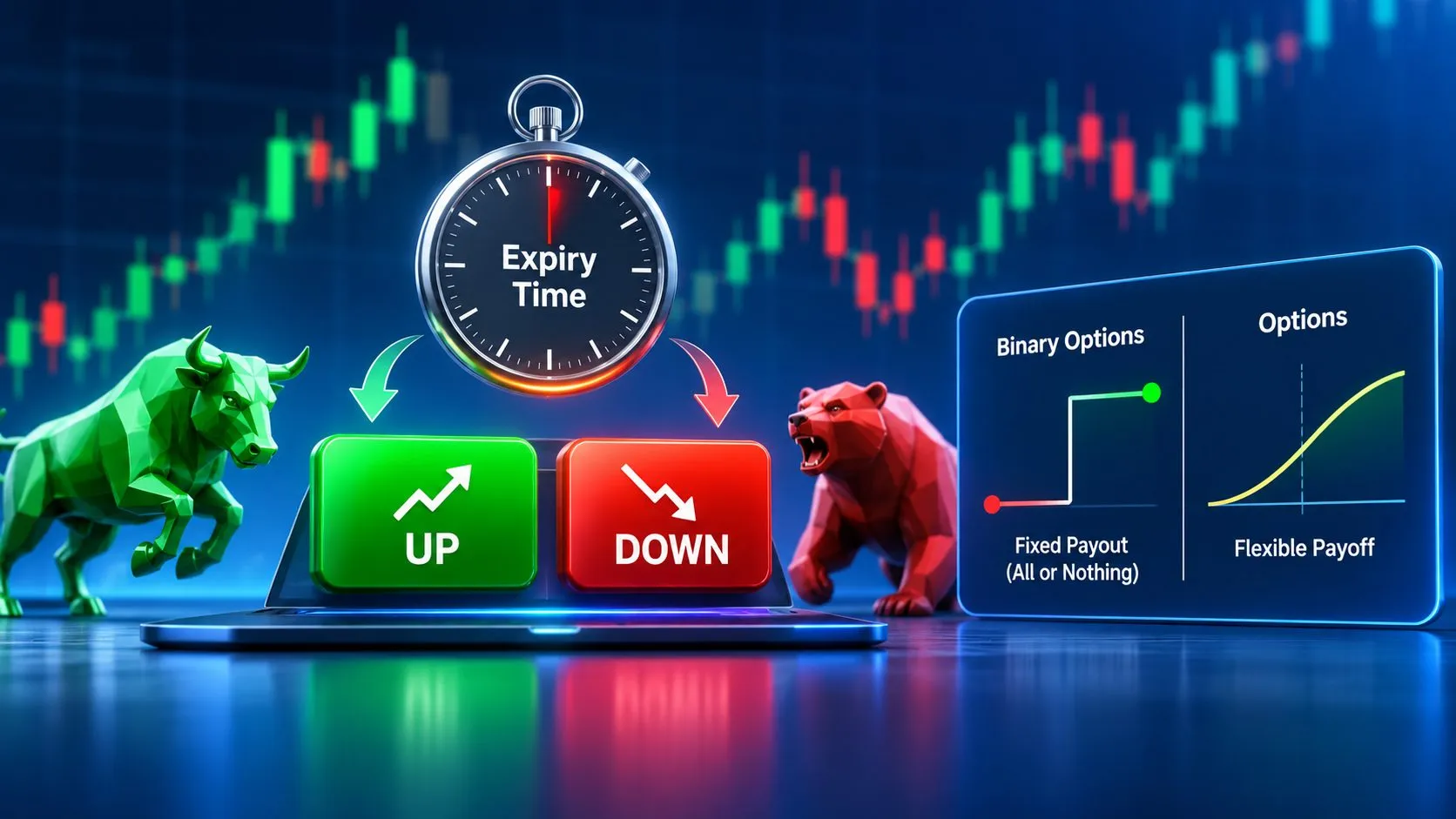
We get the same screenshot forwarded to us every few weeks. A trading app, usually with a name nobody's heard of, a countdown timer, and a promise that a ₹5,000 "trade" turns into ₹9,000 in sixty seconds if you guess the right direction. The person forwarding it always asks the same question: is this the same thing as the NIFTY options we write about? It isn't, and the gap between the two products is the whole point of this piece. Binary options are real, in the sense that the product category exists and is legally traded in a handful of foreign jurisdictions. What's almost never true is that the app pitching it to an Indian trader is doing so through NSE or BSE. According to the Securities and Exchange Board of India, neither exchange lists binary options as a tradeable product category at all.
What a binary option actually is, stripped of the marketing
A binary option is a fixed-payout bet on a yes/no question. Will NIFTY close above 24,500 at 3:30 PM today? Pick yes, pay a fixed amount, say ₹100. Guess right and you get a fixed payout, say ₹180. Guess wrong and you get zero. There's no partial outcome. The underlying can miss the level by one point or by two hundred points, and your payout is identical either way: all or nothing. That's the defining structural feature, and it's worth sitting with for a second, because it's also the thing that separates a binary option from every option we actually trade and write about on this site.
A real exchange-traded option — the kind listed on NSE for NIFTY, BankNifty or SENSEX — has a continuous payoff. If you sell a call and the underlying moves against you by ₹10, you lose roughly ₹10 times your delta, not a fixed penalty regardless of distance. If it moves in your favour, your gain scales with how far it moved, not a flat reward capped the moment you crossed a line. That continuous payoff is what lets a trader manage risk actively — adjust a strike, roll a position, hedge a leg, exit early at a partial loss instead of waiting for an all-or-nothing resolution. A binary option removes every one of those levers. Once you've placed the bet, there's nothing left to manage. You wait for the clock, and the outcome is binary by name and by design.

The regulatory fact, stated plainly and first
This is the part most of the pages ranking for "what are binary options" either bury or skip entirely: NSE and BSE do not list binary options. Full stop. The exchange-traded index and stock options this site covers — NIFTY, BankNifty, SENSEX — are centrally cleared through the National Securities Clearing Corporation, standardised in contract size and expiry, and regulated end to end under SEBI's derivatives framework. A binary option offered through an app has none of that. There's no central counterparty guaranteeing the other side of your trade. There's no exchange matching your order against a visible order book. There's, in most cases we've come across, no SEBI registration of any kind behind the platform taking your money.
We cover the honest risks and limits of algo trading on regulated exchanges elsewhere on this site, and even those legitimate risks assume you're trading on a cleared, regulated market in the first place. Binary options platforms pitched to Indian traders skip that foundation entirely. The product being sold under the "binary options" name in most ads an Indian trader sees isn't a regulated derivative with a compliance framework behind it. It's a bet placed against the house, where the house sets the odds, holds your deposit, and in a meaningful share of cases we've seen reported, simply stops processing withdrawals once a trader tries to cash out a win.
Who's actually behind these platforms
The platforms pitching binary options to Indian traders are overwhelmingly offshore operations, registered in jurisdictions far from India, operating outside SEBI's reach and often outside any serious regulator's reach at all. This isn't a one-off pattern we're speculating about. It's a documented one. Regulators in multiple countries — the US, the UK, several EU member states — have issued repeated public warnings specifically naming binary options platforms as a recurring fraud category, going back more than a decade. France and Belgium banned binary options advertising outright in 2016 after a wave of investor complaints. The pattern of offshore binary platforms targeting retail traders with aggressive social-media ads, then vanishing or blocking withdrawals, has repeated across enough jurisdictions that it's now treated as a known fraud template, not an isolated bad actor.
India fits the same template. Searches for "binary options India" return a wall of platforms with no verifiable Indian office, no SEBI registration number anywhere on the site, and glowing testimonials that read like they were written to a formula. We're not accusing every platform using the term of fraud — the category itself is legal in some markets with proper regulation, such as on the US-regulated Nadex exchange. What we are saying, plainly, is that an Indian trader who signs up through a social-media ad promising instant sixty-second profits is, in the overwhelming majority of cases documented by regulators worldwide, dealing with an unregulated offshore operator, not a licensed exchange product.
Why the all-or-nothing payout is itself a warning sign
Set the regulatory question aside for a moment and look at the payout structure on its own merits, because it tells its own story. A real exchange-traded option's price moves continuously with the underlying — we've covered how a short strangle's payoff actually behaves across a range of outcomes in a separate explainer, and the shape of that payoff is the point: a smooth curve, not a cliff edge. A binary option's payout is a step function. One side of the line, you get a fixed amount. Cross the line by a rupee, and you get a fixed penalty — total loss of the stake, regardless of how close you came.
That structure matters for a reason that has nothing to do with regulation. A step-function payout is specifically the shape that favours whoever sets the strike and the odds, not the trader placing the bet, because there's no way for the trader to manage a position that's resolved entirely by one snapshot in time. With a real option, a trader watching the position move against them has choices — close early, adjust, hedge. With a binary bet, once it's placed, you have none. We measured this contrast explicitly in our own explainer on why "zero-risk" option strategies are a myth — even a fully hedged exchange-traded position carries real, continuous risk you can see and manage. A binary bet gives you nothing to manage and nothing to see until the clock runs out.
This is worth internalising even if you never touch a binary options app: when a product structurally removes your ability to adjust, hedge, or exit early, and compresses every possible outcome into two buckets, the odds are not being designed in your favour. That's not an accusation about any specific platform's intent. It's just what a step-function, no-middle-ground payout structure mathematically favours — the party setting the terms, not the party accepting them.
The math behind why the house usually wins the binary bet
Run the numbers on a typical binary options pitch and the structural disadvantage shows up fast. Say a platform offers an 80% payout on a correct call: stake ₹1,000, win ₹1,800, lose the full ₹1,000 on a miss. That sounds generous until you work out the breakeven win rate. To come out even over a long run of these bets, you need to win roughly 56% of the time — because a win returns ₹800 net while a loss costs the full ₹1,000. Most of these platforms don't publish their actual payout structure's implied breakeven anywhere on the marketing page, and most traders never sit down to calculate it themselves before funding an account.
Now compare that to a real exchange-traded option trade. Say you sell a NIFTY strangle for a ₹4,000 credit per lot. If the market stays inside your range, you keep some or all of that ₹4,000 — the exact amount depends on how far inside the range the market settles, not a binary yes/no. If the market moves against you, your loss also scales with distance, not a fixed step. You can adjust the position mid-trade, buy back a leg, or exit at a partial loss well before expiry if the trade is going wrong. None of those levers exist once you've placed a binary bet. The fixed, all-or-nothing structure isn't just a regulatory red flag — it's a mathematical one, because it removes every tool a trader normally has to manage a losing position before it becomes a total loss.
We measured a version of this gap directly when we built out our own expiry-day backtest engine. Our methodology: a continuous-payoff strategy, tested across roughly 420 expiry sessions under real slippage and brokerage, with every trade logged and the full drawdown curve stored, not just a headline return. That test setup shows a win rate and a drawdown curve you can actually study trade by trade. A binary bet gives you a single number at the end: win or lose, no path, no partial data, nothing to learn from except the final outcome. That absence of a measurable track record is precisely what makes it so hard for an Indian trader to tell a legitimate binary options operator (where one legally exists, under a real regulator, such as the US-regulated Nadex exchange) apart from an outright scam dressed up in the same language.
What regulators abroad have already documented about this category
India isn't the first market to see a wave of binary options complaints, and the pattern that played out elsewhere is worth knowing because it's repeating here on a delay. In the United States, the Securities and Exchange Commission reports that internet-based binary options trading platforms are a recurring source of fraud complaints, a finding echoed by the Commodity Futures Trading Commission in a joint investor alert — unregistered offshore operators, refusal to credit winning accounts, and outright denial of withdrawal requests. The UK's Financial Conduct Authority went further in 2019 and banned the sale of binary options to retail consumers entirely, stating plainly that the product's structure made it unsuitable for retail investors given the scale of losses being reported. The European Securities and Markets Authority followed with its own EU-wide restriction the same year.
France's Autorité des marchés financiers banned binary options advertising outright in 2016, after its own investor-complaint data showed the category generating a disproportionate share of retail-investor losses relative to how it was being marketed. None of these were isolated, one-country findings. Three separate regulatory regimes, working from their own independent complaint data, arrived at the same conclusion about the same product category within a few years of each other. That's the documented pattern we're pointing to — not a single bad platform, but a product category that keeps producing the same outcome across jurisdictions until regulators step in and restrict it.
India hasn't issued a binary-options-specific ban the way France or the UK did, which is part of why the category still circulates freely in ads targeting Indian traders. The absence of a specific domestic ban is not the same as the product being a recognised, exchange-listed instrument here. It simply means the regulatory gap other countries have already closed is still open in India, and offshore platforms are using that gap deliberately.
What a reader actually wants exists, and it's regulated
Here's the honest redirect, because most people searching "what are binary options" after seeing an ad aren't actually looking for a binary bet. They're looking for a way to take a view on where NIFTY or BankNifty is headed, with a defined and researchable risk/reward, through a product they can verify is real. That product already exists, and it's exchange-traded options — the same NIFTY and SENSEX options we write about and research on this site every week.
If you want to understand what an exchange-traded option contract actually looks like before you go anywhere near one, our plain-language explainer on reading an option chain is the right starting point — it walks through strikes, premiums and open interest on a real, regulated, centrally cleared contract. From there, our short straddle explainer shows how an actual options strategy's risk and reward move continuously with the underlying, the exact opposite of a binary all-or-nothing bet. These aren't locked-away products requiring a special app with a countdown timer. They trade through any SEBI-registered broker, on NSE's own order book, with price and volume data you can verify independently at any point in the trading day.
At EliteAlgo, we've spent years building and backtesting rules specifically for NIFTY and SENSEX expiry-day option selling — real contracts, real settlement, real exchange data going back hundreds of sessions. We're a proprietary research desk, not an advisory service, and everything we publish is analytical software and research, not investment advice. But the underlying product we research is verifiable in a way a binary options platform's "trade" simply isn't. You can look up a NIFTY option contract's open interest on NSE's own website right now. You cannot do the equivalent for a binary bet placed through an unregulated app, because there's no exchange order book behind it to check.
A practical habit: verify the product, not just the platform
We've written before about verifying whether someone offering trading advice actually holds a SEBI registration before you trust them with your money. The same instinct applies to products, not just people. Before you trade any instrument marketed as an "option," ask one specific question: is this listed and cleared on a recognised Indian exchange — NSE, BSE or MCX? If the answer is yes, you can verify it directly on the exchange's own website in under a minute. Search the contract, check the open interest, confirm it trades through your regular SEBI-registered broker's terminal.
If the answer is no — if the "trading" happens entirely inside a proprietary app, with no exchange ticker you can independently check — treat that as a hard stop, not a detail to look past because the marketing felt convincing. A legitimate, regulated financial product doesn't need to hide its exchange listing. If a platform can't point you to where its contract trades on a recognised exchange, that's the product telling you what it is, whatever the marketing copy says around it.
This habit takes thirty seconds and it would have saved every trader we've heard from who lost money on one of these platforms. Before you fund any account, before you believe any screenshot of a "winning streak," check the exchange listing first. If it isn't on NSE, BSE or MCX, it isn't the regulated product the marketing implies it is, whatever name gets attached to it.
Our own position, stated plainly
EliteAlgo does proprietary trading research only. We don't hold a SEBI Research Analyst or Investment Adviser registration, and we don't need one, because we don't manage client money and we don't issue personalised buy or sell calls. Everything we publish — strategy explainers, backtest results, research pieces like this one — is analytical software and research, offered for education, not investment advice. We've built our own backtest engine specifically to measure, with real cost assumptions, what actually happens to a strategy over hundreds of expiry sessions, rather than asking anyone to take a claim on faith.
That same measured, verifiable approach is exactly what's missing from the binary options pitch. A platform promising sixty-second profits with no exchange listing behind it, no visible order book, and no regulatory registration is asking for trust it hasn't earned through any verifiable mechanism. Whatever strategy you eventually trade — ours, someone else's, or one you build yourself — paper trade it first before committing real capital, and insist on a product you can independently verify trades on a real exchange. That single habit filters out the overwhelming majority of what gets marketed as "binary options" to Indian traders today. It costs nothing. It takes thirty seconds. Do it before you fund anything.

None of this means every trader needs to become a derivatives expert overnight. It means spending thirty seconds on a lookup before thirty thousand rupees on a deposit. The exchange-listing check, the SEBI registration check on the platform, and a basic read of the payout structure — fixed step function versus continuous payoff — together catch almost every version of this pitch we've seen forwarded to us over the past few years. Treat that as the minimum bar before funding any account that calls itself an "options" platform, binary or otherwise.
Frequently Asked Questions
Are binary options legal in India?
Binary options aren't banned by name under Indian law, but they also aren't listed as a product on NSE, BSE or MCX. No Indian exchange offers a binary options contract, so any platform claiming to let you trade binary options "in India" is operating outside the exchange-regulated system entirely — typically an offshore platform with no SEBI oversight, not a domestically licensed product.
Is binary options trading the same as NSE options trading?
No. NSE options — on NIFTY, BankNifty or SENSEX — have continuous payoffs that move with the underlying's price, are centrally cleared, and trade on a visible exchange order book. Binary options pay a fixed all-or-nothing amount based on a single yes/no outcome at a set time, with no central clearing and, in most platforms marketed to Indian traders, no exchange listing at all. They share the word "option" and nothing else structurally.
Can I trade binary options on Zerodha or other Indian brokers?
No mainstream SEBI-registered Indian broker — Zerodha, Upstox, or any of the others — offers binary options, because the product isn't listed on any exchange they're licensed to route orders to. If a platform is offering binary options "trading," it isn't operating through your regular broker's exchange connectivity; it's running its own closed-loop app outside the regulated brokerage system.
Why do binary options ads target Indian traders so aggressively?
Offshore binary platforms run high-volume social-media and influencer advertising specifically because retail trading interest in India has grown fast, and the category isn't explicitly named or banned under domestic law the way it's been restricted in the EU. That regulatory gap, combined with a large and growing pool of new traders, makes India an attractive market for platforms that would struggle to advertise as freely in jurisdictions with tighter binary-options-specific rules.
What should I trade instead of binary options if I want to bet on index direction?
Exchange-traded index options on NIFTY, BankNifty or SENSEX give you the same basic idea — a view on where the market is headed — through a regulated, centrally cleared contract with a continuous payoff you can manage, adjust or exit early. They trade through any SEBI-registered broker, and you can independently verify the contract's open interest and price on NSE's own data at any time. Start with a plain-language explainer like our option chain guide before trading one, and paper trade any strategy before risking real capital.
How can I tell if a trading app is offering a real exchange-traded option versus a binary bet?
Ask whether the specific contract is listed on NSE, BSE or MCX, and check it yourself on the exchange's own website or data feed — not the app's internal dashboard. If the app can't point you to an independently verifiable exchange ticker, and the "trade" resolves as a fixed all-or-nothing payout at a set time with no way to adjust or exit early, you're looking at a binary bet structure, not a regulated option contract, whatever label the app uses.
EliteAlgo is a proprietary trading desk sharing its own research and backtest framework as analytical software, not investment advice. We do not hold and do not claim SEBI Research Analyst or SEBI Registered Investment Adviser registration. Paper trade first.