
Paper trade this first. Everything below explains how contract terms behave. It is not a recommendation to take any trade. Test any rule you borrow on paper before it goes near live capital. EliteAlgo is analytical software and research, not investment advice.
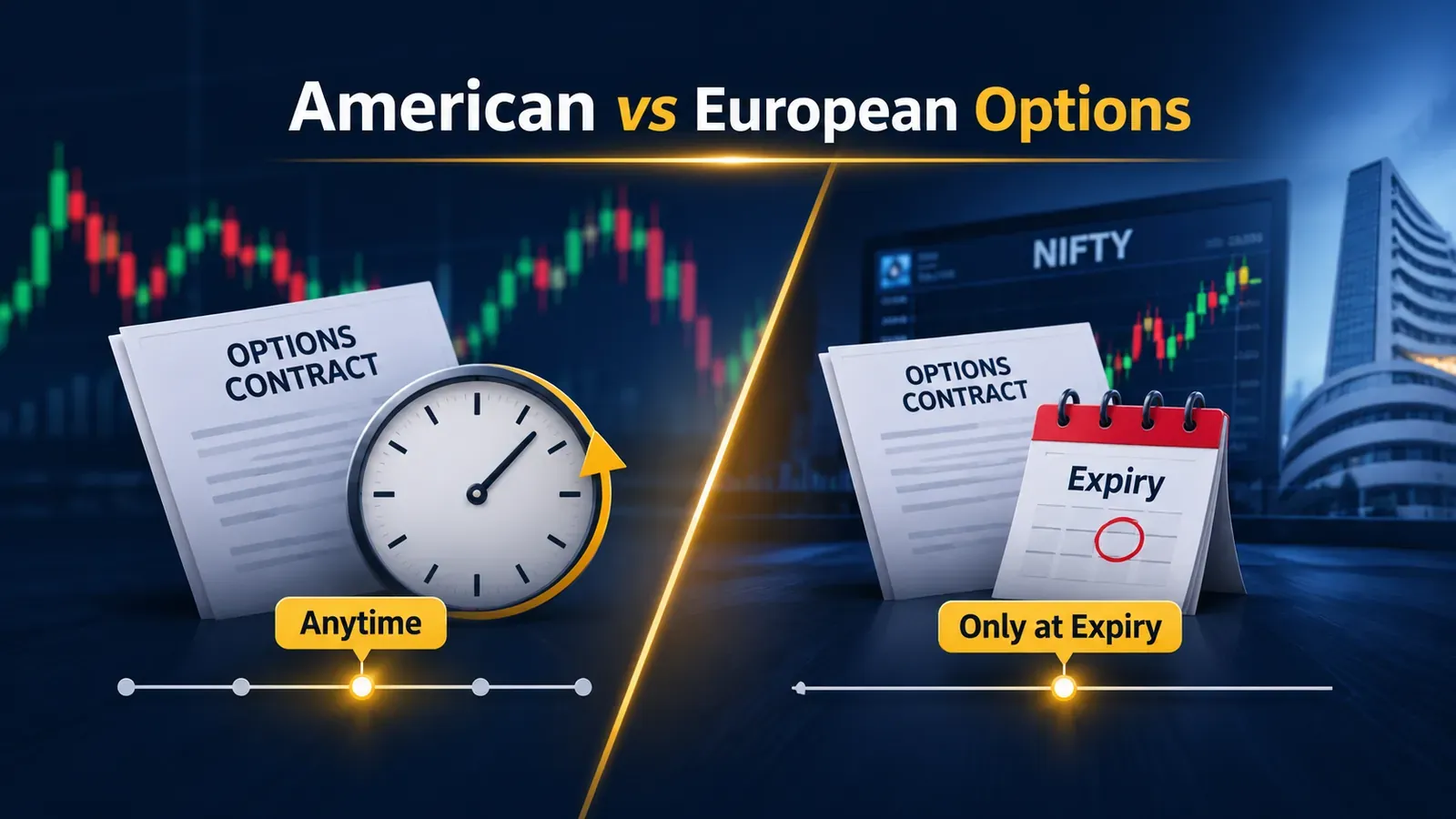
The short answer: an American option can be exercised on any day up to expiry, and a European option only at expiry. Index options on the Indian exchanges are European style. So if you sell a NIFTY or SENSEX option, the buyer can't call you up on a Tuesday and demand settlement while the contract has weeks to run. Your obligation is decided on expiry day, not before.
That one fact removes a worry that fills most US option-selling guides, and it changes how a short position behaves. The rest of this article shows where the difference comes from, what it does and doesn't change for a seller, and why it matters for the pricing models your software runs.

The one difference: when the buyer can exercise
Exercise means the buyer of an option uses the right the contract gives them. A call buyer takes the underlying at the strike price. A put buyer sells it at the strike. The style of the contract decides when that is allowed.
- American style: exercise is allowed at any time from purchase until expiry.
- European style: exercise is allowed only on the expiry date.
The names have nothing to do with geography. A European option can trade in Mumbai, and an American option can trade in Frankfurt. The labels are just textbook habit.
Why would anyone want early exercise? Mostly because of cash flows on the underlying. Take a US stock that is about to pay a large dividend. A holder of a deep in-the-money call may exercise the day before the ex-dividend date, so they own the shares and collect the payout. A holder of a deep in-the-money put may exercise early because the interest earned on the strike money beats the small time value left in the option. Both are rational acts. Both land on the seller as a surprise, because the seller is now short stock or long stock they didn't plan for.
An American option gives the buyer more rights, so it is worth at least as much as an otherwise identical European option. For plain calls on stocks that pay no dividend, the early-exercise right is worth nothing, because holding the option is always better than exercising it. In other cases the extra right has a real price.
Which style NSE and BSE options use
Index options on NSE and BSE, including NIFTY, BANKNIFTY, FINNIFTY and SENSEX, are European style. According to the NSE clearing and settlement documents, both index options and stock options carry European-style exercise. SEBI's derivatives framework follows the same convention for index and stock options listed on Indian exchanges. You can read the regulator's circulars on the SEBI website.
Two cautions before you quote this to anyone.
First, contract specifications change. Exchanges revise expiry days, strike intervals, lot sizes and settlement details by circular. This article deliberately has no lot sizes, freeze limits or margin figures in it, because those go stale within months. Check the contract specification page on the exchange site and the latest circulars before you build a rule that depends on a number.
Second, don't assume "European" means identical across every product. The exercise style is one clause of the contract. Settlement type is a separate clause, and it differs between index and stock options. The next sections cover that.
A working habit: when you add a new product to your system, read its contract specification once and record the exercise style, settlement type and last trading day in your own notes with the date you checked. It takes five minutes and saves you from relying on a blog post, this one included.
What European style means for a short option position
Start with what the seller of an American option carries. At any moment, the buyer might exercise. The clearing system then assigns that exercise to a seller, picked from the open short positions in that series. If you are assigned on a short call, you are suddenly short the underlying at the strike. If you are assigned on a short put, you are long it. Your hedge, your margin and your risk all change in a day.
On a European option none of that happens before expiry. The seller's position moves with the market price and the margin calendar, and nothing else. Concretely, for an index option seller in India:
- No early assignment. A short 24,000 call sitting deep in the money three weeks before expiry stays a short option, marked to market every day.
- The position's risk is price risk and margin risk. A big adverse move raises the margin you must post and the loss you carry, but it does not convert your option into a stock position overnight.
- The decision point is expiry. What you owe is set by where the index settles.
Does that make short options safe? No. It removes one specific risk, assignment timing, and leaves the larger ones where they were. A short straddle that runs against you still loses money every minute the index moves away from the strike. Margin can still be called when volatility jumps. A European contract is only a smaller menu of surprises.
This also affects how you think about the trade you never made. A US trader often closes a short put early because assignment risk grows as the put goes deep in the money. An Indian index seller doesn't have that reason. Whether to close early is then a pure risk and reward question: is the remaining premium worth the remaining risk? That is a cleaner question. If you want the full list of what a writer is bound to, see what being the option writer obligates you to.
A small illustration
Here is a model case with made-up round numbers, only to show the mechanics. It isn't a market quote.
Illustration (model numbers, not market data)
Short 1 call, strike 24,000, index now 24,400, 20 days to expiry

American-style contract:
  buyer may exercise any day -> seller can be assigned today,
  becomes short index exposure at 24,000 and must manage it.

European-style contract (NIFTY / SENSEX options):
  no exercise before expiry -> seller holds a short call,
  marked to market daily. Obligation decided on expiry day.
The loss on the position is the same on paper in both cases if the index keeps rising. What differs is who controls the timing. In the American case the buyer does. In the European case the market does, through expiry.
Settlement: cash-settled index vs physically settled stock options
Exercise style and settlement type get mixed up constantly, so keep them apart. Style answers "when can the buyer exercise." Settlement answers "what changes hands when the contract ends."
Index options have no deliverable asset. You can't hand over an index. So they settle in cash. On expiry the in-the-money option pays the difference between the settlement price and the strike, in rupees, through the clearing accounts. Out-of-the-money options expire worthless. For a seller, the whole outcome is a cash debit or nothing.
Stock options in India are different. Under the framework SEBI introduced for stock derivatives, stock options settle by physical delivery of the shares at expiry if they finish in the money. A seller who is short an in-the-money call must deliver the shares. A seller who is short an in-the-money put must take delivery and pay the strike. That has real consequences. It needs margin for the full delivery obligation, it triggers delivery-related charges, and it can leave you holding a stock position you did not plan to own.
Per the exchange rules in force, the details of physical settlement, such as the margin build-up in the last days before expiry, are set by circular and do change. Read the current circular before you sell stock options near expiry. This article does not state margin percentages for that reason.
Put the two clauses side by side:
| Product | Exercise style | Settlement | What the seller faces at expiry |
|---|---|---|---|
| Index options (NIFTY, SENSEX, others) | European | Cash | A rupee debit if in the money; nothing if out |
| Stock options | European | Physical delivery | Shares to deliver or take, if in the money |
Read the settlement row twice if you sell stock options. European style protects you from early assignment, but it does not protect you from the delivery that arrives on expiry day. Traders who square off before the close avoid it. Traders who forget don't.
There's one more expiry-day detail that matters for index sellers. Cash settlement uses the exchange's official settlement price, which is computed from index values near the close, not from whatever your screen shows at 15:29. A position that looks out of the money on a last-minute tick can still settle differently. Expiry day is where a lot of the real P&L is decided, so it is worth reading how the final settlement value is computed on the exchange site.
Why US option-selling guides warn about early assignment, and why it does not apply here
Search for advice on selling options and you'll hit US material first. Much of it carries warnings that don't fit the Indian index market. Here are the common ones and how they translate.
"Watch the ex-dividend date on short calls." In the US, a short in-the-money call is at risk of assignment just before a dividend. Indian index options are European, so the warning doesn't apply to NIFTY or SENSEX. The index also doesn't pay a dividend you can capture by exercising.
"Deep in-the-money short puts can be assigned at any time." Not on a European contract. The put stays open until expiry.
"Pin risk at expiry." This one does carry over, in a different form. When the index closes very near a strike, a seller can't be sure whether the option finishes in the money. In cash-settled index options the cost is a small cash amount either way. In physically settled stock options it can mean surprise delivery. Pin risk is a real expiry-day issue in India even though early assignment is not.

"Spreads can leave you with a one-sided position after assignment." A US trader running a short vertical spread can be assigned on the short leg and be left holding the long leg alone for a day. On a European contract that sequence can't happen before expiry, so the spread legs stay paired until the end.
Be careful with the reverse mistake. Some beginners read "no early assignment" and conclude there is no reason to monitor a short position until expiry. That is wrong. Mark-to-market losses, margin calls and gap risk all run the whole time. A stop or exit rule still matters. For an expiry-day seller, risk comes from the price path, not from the contract's exercise clause. The article on how futures and options differ in risk shape goes through that difference in more detail.
Exercise style and the Black-Scholes model
Black-Scholes prices a European option. The model assumes the option can only be exercised at expiry, and it gives a closed-form answer. That is why the formula fits NIFTY and SENSEX options without any adjustment for early exercise.
For American options the situation is different. There is no simple closed-form price, because the holder's right to exercise early changes the value in a way the formula can't capture. Practitioners use other methods, such as binomial trees or finite-difference schemes, which test at each step whether exercising now beats waiting. Black-Scholes is only a starting point for an American option and is usually adjusted or replaced.
For an Indian index seller this is good news. The model your calculator uses is the right one for the contract, within the model's other assumptions. Those assumptions, constant volatility and a smooth price path, are still wrong in practice, and that is where the pricing errors come from, not from the exercise style. See the Black-Scholes calculator for NIFTY weekly options for how to use it sensibly and where it misleads.
Here is the shape of the call price in code, so the "European only" assumption is visible. The price depends on time to expiry and nothing else about when you might exercise.
from math import log, sqrt, exp, erf

def norm_cdf(x):
    return 0.5 * (1 + erf(x / sqrt(2)))

def bs_call(S, K, T, r, sigma):
    # European call: exercise only at T. No early-exercise term anywhere.
    d1 = (log(S / K) + (r + 0.5 * sigma**2) * T) / (sigma * sqrt(T))
    d2 = d1 - sigma * sqrt(T)
    return S * norm_cdf(d1) - K * exp(-r * T) * norm_cdf(d2)
Nothing in that function asks "should I exercise today?" That missing question is the whole difference. A pricer for American options has to ask it at every step before expiry.
One practical point for software builders: when you backtest option selling, you can treat a short index option as held to expiry or closed by your own rule, with no random assignment event to model. That removes a source of complexity from a backtest. It does not remove slippage, margin or gap risk, which you still have to model honestly. The methodology of any such test, its dataset and its assumptions, belongs in the write-up so a reader can judge it.
Frequently Asked Questions
What is the difference between American and European options?
An American option can be exercised on any day until expiry. A European option can be exercised only on the expiry date. Everything else, the strike, the premium and the payoff, works the same way. The difference only changes what the seller must be ready for before expiry.
Are NSE options American or European?
European. NSE index options and stock options are European style, and BSE's SENSEX options follow the same convention. Confirm on the current contract specification page of the exchange, because terms are revised by circular.
Can an option seller in India be assigned before expiry?
No. Because the contracts are European, the buyer can't exercise before expiry, so there's no early assignment. The seller still faces daily mark-to-market, margin changes and the expiry-day settlement.
Are stock options in India European style?
Yes. Stock options are European style too. The difference from index options is settlement: stock options settle by physical delivery of shares if they finish in the money, while index options settle in cash. Check the current exchange circular for the details in force.
Which is more expensive, an American or a European option?
An American option is worth at least as much as an otherwise identical European one, because it gives the buyer extra rights. The gap is often tiny, and for non-dividend-paying calls it is zero. It's larger for deep in-the-money puts and for calls just before a dividend.
Does Black-Scholes work for American options?
Not directly. Black-Scholes assumes exercise only at expiry, so it prices European options. American options need methods that test early exercise at each step, such as binomial trees. For NIFTY and SENSEX options, which are European, Black-Scholes is the right family of model.
This article is analytical software and research content from EliteAlgo, not investment advice. Paper trade first. Contract terms such as exercise style, settlement type, lot sizes and margins are set by the exchanges and SEBI and change by circular. Check the current contract specification before you rely on any detail. For definitions of option terms from a US regulator, see the Investor.gov glossary entry on options.
To see how EliteAlgo approaches rule-based expiry-day option selling, read our overview of algo trading strategies.