
Most articles on this topic list nine or ten disadvantages and treat them as equally important. They are not. Some are cheap to fix with a VPS and a monthly bill; one of them quietly destroys accounts and gives no warning at all. This page covers the full list, and then ranks what actually matters for an Indian index option seller in 2026 — including the compliance costs that stopped being hypothetical in April. New to the subject? Start with our complete guide to algorithmic trading in India.
According to Investopedia's overview of algorithmic trading, while algo trading offers significant advantages in speed and consistency, it carries unique risks that every trader must understand before committing capital.

Disadvantages of Algo Trading
While algo trading is full of positive points, there are some disadvantages of algo trading too.
- Complete Dependency on Technology: One of the most significant disadvantages of algo trading is that it is entirely dependent on technology. Suppose the trade process is happening on the computer and not on the web server, and due to painful conditions like loss of internet connection or power supply, then the trade will not be sent for execution. It is the opposite of what we use algo trading for; with these issues, traders can lose a big chunk of money due to their total dependency on technology.
- Knowledge of Coding and Programming: Algo trading is not for those who don't want any expert's help and want to DIY without having any prior knowledge of complex algorithms and coding. To create your trading algorithm, you need working knowledge of a language such as Python, C++ or Java, plus the discipline to test what you write. Paying a developer to code it is a fair shortcut, but then you depend on someone else to fix it at 9:20 on an expiry morning. The coding barrier has also shrunk a lot; see point 5 below.
- The Risk of Over-Optimization: A strategy fitted too closely to past data looks excellent in a backtest and then disappoints live. Cross-checks help, but they do not remove the problem, because the more settings you tune the more of the past you are memorising instead of learning anything repeatable. This is the one we rank first below.
- Need for Constant Monitoring: Programs in algo trading are completely automated but still require to be constantly monitored by the trader to look for any anomaly or technical issues like loss of internet connection, system or server crash, power loss, etc. In the early stages of execution, the algorithms need to be constantly monitored to check if the program is functioning properly to ensure there are no missing orders or wrong execution of trade orders. However, after successful implementation, you don't necessarily need to stick around to your computer; you can monitor it from anywhere using your smartphone every few hours, although it can be one of the significant disadvantages of algo trading for some people.
- Requirement of Resources: While algo trading reduces transaction costs by a huge percentage but also adds a lot of expenses on resources required for successful algo trading. The traders need to have high-end systems and servers that can process data in a fraction of second and build algorithms from scratch according to each person's unique strategy and goals. That is one of the significant disadvantages of algo trading for people who cannot manage all these resources.
- Not Every Strategy Can Be Automated: Rules have to be written down precisely. A setup that depends on how the tape "feels", on reading a news headline, or on a gut call about whether a spike will fade cannot be coded without throwing away the part that made it work. If you cannot state the entry, the exit and the size in plain numbers, you do not yet have something to automate.
- Compliance Overhead (this one is now real, not theoretical): SEBI's retail algo framework has been fully in force since 1 April 2026. It is not a future rule you can plan for later. Every automated order has to route through your broker's API, carry a unique Strategy ID, and originate from a static IP address that your broker has whitelisted. In practice that means a home broadband connection with a dynamic IP will not do, you cannot casually move your setup to a different machine or network, and orders are tagged and logged whether you like it or not. A self-coded strategy that stays under the 10-orders-per-second threshold does not need exchange registration of its own, but a platform or vendor you plug into has to be empanelled with the exchange. None of this makes algo trading worse as an idea — but it is real paperwork, a real monthly cost for a static IP or VPS, and a real source of order rejections on the day you forget about it. Read how SEBI's algo trading rules work now that they are live before you build anything.
- Reduced Human Control: Automation takes the decision out of your hands in the moment, which is the whole point and also the cost. You can always flatten a position manually or kill the strategy — the order book is not sealed once a trade fires. What you cannot easily do is intervene selectively without wrecking the logic. Override one trade because it "feels wrong" and you no longer own the system you tested; you own a discretionary book wearing an algo's clothes. In our own experience this is the single most common way a working strategy stops working.
- Faulty Algorithms: A bug repeats itself at machine speed. The textbook case is Knight Capital on 1 August 2012: the US regulator, the SEC, says a router fed with incorrectly deployed code sent more than 4 million orders in the first 45 minutes of trading while trying to fill just 212 customer orders, and the firm lost more than $460 million. Retail setups are tiny next to that, but the mechanism is the same. A wrong lot size, a duplicated order or a stop that never fires costs you the same way, only slower to notice if nobody is watching. Details are in the SEC's order summary.
Which of these actually bites, in India, in 2026

The list above is the complete set of textbook disadvantages. But they are not equally dangerous, and the ranking is different for an Indian index option seller than it is for someone running an equity momentum system. Based on what we see on our own NIFTY and SENSEX option-selling desk, here is the honest order.
| Disadvantage | How it shows up | What fixes it | Cost to fix | Our severity for an index option seller |
|---|---|---|---|---|
| Over-optimisation | Great backtest, weak live results, no warning | Fewer parameters, untouched out-of-sample data | Discipline, not money | Highest |
| Costs and slippage | Thin edge turns negative on real fills | Model costs and slippage per leg in every test | Time | High |
| Market regime change | A short-volatility book gives back profit in a volatility spike | Sizing, hard daily loss limit, regime filters | Lower returns in calm weeks | High |
| Faulty code | Wrong size, duplicate or missing orders | Paper trading, order-count and size caps, kill switch | Time | High, rare |
| Compliance setup | Rejected orders from the wrong IP, market orders not allowed | Fixed-IP VPS, limit-based exits, empanelled platform | A VPS or static IP bill every month | Medium |
| Technology and connectivity | Power cut, Wi-Fi drop, broker API timeout | VPS, alerts, broker-side stop orders | Low monthly cost | Medium |
| Monitoring load | A missing trade nobody noticed for days | Did-not-fire alerts and position reconciliation | An evening of setup | Medium |
| Losing the nerve to follow it | Overriding trades, quitting in a drawdown | Decide the tolerable drawdown before you start | Free, and hard | Medium |
| Coding skill | Cannot build or fix it yourself | No-code builders or a hired developer | Subscription or fee | Low |
1. Over-optimisation is the one that quietly ruins people

Every other item on the list announces itself. Your internet drops and you know it. A bug throws an error and you see it. Over-optimisation does the opposite: it hands you a beautiful equity curve and says nothing. The mechanism is simple — the more parameters you let yourself tune, the more certain it becomes that you have fitted the specific sequence of the past few years rather than any repeatable behaviour. Expiry-day option selling is especially exposed, because there are only so many expiries in a backtest window. Slice a few years by index, by weekday and by volatility regime and your "large sample" is suddenly a few dozen genuinely independent days. A curve that looks flawless on that sample is not evidence of anything.
The defence is boring and unavoidable: fewer parameters, out-of-sample periods you never looked at while building, and a willingness to throw away a result that only works with one specific set of numbers. If a strategy collapses when you nudge a stop by ten percent, it was never a strategy. The same caution applies to anything you take off a chart: indicators that repaint hide this behind a signal history that redraws itself after the fact.
2. Costs and slippage eat more than beginners model
Backtests are usually run at the mid or the close. Live fills are not. For option selling the gap shows up in the places you least want it — widening spreads in the last hour of expiry, a stop-loss that triggers into a thin book, the second leg of a strangle filling at a worse price than the first. Add brokerage, exchange charges, STT on the sell side of options, stamp duty and GST, and a strategy with a thin edge per trade can turn negative on the real tape while still looking profitable in the sheet. Any backtest that does not model costs and realistic slippage is not a backtest, it is a hope.
3. The monitoring load is lighter than the list suggests — but never zero
The old framing of this one oversells it. You do not need to sit and watch a screen; the system places orders faster and more consistently than you can. What you do need is a monitoring layer: alerts that tell you when the strategy did not fire, when a leg is unhedged, when the position size does not match what the rules say it should be. The failure that hurts is not a wrong trade, it is a missing trade you did not notice for three days.
4. Technology dependency is mostly solvable with money
Running your algo from a laptop on home broadband is a genuinely bad idea — and since the static-IP requirement went live, it is often not even permitted. Moving to a VPS solves the power cut, the Wi-Fi drop and the compliance requirement in one go, and it costs less per month than one bad fill. This is a real disadvantage, but it is the cheapest one on the list to fix.
5. The coding requirement is no longer much of a barrier
A decade ago this belonged near the top. Today there are enough no-code strategy builders in the Indian market that a trader with clear rules and no programming background can deploy and backtest without writing a line. See our comparison of algo trading software in India for what the no-code tools actually do, and our list of free algo trading software in India for what you get at zero cost and where each free tier stops. The catch has moved rather than disappeared: it is now easy to deploy a system you do not fully understand, which is arguably a worse problem than not being able to deploy at all.
What the usual lists leave out
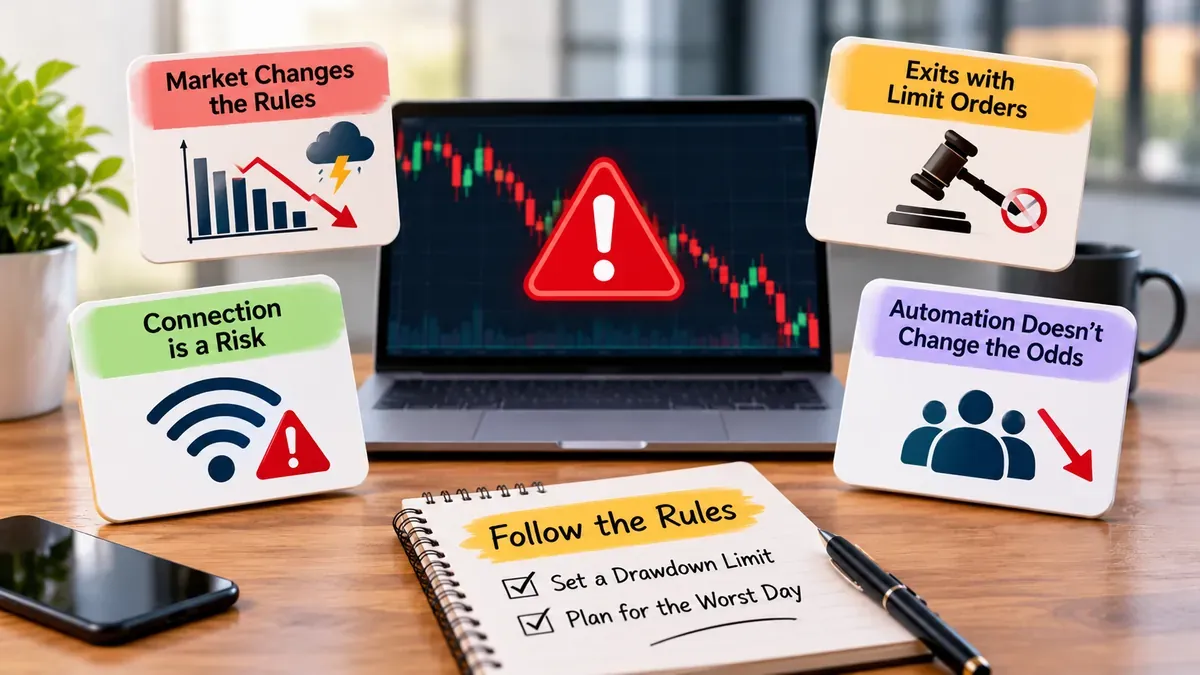
Competitor lists stop at technology, cost and coding. Those are real, but four things we see more often in practice never make it onto them.
The market changes the rules on you
An algo does not know what regime it is in. A strategy that sells premium on expiry day does well in a quiet, range-bound session and badly when volatility jumps and the move keeps going. That is not a bug in the code. It is the strategy doing exactly what you told it to do on the wrong kind of day. In our own log of 163 expiry sessions, the median position gave back 42.8% of its intraday profit peak by the close, and roughly 30% of the sessions that were profitable at some point finished red. We publish that, with the uncomfortable parts left in, on our page is algorithmic trading profitable, using our own data. The practical lesson: size the book for the bad day, not the average day, and put a daily loss limit in the code, not in your head. If you want to see how much premium you can afford to risk in a given volatility regime, we work through it in the India VIX short strangle premium budget.
Exits that are not allowed to be market orders
The exchange framework does not allow algo orders to go in as plain market orders. NSE's FAQ, which we summarise on our SEBI algo trading rules page, restricts market-type algo orders, and in commodities it also restricts IOC orders. For a seller this changes how you write a stop. A stop that fires into a thin book as a limit order can simply not fill, and a limit set too tight leaves you short through the very move you were trying to escape. Build exits as limits with a sensible buffer, test how they behave in a fast market, and know what your platform does when the limit is not hit. Our notes on trailing stop-loss on short options cover the mechanics.
Your connection to the broker is also a risk
Three separate things can go wrong between your code and the exchange, and each looks different. Stale or wrong data gives a perfectly logical order on a bad number. An API timeout or a broker-side rejection means the order never reaches the market, and you only find out if you are checking. And the API key itself is a credential: anyone who gets it can place orders from your account, which is why the framework ties it to a whitelisted static IP and bans open APIs. Keep keys out of shared files and chat messages, and rotate them if you ever paste one somewhere you should not have. If you are choosing how to connect, our comparison of broker APIs for algo trading in India covers what each one does and charges.
Automation does not change the base rate
SEBI's July 2025 study of the top 13 brokers found that about 91% of individual traders in equity derivatives lost money in FY25, with net losses of roughly ₹1.06 lakh crore (see Business Standard's report on the study). That figure covers all individual F&O traders, not only algo users, so do not read it as "algos lose 91% of the time". Read it as the background. The market was already hard to beat before you wrote a line of code, and an algo only changes how you execute, not whether the rule has an edge. A bad rule run perfectly is still a bad rule.
Following it is harder than building it
Every system has a drawdown. The ones that survive are usually not the best strategies, they are the ones whose owners decided in advance how much loss they could sit through and then actually sat through it. The common failure is stopping a sound system in the middle of a normal losing patch, or overriding single trades until the live record no longer matches the test. Write the maximum drawdown you will tolerate before you go live, and treat that number as a rule, not a feeling.
Algo trading versus manual trading: where each one loses
| Factor | Algo trading | Manual trading |
|---|---|---|
| Rule discipline | Follows the rule every time, including the bad ones | Drifts when the day gets uncomfortable |
| Speed and multi-leg entries | All legs go in within a second | Slower, and legs get filled one by one |
| Handling a day nobody planned for | Does nothing sensible unless you coded for it | Can read the situation and step aside |
| Silent failure | A missed trade or stuck order can go unnoticed | You see your own screen |
| Setup cost and time | Testing, a VPS or static IP, monitoring | Almost none |
| Compliance | Strategy tagging, whitelisted IP, API-only routes | Standard order entry |
Neither wins every row. If you are a rule-based seller who keeps overriding your own plan, automation fixes a real problem. If your edge lives in judgement, forcing it into code usually makes it worse.
How to cut each risk before you fund it
- Paper trade first. Run the exact system with no money for several expiries and compare the fills to your backtest. Our guide to paper trading an option selling algo shows what to compare.
- Test with costs and slippage on every leg. Brokerage, exchange charges, STT on the sell side, stamp duty and GST should all be in. What a backtest can and cannot prove explains why a clean curve is not evidence on its own.
- Hard caps in the code. A maximum order size, a maximum number of orders per minute, and a maximum daily loss that stops the strategy for the day.
- A kill switch you can reach from your phone. You should be able to square off and stop new orders without opening a laptop.
- Alerts for what did not happen. Notify yourself when an entry was due and did not fire, when a leg is unhedged, and when open lots do not match the rules.
- A fixed-IP VPS. It handles the power cut, the Wi-Fi drop and the static-IP requirement together.
- Start small and size up slowly. A lot you can afford to lose on a day the algo is wrong is the only lot size that makes sense at the start.
The Bottom Line — Disadvantages of Algo Trading

Algo trading is a very effective and efficient method of trading but has some disadvantages too, and you can face the risk of financial losses if you're thinking about algo trading software without seeking any expert advice or help. Therefore, seeking help from experts, constant cross-checks on algorithms, and proper testing before the execution of live trade is highly recommended.

None of this is an argument against automation. It is an argument for going in with the costs priced in rather than discovering them with live money. Use backtested algo trading strategies with costs and slippage modelled, paper trade the setup before you fund it, and make sure your execution meets SEBI's algo trading rules, which have been fully in force since 1 April 2026 — the static IP and Strategy ID requirements are not optional any more. If you would rather use a system that has already been through this, look at EliteAlgo's NIFTY and SENSEX option-selling strategies, or read how the index algos are set up in Nifty and Sensex algo trading.
Frequently Asked Questions:
What are the risks of Algo Trading?
While algo trading can be a great option for a wide audience, there are always lies some risks.
Buggy Software/Algorithm: All software is always at risk of some bugs embedded in the code that compromises the quality of the software. Algo trading software sometimes may contain logical errors in the code that result in improper implementation of the trade order. And this is one of the biggest risks in algo trading because despite rigorous testing and monitoring of algo, accidental errors, and bugs may still cause algo to work properly sometimes.
Technical Issues: Algo trading can be easily affected if one or another technological end malfunctions, as Algo trading completely relies on technology. There could be many reasons, like loss or unstable connection, hardware failures, integration issues with third-party vendors, etc.
Quick Losses: Losses can happen more quickly with algo trading if your algo trading system doesn't have a strong backbone. Any of the above factors can cause more losses because you have limited control while algo trading.
Is algo trading a good or a bad option in 2026?
Algo trading is a better way to execute a strategy you already trust. It removes hesitation, kills manual entry errors, and enforces your stop and position size on every single trade — genuinely hard to do by hand on an expiry-day option position.
What it does not do is make a losing strategy profitable, and it does not reduce market risk. Volatility hits an automated position exactly as hard as a manual one; only execution improves. So it is a good option in 2026 if your rules are tested out-of-sample and you have priced in brokerage, slippage and the static-IP setup now required — and a bad one if you are automating something you have not validated, because then automation just loses money faster and more consistently.
What is the biggest disadvantage of algo trading in India right now?
Over-optimisation, by some distance — it is the only item on the list that gives you no warning signal. Every other problem announces itself; a strategy fitted to historical noise just hands you an excellent backtest and then underperforms for months before you can be sure why. Second is the gap between backtested and real fills, which most beginner backtests do not model at all. Third, and newest, is the April 2026 compliance setup. All three are covered in detail above.
Can retail traders make money with algo trading?
Some do, but automation is not the reason. An algo only executes a rule, so whether you make money depends on whether the rule has an edge after brokerage, STT, slippage and the cost of the setup.
SEBI's July 2025 study found that about 91% of individual equity-derivatives traders lost money in FY25. That covers all individual F&O traders, not only algo users, but it is the background any retail algo trader starts from. Test with costs included, paper trade, and start small.
Is algo trading safe?
It is as safe as the rules, code and limits behind it. The main dangers are a bug that repeats at machine speed, a strategy fitted too tightly to past data, and a silent failure that nobody notices.
You reduce them with paper trading, order-size and daily-loss caps, a kill switch and alerts. Algo trading by itself does not protect you from market risk.
Is algo trading better than manual trading?
It is better at following a fixed rule, entering several legs quickly and ignoring fear on a bad day. It is worse at handling a situation nobody planned for, and it can fail without telling you.
If you keep overriding your own plan, automation helps. If your edge is judgement, forcing it into code usually hurts.
What happens if my internet or server fails while an algo trade is open?
The position stays open at the exchange, but your code cannot manage it. That is why serious setups run on a fixed-IP VPS, keep a broker-side stop where the product allows it, and send an alert if the system stops responding.
Know in advance how you will square off by phone or from the broker app.
Is algo trading legal for retail traders in India?
Yes. SEBI's retail algo framework (circular of 4 February 2025) has applied to all stock brokers since 1 April 2026. Orders go through a broker API, carry an exchange-issued identifier, and come from a whitelisted static IP. A self-coded algo under 10 orders per second does not need exchange registration of its own.
Read how SEBI's algo trading rules work now that they are live for the detail.