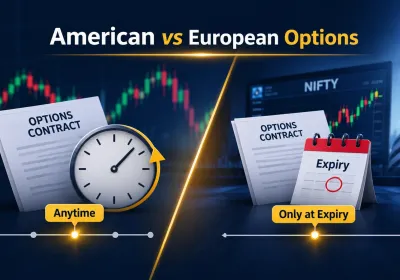
Intraday option trading means two different jobs, and most pages online describe only one of them. The buyer pays premium and needs the index to move far and fast. The seller collects premium and needs it to stay inside a range. Same screen, same contracts, opposite risks.
Almost every page that ranks for this topic is written for the buyer. This one covers the other side: how a systematic desk thinks about selling NIFTY and SENSEX options inside a single session. EliteAlgo is a proprietary desk in Delhi, trading since 2006, so the points below are about how rules get built, not about what you should do with your money.
Paper trade every rule in this article first. Nothing here is a tip, a signal or a promise of return. It is research and analytical software, not investment advice.

Intraday option trading: buyers and sellers play different games
A buyer of an option pays a fixed premium. The worst case is that the whole premium goes to zero, and the upside has no ceiling. That sounds friendly until you see the odds: the option has to move enough, soon enough, to beat the time decay that runs against the buyer from the first minute.
A seller takes the opposite side. The premium comes in on day one. The top outcome is keeping all of it. The worst case is large, because a short option loses more as the index runs against it. So the seller's whole craft is about limiting that worst case before it happens.
This difference changes every decision. A buyer asks, "Where will the market go?" A seller asks, "Where will it not go, and what do I do if I'm wrong?" The second question is why a seller's plan reads like a risk manual and not like a prediction.
It also changes what a good day looks like. A buyer's good day is one large move. A seller's good day is boring: the index drifts, premium melts, and the position is closed with a small gain. A seller who wants excitement is usually breaking a rule.
Here's one more point that rarely gets said plainly. Selling is not the safe side and buying is not the risky side. They carry different shapes of risk. The buyer risks the premium with high probability. The seller risks a large loss with lower probability. According to SEBI's published study on individual traders in equity derivatives, a large majority of individual F&O traders lost money over the period it examined, and that covers buyers and sellers alike. Read the study itself on the SEBI website before you form a view about who wins.
What "intraday" adds to the picture
Intraday means the position is opened and closed on the same day. No overnight gap risk, and no margin carried into the next session. For a seller that matters a great deal. The risk of a gap against a short position is the one a stop-loss cannot fully protect, because a stop only works if the market trades through your price on the way. A gap skips it.
The price of that safety is time pressure. You have roughly 6 hours and 15 minutes of market, from 9:15 AM to 3:30 PM IST, and every rule has to fit inside it. That is the frame for the rest of this piece.
Why sellers prefer the decay of the last sessions
Time value is the part of a premium that reflects the chance of finishing in the money. It reaches zero at expiry. So on the final day of a contract, a lot of value has to disappear within a single session. That is the whole attraction of expiry-day and weekly-contract selling.
But the decay is not a straight line, and this is where beginners get caught. The desk studied this on 62 NIFTY expiry sessions and 62 SENSEX expiry sessions, and published the full method in its NIFTY expiry-day premium clock. According to that study, the median at-the-money straddle on NIFTY still held 91% of its 9:20 AM value at 10:00 AM. It held 49% at 2:00 PM and 23% at 3:00 PM.
Read those three numbers slowly. After 40 minutes, about 9% of the value was gone. Most of the fall came in the afternoon. A seller who expects the morning to do the heavy lifting will sit through hours of small movement and big risk for a modest reward.
The same study showed the other edge of the blade. The median session had a late-afternoon rise of about 11% of the opening straddle value, and the largest was 41%. Decay is real, but so is the late spike. A short position in the last hour earns the most per minute and also hurts the most per minute.
That is why many sellers like the weekly contracts. Nifty weekly options expire on Tuesday on NSE, and Sensex weekly options expire on Thursday on BSE, per the exchanges' current contract specifications. Exchanges change expiry days with notice, so check the specification in force before building a week around a weekday.
Decay versus risk: the trade you are really making
A short option's profit is the decay. Its risk is the index moving through your strike. Near the close, the same fact that makes decay fast also makes your option's price swing sharply on small index moves. Traders call this gamma, and it is the reason a short position that looked comfortable at 2:30 PM can look terrible at 3:10 PM.
So the choice is not "sell and wait". The choice is how much of that curve you want to be exposed to, and for how long. Every other section below is a way of answering it.
Choosing the entry time, and why the first minutes are skipped
The market opens at 9:15 AM IST. Many sellers would love to enter at exactly that minute, because there is more premium on the table than at any other time. The desk does not, and the reason is practical.
The opening seconds are thin. Quotes jump around, spreads are wide, and a backtest that assumes a fill at the 9:15 price is assuming something the live market may not give you. For that reason the desk's rule is that no leg is entered before 9:16 AM, with the order filled at the open of that minute and not at a price from the minute before.
That is a rule about honesty in testing as much as about trading. If your simulator fills you at a price you could never have got, every number it reports is flattering. A rule you cannot execute is not a rule.
Three questions to settle before choosing a time
Pick a single entry minute and test it. Do not average over "the morning". A rule with a fixed clock time can be repeated, measured and compared. A rule that says "enter when it looks calm" cannot.
First, how much premium is left at that minute? From the premium-clock numbers above, a 10:00 AM entry still has about 91% of the 9:20 value to work with, so little is lost by waiting 40 minutes for the opening noise to settle.
Second, how much time is left for the position to work? Enter at 1:30 PM and you have two hours, which is short if the first stop gets hit and you want a second try.
Third, what does that minute look like on a typical day versus an event day? Budget days, central bank days and result days behave differently. A fixed rule should say what it does on those days, even if the answer is "stay out".
A note on entering "when volatility is high"
Some sellers prefer to enter after a volatility spike, since premium is richer. The idea is sound, but it needs a measurable trigger, such as India VIX above a level you chose in advance. "It feels expensive" is not a trigger. Check the live India VIX on the NSE website, and write down the number before you place the order, not after.
Stops written before the order
This is the single biggest difference between a seller who lasts and one who doesn't. A stop-loss for a short option is not something you work out while the position is going against you. By then you are paying for your own hesitation. It is written first, in plain numbers, before the order goes in.
There are three common ways to define it, and none is "right".
A multiple of the premium collected. If you sold a leg at 80 points, you might exit if it trades at 160. Simple to state, simple to automate. The risk is that in a fast move the price jumps from 140 to 200 and your exit fills near 200, not 160. Slippage is part of the stop's real cost.
A fixed rupee loss for the day. Work out the loss if every stop is hit: the points lost per leg, times the rupee value per point for your lot size, times the number of lots. Then check that this figure is one you can absorb without changing your plan. Look up the lot size in force on the exchange's contract page, because lot sizes are revised from time to time. Do not copy a number from an old article, including this one.
An index level. You exit when the index touches a price that makes the trade's logic false. This ties the stop to the reason for the trade, but it ignores how much the premium has actually moved.
The part people skip: the stop has to be tested with costs
A stop that looks fine on a clean chart can behave badly in live trading. Test it with slippage, which is the gap between the price you expected and the price you got. On a thin far-out-of-the-money leg, that gap can be several points, which is a large share of a small premium.
And decide in advance what happens after a stop is hit. Do you stop for the day? Do you re-enter once? A written rule such as "one re-entry, then flat" prevents the revenge trade, which is what turns a controlled loss into the day's worst.
Hedges as a stop you cannot argue with
One more option is to buy a far-away option against the short one, so the maximum loss is capped by structure and not by your discipline. It costs premium and lowers margin needs, because exchanges and brokers treat a hedged position as lower risk. Your broker's margin calculator will show the exact figure for the exact structure. Margin changes with the index level and volatility, so no fixed number belongs in an article.
Square-off: broker auto square-off vs your own exit
An intraday position has to end the same day. There are two ways that happens, and they feel very different.
The first is your own exit. You close the trade on your rule, at your time, at a price you chose. The second is the broker's auto square-off. Brokers close intraday positions automatically near the end of the day, and some do it earlier if the account's margin runs short. Each broker publishes its own cut-off time and its own auto square-off charge on its support pages, so read yours and note the date you checked it. Do not assume the time from a forum post.
The difference is simple to state. When you exit, you control the price. When the broker does, the system sends a market order at whatever the market gives. In the last minutes of the day that can be a poor price, especially on a leg that has moved close to the money.
The desk's rule is to be flat well before any broker deadline. Its hard cut-off is 3:20 PM IST for any leg still carrying meaningful exposure, ten minutes before the 3:30 PM close. That is a desk rule and not an exchange requirement. It exists to avoid the last-quarter-hour price spike and the risk of a poor fill in the final minutes. The full reasoning is in the desk's piece on what square off really means for an option seller.
If you hold a position past the close for any reason, understand what happens to it. Index options on NIFTY and SENSEX are cash-settled. No opposite trade is placed for you. The exchange computes a settlement price and every open contract settles at it. Settlement rules are being revised, so read the current exchange notice and not a summary that is a year old.
Square-off timing is a choice with a cost
Closing at 3:20 PM instead of 3:29 PM gives up a little remaining decay. In the premium-clock study the median NIFTY straddle still held about 16% of its 9:20 value at the last one-minute bar. That is value left on the table, deliberately, in exchange for avoiding the worst of the final spike. Whether that trade is worth it is something to test on your own strategy, not something to take on trust.
Costs: brokerage, STT and slippage on small moves
An intraday seller's edge is usually small per trade. A few points on a lot, repeated. That makes costs a bigger part of the story than in any longer-term style. A strategy that makes 12 points before costs and spends 9 on them is a very different business from the pre-cost chart.
Four items matter.
Brokerage. Charged per executed order. Flat-fee brokers charge the same on a 5-point premium as on a 500-point one, so the cost hits cheap far-strike legs hardest. See your broker's current charges page.
Securities transaction tax (STT). Charged on the sell side of options premium, and the rates are set by the Finance Act and carried in exchange circulars. They were revised in recent years, so never trust a number from memory. Check the circular in force, or read the desk's explainer on what sellers get wrong about STT.
Exchange and regulatory charges, stamp duty and GST. Small each, but they stack up over hundreds of orders. Your broker's contract note shows each of them line by line. Read three of them end to end once, and you will know exactly where the money goes.
Slippage. The hidden one. It does not appear on the contract note, only in the gap between your plan and your fill. For a seller using stops, slippage is worst exactly when it matters most: in a fast move, when everyone is exiting at the same time.
How to test whether costs kill an edge
Run the same rule twice in your backtest, once with zero cost and once with realistic cost and slippage. If the result flips from positive to negative, the edge was never real, only a rounding error against the cost line. This is the cheapest test in trading and the one most often skipped.
The methodology is simple: apply the same entry, the same stop and the same exit to every session in your sample, then charge each trade the full cost. Keep a sample of sessions you did not use while designing the rule and test on those last. A rule that only works on the days you tuned it on has learned the past, not the market.
This is also where automation helps. A rule written in code gets the same stop and the same exit every time, and the cost is applied to every trade. For how the desk thinks about that, see the overview of NIFTY and SENSEX algo trading.
Putting the pieces into one written plan
Pull the sections together and a one-page plan has only a few lines:
- Instrument and contract: NIFTY or SENSEX, weekly or monthly, and which expiry day.
- Entry: a fixed clock minute, never before 9:16 AM, with a volatility condition written as a number.
- Structure: naked or hedged, and the margin your broker shows for it.
- Stop: the number, the type, and what happens after it hits.
- Exit: a time well before any broker auto square-off, such as 3:20 PM IST.
- Costs: brokerage, tax and slippage built into the test.
- Daily limit: the most you will lose in one day, after which you stop.

If you cannot fill every line with a number, the plan is not ready, and that is a good thing to find out on paper and not on a live order.
Then paper trade it. Run it on live prices without money for a few weeks, log every fill, and compare the fills with what the backtest assumed. The gap between the two is what real trading will cost you in addition to everything else.
Frequently Asked Questions
Is intraday option trading profitable?
It depends on the person and the rules, and no article can promise it. SEBI's study of individual derivatives traders reported that most lost money over the period it examined. A rule that survives realistic costs and out-of-sample testing is the minimum bar, and even that does not guarantee future results.
What is a sensible time for intraday option selling?
There is no single right minute. The desk skips the first minute after 9:15 AM because fills there are unreliable, and tests fixed clock entries after that. According to the premium-clock study, the median NIFTY straddle had lost only about 9% of its 9:20 AM value by 10:00 AM, so the morning is not where most decay happens. Paper trade any time you choose before using it live.
Do I need margin for intraday option selling?
Yes. Selling an option needs margin, and the amount changes with the index level, volatility and the structure. A hedged spread blocks much less than a naked short. Use your broker's margin calculator for the exact structure, since any fixed number in an article goes out of date.
What happens if I don't square off an intraday option position?
If the product is intraday, your broker will usually close it automatically near the end of the day and may charge a fee. The price can be poor because it is a market order in the last minutes. If you hold a deliverable-type position into expiry, NIFTY and SENSEX options are cash-settled by the exchange. Read your broker's auto square-off policy and note the date you read it.
Is intraday option selling safer than buying?
Not safer, only different. The buyer risks the premium and loses it often. The seller wins small often and can lose a lot on a bad day. Stops written in advance, a hedge or a daily loss limit are what reduce the seller's risk.
How many trades a day is too many?
Set the number before the day starts. Many rule-based sellers allow one entry and at most one re-entry per index per day, since each extra trade adds cost and slippage and tends to follow a loss. Pick your own limit, test it, and never raise it in the middle of a losing session.
Paper trade first. EliteAlgo trades proprietary capital only. This article describes how a systematic desk works, as research and analytical software. It is not investment advice, and it is not a recommendation to trade any contract.