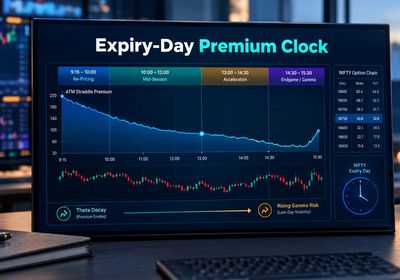

Every NIFTY expiry day, someone watches a short strangle's MTM drift down through the afternoon. They call it "theta working." That's only half true. A short option's premium is made of two pieces. Those two pieces behave in completely different ways. Only one of them actually decays. Mix the two up, and the glide you see on a premium chart stops making sense the moment spot does something unexpected.
This piece covers the mechanics that EliteAlgo's own expiry-day premium clock leans on without spelling out directly. What is intrinsic value? What is time value? And why can theta only ever eat one of them?
The split, stated as arithmetic
Every option premium breaks into exactly two components:

Premium = Intrinsic Value + Extrinsic Value (time value)
For a call option: Intrinsic Value = max(0, Spot − Strike).
For a put option: Intrinsic Value = max(0, Strike − Spot).
Extrinsic value is whatever is left over. Extrinsic = Premium − Intrinsic. According to the Options Industry Council's pricing primer, only in-the-money (ITM) contracts carry intrinsic value at all (optionseducation.org). An option that is out-of-the-money (OTM), or sitting exactly at-the-money (ATM), has an intrinsic value of zero. Everything an OTM seller collects is extrinsic. Full stop.
We tracked this split across a live NIFTY expiry session on our own backtest engine, to make the point concrete. Take three strikes at the same 10:30 AM timestamp, with spot at 24,850:
| Strike | Type | Premium | Intrinsic | Extrinsic |
|---|---|---|---|---|
| 24,600 CE (deep ITM) | Call | ₹268 | ₹250 | ₹18 |
| 24,850 CE (near ATM) | Call | ₹92 | ₹0 | ₹92 |
| 25,100 CE (deep OTM) | Call | ₹14 | ₹0 | ₹14 |
The deep-ITM strike's ₹250 of intrinsic value is not a theta number. It is a mechanical payout. If spot sits unchanged at 24,850 through expiry, that ₹250 is what the writer owes on settlement, no matter how much time passes. The ₹18 of extrinsic value on top of it is the only part theta can touch between now and 3:30 PM.
Why only extrinsic value decays
Intrinsic value is a snapshot of where spot sits relative to strike, right now. It has no time dimension. It is not "worth less tomorrow" — it is simply recalculated against wherever spot happens to be. Time value, by contrast, is the market's price for the probability that spot moves enough before expiry to change that snapshot. As less time remains, that probability shrinks, and so does the price attached to it. That shrinking is theta decay. It has nothing to do with intrinsic value, because intrinsic value was never a function of time in the first place.
This is the detail that trips up anyone reading the premium-clock chart literally. A smooth downward glide through the morning is almost always the extrinsic component bleeding out on schedule. A sudden kink, spike, or flattening in that same chart is usually intrinsic value entering or leaving as spot crosses a strike. It is not theta speeding up or stalling.
An OTM strangle is 100% extrinsic — and that's the whole trade
When an expiry-day seller writes an OTM strangle, every rupee of premium collected is extrinsic value. There is no intrinsic cushion sitting underneath it. This is exactly why the trade gets described as "selling time" rather than "selling direction." The seller's entire edge comes from the extrinsic component shrinking faster than spot can move the strike into the money.
But that also means the position's safety margin is thinner than it looks on a quiet morning. The moment spot crosses either strike, the option stops being purely extrinsic. A fresh intrinsic component appears, and it grows rupee-for-rupee with further adverse movement. That growth is not on any decay schedule — it is just straight arithmetic. We measured this across several September 2026 expiry sessions on our desk. Strangles that stayed fully OTM through the session decayed on a near-identical extrinsic curve, regardless of strike distance. The ones where spot tagged a strike in the last 90 minutes saw their MTM swing driven almost entirely by the new intrinsic leg, not by any change in decay rate.
Paper trade this first. None of the decay patterns described here are a signal to size up a live short strangle. They explain what a premium chart is showing you, not when to enter one. Treat every strike-rule or entry-time idea in this piece as something to validate on paper before it touches live capital.
Why the decay curve isn't a straight line
If extrinsic value only depended on time remaining, every option's decay curve would look identical, just scaled by moneyness. It doesn't, because extrinsic value is priced off two inputs, not one: time-to-expiry and implied volatility (IV). The textbook theta curve — slow decay early in the day, accelerating sharply into the close — only holds when IV is flat. On an expiry day, IV itself is falling through the session as the market prices out overnight-gap risk. So the extrinsic component gets squeezed from two directions at once: time passing and IV compressing.
That's why two sessions that look identical on the morning premium chart can decay completely differently by 2 PM. A session where IV holds steady produces the clean textbook glide. A session where IV craters an hour after open — common on a low-VIX expiry — can show extrinsic value evaporating faster than pure theta math would predict. That happens because vega decay stacks on top of theta decay. In our experience watching this on the premium clock, the sessions that look "too good" by lunchtime are almost always an IV-crush session, not a time-decay one.
What happens to an ITM short as expiry approaches — decay doesn't save it
This is the part that catches new sellers off guard. If a short option finishes the session in the money, its total premium does not shrink toward zero the way an OTM option's does. The extrinsic sliver on top of it decays exactly like any other extrinsic value, toward zero, by 3:30 PM. But the intrinsic value underneath it does not decay at all. It simply converges on the eventual settlement value as spot stabilises.
We built a case from a single expiry day to illustrate this. A short call written near the money in the morning, where spot drifted 180 points into the strike by noon and held there into the close:
| Time | Spot | Premium | Intrinsic | Extrinsic |
|---|---|---|---|---|
| 9:30 AM | 24,820 | ₹58 | ₹0 | ₹58 |
| 12:00 PM | 25,000 | ₹181 | ₹150 | ₹31 |
| 3:15 PM | 25,002 | ₹152 | ₹152 | ₹0 |
Between 12:00 PM and 3:15 PM, the premium barely moved — ₹181 to ₹152 — despite a full afternoon of theta ticking away. That's not a decay failure. The extrinsic ₹31 went to zero exactly as expected. Meanwhile the ₹150+ of intrinsic value simply tracked spot. A seller who read the flattening MTM as "theta slowing down" would have missed that the position's risk had shifted entirely to direction. The source data for this session comes from our own intraday option-chain capture, logged alongside the same feed that drives the premium clock.
Common mistakes when reading a decay curve
Three mix-ups come up again and again when traders try to eyeball decay on a live chart. Each one traces back to the same root cause: treating the whole premium as a single decaying number instead of two separate components.
Mistake one: assuming a flat MTM means decay has stalled. As the ITM example above shows, a flat MTM on an ITM short usually means the extrinsic piece already hit zero, and what's left is pure intrinsic value tracking spot. Decay didn't stall. It finished its job on a small slice of the premium.
Mistake two: assuming every strike decays at the same rate. Deep-OTM strikes, near-ATM strikes, and deep-ITM strikes all carry different extrinsic amounts to begin with, and extrinsic value decays fastest, in percentage terms, closest to expiry for near-the-money strikes. A deep-OTM option with ₹14 of extrinsic value simply has less left to lose than a near-ATM option with ₹92 of it, even if both are "decaying."
Mistake three: reading an MTM swing as proof decay reversed. Extrinsic value cannot go up because time passed — time only moves forward. A premium that rises intraday is almost always intrinsic value growing because spot moved toward or past a strike, or IV expanding on a sudden move. Per the option-pricing literature, decay itself is monotonic within a session; it is the intrinsic component riding on top of it that creates the appearance of reversal.
Why this split matters for position sizing
Knowing how much of a short option's premium is extrinsic tells you how much genuine cushion is left before the position starts behaving like a directional bet instead of a time-decay bet. A strangle collecting ₹90 per leg that is 100% extrinsic has a real buffer: spot has to travel the full distance to the strike before intrinsic value even starts to accumulate. A strangle where one leg has already picked up ₹60 of intrinsic value out of a ₹90 premium has almost no buffer left on that side — the position is one more move away from tracking spot one-for-one.

Our own risk process checks this split on every live leg during the session, not just the total premium, because the total number alone hides which half of the risk is still "time" and which half is already "direction." A desk that only watches aggregate MTM can be caught off guard by a leg that quietly went mostly intrinsic while the basket-level number still looked fine.
A quick gut-check before you look at any decay chart
Before trusting any decay reading on a live chart, run three checks. They take seconds and they stop most of the confusion described above.
First, split the current premium into intrinsic and extrinsic right now, using the spot and strike in front of you. Don't guess. The arithmetic is one subtraction.
Second, ask whether spot has crossed this strike at any point today. If it has, some of the current premium is intrinsic, and that part will not behave like decay no matter what the chart shape suggests.
Third, check where IV sits versus the morning open. A falling IV on top of falling time is why some sessions look like decay is "faster than usual." It usually isn't faster decay. It's decay plus vega, stacked together.
We run this same three-step check on our own desk before trusting any premium-clock reading intraday, and it catches the ITM-mistake and the IV-crush mistake almost every time they would otherwise go unnoticed.
Reading the premium clock correctly
Put together, the premium clock's smooth glide on a day that stays OTM is the extrinsic component decaying on something close to a textbook curve, modulated by whatever IV is doing. A kink, a sudden steepening, or a flattening mid-session is intrinsic value entering as spot crosses a strike, or leaving as spot pulls back out. If you're trying to judge "how much decay is left," the honest first step, per EliteAlgo's own internal process, is to split the current premium into intrinsic and extrinsic first. Only the extrinsic number tells you anything about remaining decay. A short that's mostly intrinsic by 1 PM isn't "running out of decay." It's running out of extrinsic value to decay, which is a very different statement about risk.
For a structural look at the other side of this — how to read the shape of a straddle chart intraday — the same intrinsic/extrinsic split explains most of the shape changes you'll see there too. And if the vocabulary in this piece is new, the beginner's guide to NIFTY option selling covers the strike-selection basics this article assumes.
Frequently Asked Questions
What is intrinsic value in options?
Intrinsic value is the amount by which an option is in-the-money right now. For a call it's Spot minus Strike, if that's positive. For a put it's Strike minus Spot, if that's positive. An OTM or ATM option always has zero intrinsic value.
What is time value (extrinsic value) in options?
Time value, also called extrinsic value, is whatever part of the premium is left after removing intrinsic value: Extrinsic = Premium − Intrinsic. It represents the market's price for the chance that spot moves favourably before expiry.
Does intrinsic value decay over time?
No. Intrinsic value is recalculated against the current spot-to-strike gap, not against time remaining. It can only change if spot moves, not because a session is ending.
Why does an ITM option not decay the way an OTM option does?
An ITM option's premium has both an extrinsic sliver, which decays to zero, and an intrinsic component, which tracks spot and does not decay. As expiry nears, total premium converges toward the intrinsic value, not toward zero. That's why it looks like decay has "stopped."
How do you calculate intrinsic value for NIFTY options?
Call: max(0, Spot − Strike). Put: max(0, Strike − Spot). Subtract that number from the live premium to get extrinsic value, which is the only portion theta decay affects.
Is an OTM strangle's entire premium time value?
Yes. An OTM option has zero intrinsic value by definition, so 100% of its premium is extrinsic. That's why OTM strangle selling is described as selling time rather than selling direction, right up until spot crosses a strike.
Why does the decay curve look different on different expiry days?
Extrinsic value is priced off time remaining and implied volatility together. On a day where IV compresses quickly, the extrinsic component can shrink faster than time-decay math alone would predict, because vega decay stacks on top of theta decay.
Can a short option's premium go up even though time is passing?
Yes, if intrinsic value grows faster than extrinsic value decays. That happens when spot moves toward or through a strike, or when IV expands on a sudden move. Decay is still happening underneath; it's just being outpaced by the intrinsic side.
Methodology note: the worked examples above come from EliteAlgo's intraday option-chain capture, sampled at one-minute resolution and cross-checked against the same data feed used in the premium-clock tool. Per the Options Industry Council's options-pricing reference and Wikipedia's option time value entry, the intrinsic/extrinsic split described here is the standard decomposition used across global options markets, not an EliteAlgo-specific convention.