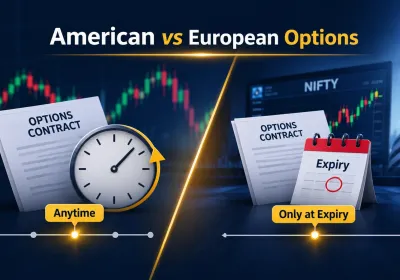
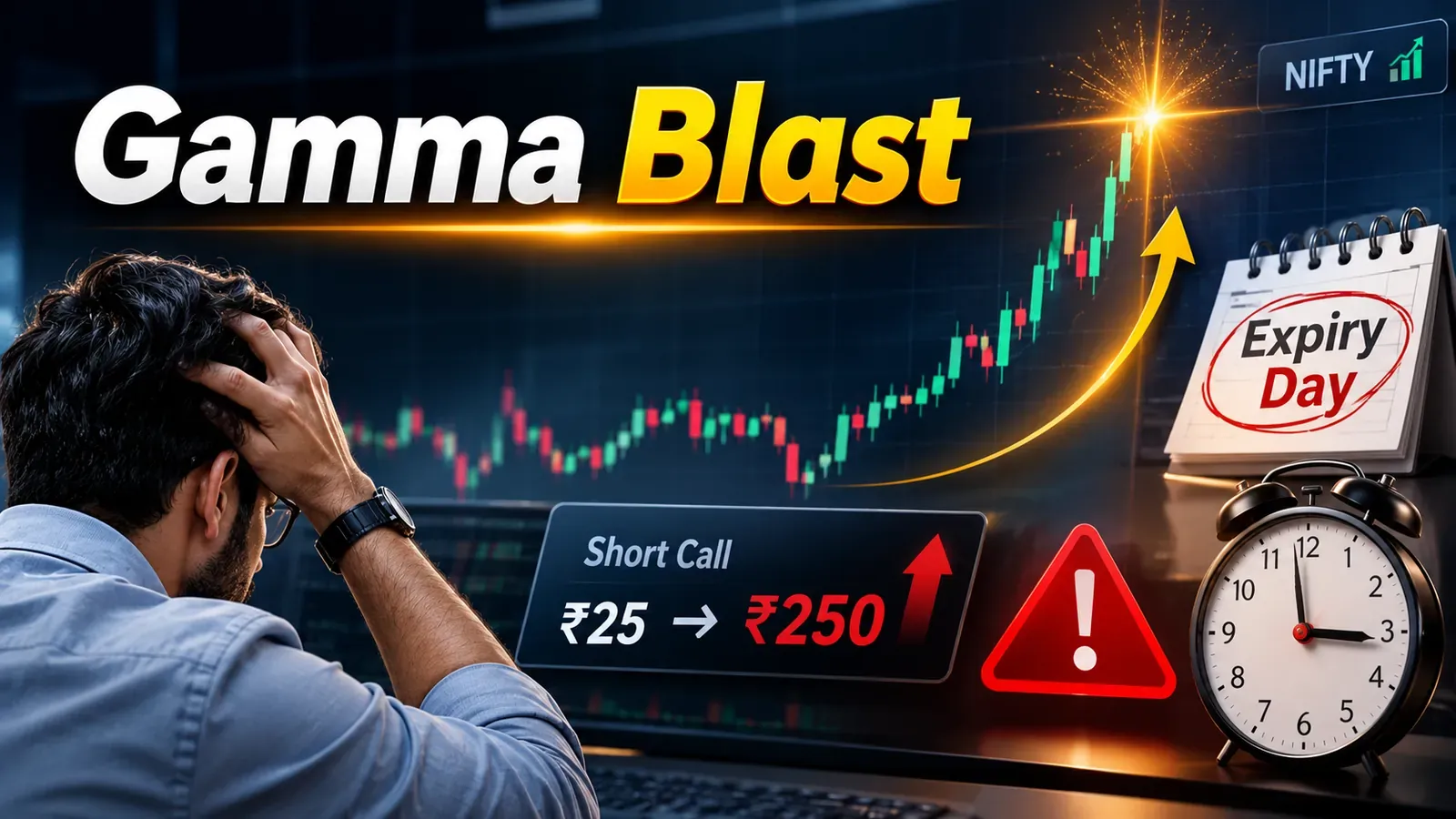
Search for "gamma blast" and you'll find videos, scanners and a few indicator scripts. Almost all of them are written for the buyer. A cheap out-of-the-money option, a late move in NIFTY, and a premium that goes from ₹2 to ₹60. The pitch is simple: small risk, huge reward.
The mechanics behind that story are real. The story itself leaves out half the trade. For every buyer holding a ₹2 option that explodes, someone sold it at ₹2 and now holds a loss many times larger than the premium they collected. If you sell options on NIFTY or SENSEX, that second person is you. This article explains the mechanics in plain English, runs one worked example, and then looks at the seller's side: stops, size, and the last hour of the day.
Paper trade this first. Every rule, time and threshold below is an explanation of how the numbers behave, not a recommendation. Test anything you take from here on paper before it goes near live capital. EliteAlgo is analytical software and research, not investment advice.

What people mean by "gamma blast"
"Gamma blast" isn't a term from an exchange rulebook or a textbook. It's trader slang. It describes a sudden, sharp rise in the price of a near-the-money option late on expiry day, usually when the index makes a quick move toward a strike that looked far away a few hours earlier.
The word "blast" does a lot of work in that phrase. A cheap option doesn't rise because the market suddenly got more volatile in any grand sense. It rises because it has gone from "almost certainly worthless" to "might finish in the money" in a few minutes. Delta, the option's sensitivity to the index, jumps from near zero to something large. The thing that makes delta jump is gamma.
You'll also see "gamma blast" used for the scanners and indicator scripts that try to flag the setup. Chartink and TradingView both host a few. They're worth a look to see what people are watching, but they all share one limit: they can describe a move that already started. None of them tells you which expiry will produce one.
Gamma near expiry, explained without the maths
Start with delta. Delta tells you how many rupees an option's price changes for a one-point move in the index. A call with a delta of 0.50 gains roughly ₹0.50 when NIFTY rises by one point. A call with a delta of 0.05 gains roughly ₹0.05.
Gamma is the rate at which delta itself changes. If gamma is high, a small move in the index changes delta a lot, which means the option's price starts moving faster with each additional point. According to Zerodha Varsity's chapter on gamma, it is the rate of change of delta, and the chapter walks through how it behaves as expiry gets closer.
Two things drive gamma:
- Distance from the strike. Gamma is highest when the index is at or very near the strike. Far away, in either direction, it's small.
- Time left. Gamma at the at-the-money strike keeps rising as expiry approaches. With hours left, the peak is a gentle hill. With minutes left, it becomes a narrow spike.
Put those together on expiry day and you get the situation traders are describing. By the afternoon, strikes that are comfortably away from the index have almost no gamma, so their prices barely react. The strikes right at the index have enormous gamma, so each point of movement shifts their delta quickly. The boundary between "dead" and "alive" is thin, and it moves with the index.
For a longer treatment of how all the Greeks behave on the day itself, see our guide to option Greeks on expiry day. This article only needs the one idea: gamma gets concentrated at the strike nearest the index as the clock runs down.
Why a 50-point move can multiply a cheap option
Words only go so far, so here's a worked example. It uses the standard Black-Scholes formula with a flat 15% implied volatility and zero interest rate. Those are simplifying assumptions, and the numbers are model outputs, not market quotes. Real prices will differ because of skew, bid-ask spreads, tick size and how implied volatility behaves intraday. The point is the shape, not the decimals.
Setup: NIFTY is at 24,000 (a round hypothetical number). Consider a 24,100 call, 100 points out of the money, on expiry day.
| Time (IST) | Time left | Model price of 24,100 call | Delta |
|---|---|---|---|
| 9:15 | about 6.25 hours | ₹7.5 | 0.15 |
| 11:30 | 4 hours | ₹3.5 | 0.10 |
| 13:30 | 2 hours | ₹0.7 | 0.03 |
| 14:30 | 1 hour | ₹0.1 | 0.005 |
By 14:30 the option is, in the model, nearly worthless. That's what traders mean by a "cheap" option: ₹0.10 to ₹2, depending on how the market is pricing the tail.
Now let the index move while that hour is still on the clock. Same option, 14:30, same volatility assumption:
| NIFTY at 14:30 | Distance to 24,100 strike | Model price |
|---|---|---|
| 24,000 | 100 points below | ₹0.1 |
| 24,050 | 50 points below | ₹1.8 |
| 24,100 | at the strike | ₹15.4 |
| 24,150 | 50 points above | ₹51.8 |
A 50-point rally takes the option from ₹0.1 to ₹1.8. A 100-point rally takes it to ₹15.4. A 150-point rally takes it to ₹51.8, which is a gain of several hundred times on the starting price. Nothing about the option changed except where the index sits relative to the strike. That's gamma, doing exactly what it says.
Two caveats matter here, and neither shows up in the hype.
First, those percentage gains are measured from a price so small that rounding dominates them. A ₹0.10 option can't really trade at ₹0.10 on screen; the exchange has a minimum tick, and the quote you can actually fill is whatever the order book offers. Treat "500x" claims with suspicion, because the denominator is partly fiction.
Second, the same table works in reverse. Look at the 24,050 row at 14:30 and imagine the index had been at 24,150 an hour earlier. The option was worth far more then, and it decayed to almost nothing as the index drifted back. The model that produces the jackpot also produces the wipe-out. Gamma and theta (time decay) are two sides of the same coin: the option that can multiply quickly can also lose its entire value quickly.
The seller's side of the same move
Pick the same option and flip your position. You sold the 24,100 call at ₹2 in the early afternoon, thinking NIFTY was at 24,000 with a long way to go. You collected ₹2 per unit. You think of it as nearly free money.
Then NIFTY runs to 24,150. The option is at ₹51.8 in the model. You're down ₹49.8 per unit against a ₹2 gain you were hoping to keep. The ratio of potential loss to potential gain on that trade was never small. It only looked small because the loss needed a move that hadn't happened yet.
This is the core asymmetry of selling options near expiry:
- The premium you collect gets smaller every minute, because time decay is front-loaded into the last hours.
- The loss you can take on a fast move gets larger relative to that premium, because gamma is rising.
- Your probability of keeping the premium goes up, but your exposure on the unlikely day goes up faster.
That is why sellers describe the last hour of expiry as a different trade from the morning. In the morning, you're selling time with plenty of room. In the afternoon, you're selling a small amount of money against a position that behaves like a coiled spring. It's the same strike and the same lot, with a very different risk profile.
Our piece on the NIFTY expiry-day premium clock looks at how option premium drains through the session. The short version is that most of the decay has happened by early afternoon, which means the money left to collect is small just as the risk per point is at its highest.
The straddle is the cleanest example. A seller of an at-the-money straddle holds both a call and a put at the same strike, so there's gamma exposure on both sides and the index only has to move far enough in either direction. We cover the structure in short straddle explained. If that structure is new to you, read it before you think about selling anything close to the money late in the day.
Stops, size and the last hour
This section is about process, not prediction. Nobody can tell you at 14:30 whether today is the day the index runs. What you can control is what happens to your account if it does.
Decide the exit before you enter
A stop that is chosen after the position is losing is usually a hope with a number attached. Write the rule down first. It can be a premium multiple (exit if the option reaches a set multiple of the sale price), an index level, or a time. Which one you use matters less than having one that was set while you were calm.
A word on the mechanics of exits: not every order type does what its name suggests on an index option. Stop-loss orders can be rejected, can fill far from the trigger in a fast market, or may not be available for certain contracts. Check your own broker's current order-types page and test it on a paper account. Our article on bracket orders versus coded stops for option sellers compares the options sellers actually have.
Size for the bad day, not the average day
Position size is the decision that gamma punishes most directly. A simple test: take the largest single-day index move you want to survive, assume the option you sold goes to the model value at that point, and ask what that loss is as a share of your capital. If the answer is a number you wouldn't accept, the position is too big, whatever the premium looks like.
Don't carry lot sizes, margin figures or freeze limits from an old article into this arithmetic. They change by exchange circular. Look them up on NSE's website and your broker's margin calculator on the day you plan the trade.
Treat the last hour as its own regime
Many sellers do one of three things as the afternoon runs down:
- Square off short options that are still near the money, accepting that the leftover premium isn't worth the gamma.
- Buy a far, cheap option against the short one so the loss has a ceiling. This costs a little and changes the shape of the position from open-ended to capped.
- Close everything by a fixed clock time, regardless of P&L, so no position depends on a judgment call made under pressure.

None of these is free. Squaring off early gives up premium on the many days when nothing happens. A hedge costs money on every one of those days. A clock exit sometimes closes a position that would have expired worthless. You are paying a small, certain cost for protection against a rare, large one. Whether that trade-off suits you is a decision about your capital and temperament, and it's the part software can help with by making the rule automatic rather than emotional.
Test it on data before it matters
The honest way to settle "should I be short this strike at 14:30?" is to run it through a backtest across many expiries, with slippage and costs included, and look at the worst days as closely as the average. The methodology matters, so for anyone doing that: use the same entry clock and the same exit rule on every day, include the days where the index moved most, and compare the worst single day to the total premium collected. That comparison tells you more than the win rate. The NIFTY and SENSEX algo trading page explains how EliteAlgo approaches rule-based execution on these two indices.
Why chasing it is not a strategy
The mirror image of the seller's problem is the buyer's. Buying a cheap option late on expiry in the hope of a "gamma blast" is a bet on a rare event, and the price already reflects some chance of it. The model table above shows the shape of the payoff: a long run of near-zero outcomes and an occasional large one.
That payoff is a lottery ticket. Lottery tickets aren't illegal or stupid, but they aren't a method either. A method has an edge you can measure, a sizing rule and an exit. "It might blast today" has none of the three.
The wider data on retail option trading doesn't flatter it. According to the regulator's own reports, SEBI has published studies, with data from retail trader accounts, on the profits and losses of individual traders in equity derivatives, and the regulator's own documents are the right place to read the figures, with their dates and definitions, rather than a second-hand number on a video thumbnail. Start from the studies and circulars section of SEBI's website and read the original document.
Option buyers do have reasons to trade expiry day, and a defined-risk long option is a legitimate tool. The comparison of the two sides is covered in option buying versus option selling. What doesn't hold up is the idea that one specific afternoon pattern is a dependable source of income. If it were, the sellers on the other side of it would have stopped selling.
Notice also how the content around this topic is built. The screenshots show the winners. The losing tickets, which are the large majority by count, don't get a thumbnail. That's survivorship bias in its plainest form, and it's the reason a bare "how to catch a gamma blast" tip should make you more careful, not less.
A short checklist for expiry-day gamma
If you only take one thing from this article, take the list. It works for sellers and for buyers.
- Know where gamma is concentrated: the strike nearest the index, and it moves as the index moves.
- Remember that the premium for the last hour is small and the exposure per point is large.
- Write the exit rule before the entry, and test it on paper.
- Size so that the worst plausible expiry day is survivable on its own.
- Check broker order types and exchange limits on the day, from the source, not from memory.
- Read the regulator's original studies before you read anyone's summary of them.
For readers who want a reference outside this site, the Options Industry Council's education pages at optionseducation.org explain the Greeks in general terms, and Zerodha Varsity's gamma chapter is written with Indian contracts in mind.
Frequently Asked Questions
What is a gamma blast in options?
It's trader slang for a sharp jump in the price of a near-the-money option, usually late on expiry day, when the index moves quickly toward a strike. The cause is gamma: delta changes fast when little time is left and the index is close to the strike, so each extra point of movement adds more to the option's price than the one before it.
Why does gamma increase on expiry day?
With less time left, the range of prices the index can plausibly reach shrinks. That squeezes gamma into a narrow band around the strike nearest the index. At that strike, gamma keeps rising as expiry approaches. Far away strikes lose their gamma instead, which is why the same cheap option can be dead at one index level and alive at another.
Can option sellers protect against a gamma blast?
They can limit it, not remove it. Common tools are a written exit rule, a smaller position, a far-out-of-the-money option bought to cap the loss, and a fixed clock time to close. Each costs something in lost premium. Test your own version on paper and in a backtest that includes costs and slippage before you rely on it.
Is buying cheap options on expiry a good strategy?
It is a low-probability, high-multiple bet, closer to a lottery ticket than a method. The model example above shows long stretches of near-zero value and occasional large jumps. Most tickets lose their whole premium. If you do it, treat the cost as spent money and size accordingly.
What time does a gamma blast usually happen?
There's no reliable time. The effect is strongest in the final hours because gamma is highest then, but whether the index actually moves is not predictable by the clock. Be wary of anyone who gives a fixed time and a fixed outcome.
Does a gamma blast happen every expiry?
No. Many expiries drift and the cheap options simply expire worthless. That is exactly why sellers collect premium on them. The rare days when the index runs are the days that decide whether a seller's risk rules were good enough.
This article is analytical software and research content from EliteAlgo, not investment advice. Paper trade first. The numbers in the worked example are model outputs on stated assumptions, not market quotes, and past behaviour of any structure does not predict future results.