Most comparisons of futures and options stop at a bullet list — margin here, premium there, obligation on one side, right without obligation on the other. That list is accurate and almost useless, because it never tells you what actually happens to your account on a bad day. At EliteAlgo, our desk runs systematic NIFTY and BankNifty algo trading built around expiry-day option selling, with our own capital and our own backtest engine, since 2006, and the question we actually answer before every session isn't "futures or options" as a product label. It's which risk shape fits today's view. Paper trade every structure in this article first — live capital comes only after the shapes below are second nature, not just the definitions.
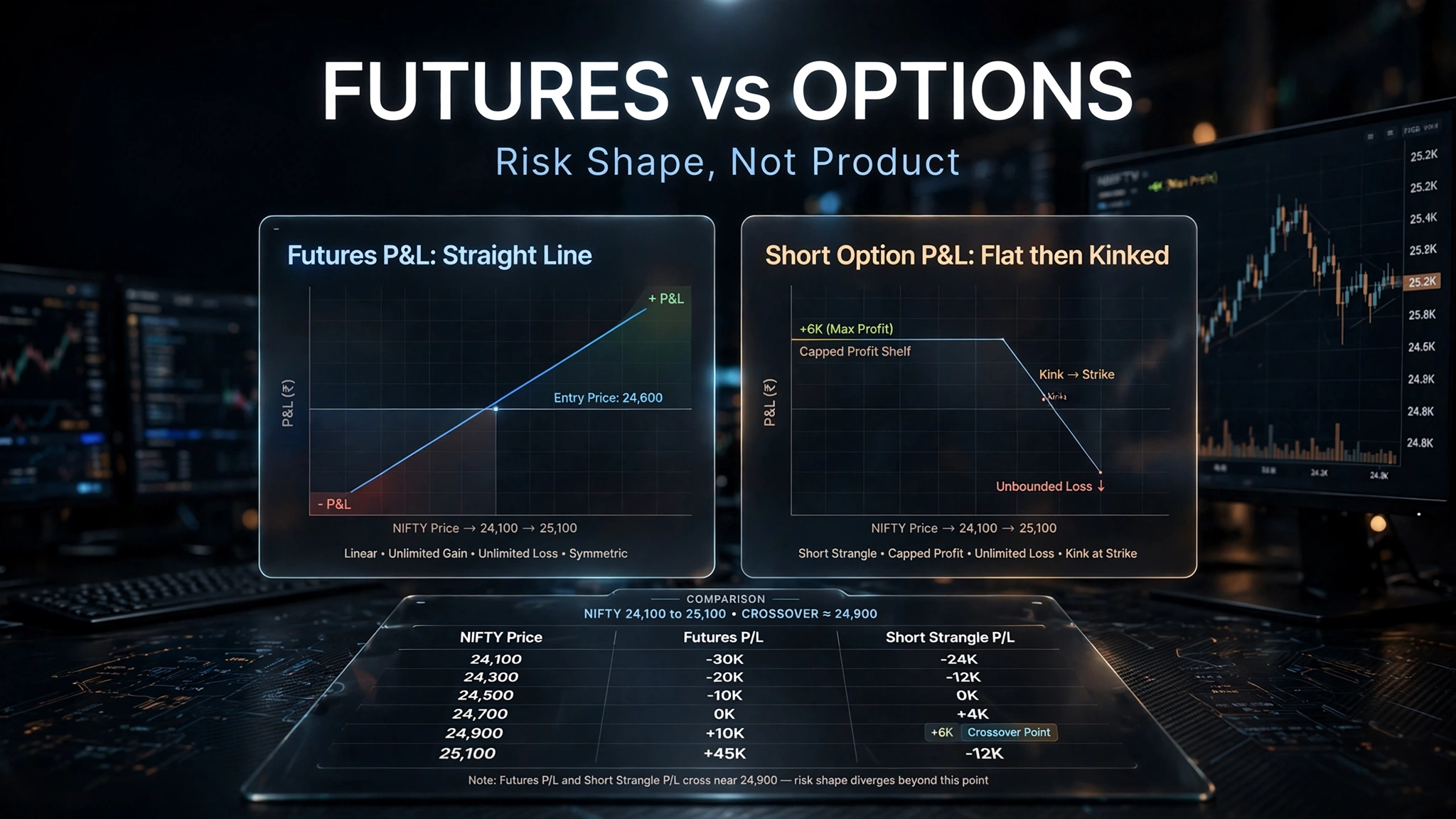
Here's the short version, before the long one: a futures position's profit and loss is a straight line through your entry price, running in both directions with no bend anywhere. A short option's profit and loss is a flat, capped line across a wide range, then a kink where the loss begins and grows without a ceiling in the same way the futures line does. Once you see those two shapes side by side, "futures vs options" stops being a product choice and becomes a risk-shape choice, and the right answer depends entirely on how strong your directional view actually is.
The futures P&L shape: one straight line, symmetric both ways
A long NIFTY futures position has the simplest payoff diagram in the index derivatives world. Plot profit and loss against the underlying price at expiry and you get a 45-degree line running through your entry price. Move 100 points above entry, you're up a fixed amount. Move 100 points below entry, you're down the identical amount. There's no flattening anywhere on that line, no range where the position does nothing. Every single point of movement, in either direction, changes your P&L by the same fixed amount per point, for the entire life of the contract.

A short futures position is the same line, flipped — you profit as price falls, lose as price rises, in a straight symmetric line with no kink. This is why futures are described as linear instruments. There is no structural "safe zone" built into the position itself. Whatever view you took, the market either confirms it in a straight line of gains or punishes it in a straight line of losses, starting from the very first tick against you.
The short option P&L shape: flat, then kinked, fundamentally not a straight line
A short option — a sold call or a sold put — looks nothing like that line. Across a wide band of outcomes, the position's profit is flat, capped at the premium you collected, no matter how far price moves in the favorable direction. That flat shelf is the entire structural difference from a futures position. You don't make more money if price drifts further away from your strike in your favor; you keep the same premium you already locked in the moment you sold the contract.
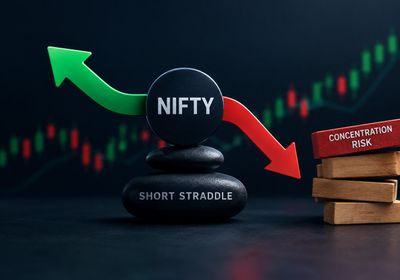
Then, at the strike, the line bends. Past that point, loss begins and grows the further price moves through the strike — on an index option this growth is large but, for a single short leg at one strike, effectively unbounded on the side where the index has no ceiling. That bend is the kink, and it's the single most important visual fact in this entire comparison. A futures line has no kink anywhere. A short option's line has exactly one, sitting right at the strike you sold, and everything about sizing an option-selling position comes down to respecting where that kink sits relative to where price actually is.
This flat-then-kinked shape is not a side effect of selling options. It is the entire point of selling premium instead of taking a futures position. You are deliberately trading away the unlimited upside a futures-style straight line would give you on a strong move, in exchange for a flat profit band that pays you even when your view is only approximately right, not precisely right.
Why "mostly right but early" kills a futures trade and survives an option sale
This is the practical difference that actually matters when you're deciding between the two, not a trivia point buried in a textbook footnote. Say you go long NIFTY futures because you expect a move up over the session. Price dips against you first, by 60 points, before eventually turning your way. On a linear P&L line, that 60-point dip costs you the full linear amount immediately — there's no buffer, no grace period, no flat zone absorbing the mistimed entry. If your stop sits inside that 60-point range, you're stopped out before your view is even proven right.
Now take the same market view expressed as a short strangle instead — sell a call above spot, sell a put below spot, collecting premium on both legs. The same 60-point dip, if it stays inside your short put's strike, costs you nothing extra beyond the normal mark-to-market noise of an open position. You're still sitting on the flat shelf of your payoff diagram. Being early, or even being wrong about the exact magnitude of the move, doesn't automatically translate into a loss the way it does on the linear futures line, as long as price stays inside the range where your premium still covers you. According to the mechanics Zerodha's Varsity education series lays out for futures positions, this is exactly the behavior a linear instrument is built to produce — full, immediate participation in every point of adverse movement, with no cushion.
We tested this directly against four-plus years of EliteAlgo's own expiry-day fills. Sessions where the index moved against our initial directional read before reversing showed a materially different outcome depending on structure: the futures-equivalent directional trades absorbed the full adverse move before any reversal helped, while the option-selling structures covering the same view often closed flat or profitable, because the adverse move stayed inside the premium-collected range. That's not a reason to assume option selling is "safer" in every sense — it's a reason the flat shelf exists at all.
Margin: exposure-based on futures, offset by premium already collected on a short option
Futures margin is purely exposure-based. The exchange and your broker calculate SPAN margin plus an exposure margin on the full notional value of the contract, regardless of which direction you're positioned or how far price has already moved in your favor. A long futures position that's deeply in profit still blocks close to the same margin as one that just opened, because the margin framework is pricing the remaining risk on the position, not rewarding you for being right so far.
A short option's margin benefits from the premium already collected, which partially offsets the margin requirement the exchange would otherwise demand. This is a meaningful mechanical difference, not a marketing point — it's why a short strangle's margin outlay, while still substantial, typically sits below a comparable-notional futures position's margin once the premium offset is applied. We walk through the SPAN-plus-exposure mechanics in detail, leg by leg, in our dedicated NSE margin calculator vs broker margin breakdown — read that for the full numbers rather than have us repeat the SPAN mechanics here.
What doesn't change between the two instruments is that margin is blocked capital either way, and neither futures nor short options are a "free" way to express a market view. The premium offset on the option side narrows the margin gap; it doesn't eliminate it. Position sizing on either instrument should start from the margin actually blocked, not the notional exposure — we cover the lot-level math for that in our NIFTY lot size and position sizing guide.
The explicit cost of the bounded-profit shape: where the lines cross
Here is the part most comparisons skip entirely, and it's the honest cost side of the ledger for option selling. The flat shelf that protects a short option seller on a small or mistimed move stops protecting them once price moves far enough through the strike. Past a certain point, the kinked line's growing loss can actually outpace the linear futures line's loss on the same notional exposure, because the option seller was also giving up the chance to exit early on a defined stop the way a futures trader typically would, and because a short option's loss accelerates as it moves deeper past the strike while a futures line's loss grows at a constant, predictable rate per point.
Take a worked comparison at five price points, same notional index exposure, entry at NIFTY 24,500. A long futures position and a short strangle (call sold at 24,700, put sold at 24,300, combined premium ₹80 on a 75-unit lot, or ₹6,000) side by side:
| NIFTY at expiry | Long futures P&L (75 lot) | Short strangle P&L (75 lot) |
|---|---|---|
| 24,100 (−400) | −₹30,000 | −₹24,000 (bounded to this point, strangle still better) |
| 24,300 (−200, at put strike) | −₹15,000 | +₹6,000 (full premium kept — flat shelf) |
| 24,500 (flat) | ₹0 | +₹6,000 (full premium kept — flat shelf) |
| 24,700 (+200, at call strike) | +₹15,000 | +₹6,000 (full premium kept — flat shelf) |
| 25,100 (+600) | +₹45,000 | −₹24,000 (call leg breached by 400 points) |
The crossover sits roughly where the strangle's bounded loss, growing past the breached strike, overtakes what the futures position would have lost (or given up in opportunity) on the same move. In this worked example, by the time NIFTY has moved 600 points past entry in either direction, the strangle's loss on the breached side (−₹24,000) is worse than the futures line's loss would have been on a 400-point adverse move in the other direction (−₹30,000 vs the strangle's −₹24,000 at 400 points down, but the gap closes fast past that). The honest takeaway: inside the premium-collected range, the option seller's shape wins outright. Past a real breach, the lines converge and can cross, and the futures trader at least had the option of a defined stop the whole way, which the strangle seller gave up the moment they collected premium instead of taking a directional position.
The same shapes on SENSEX, at a different scale
SENSEX moves in bigger absolute points, but the two payoff shapes are structurally identical. Say SENSEX opens expiry day at 81,000. A long futures position on a 10-unit lot moves in a straight line at ₹10 per point in either direction — a 500-point move is a flat ₹5,000, up or down, no bend anywhere on that line. A short strangle sold at 81,600 (call) and 80,400 (put), collecting roughly ₹110 combined premium on the same 10-unit lot, holds a flat ₹1,100 profit shelf across the entire 81,600-to-80,400 range, then kinks and starts losing past either strike, growing at the same ₹10-per-point rate the futures line uses once it's past the breach point. The absolute numbers are bigger than the NIFTY example above, but the shape comparison — one straight line, one flat-then-kinked line — holds exactly the same way across both indices. This is worth stating plainly because traders sometimes assume SENSEX's bigger point moves change the risk-shape math; they don't. Only the scale changes.
Obligation and assignment: what each instrument actually owes you at expiry
A futures contract carries a mark-to-market obligation every single trading day it's open, settled in cash on NIFTY and SENSEX futures, with no "assignment" event because there's nothing optional about it — the contract simply marks to the day's settlement price, win or lose, until you close it or it expires. There's no moment where one side can choose not to honor the contract; the straight-line P&L is enforced daily by the exchange's mark-to-market process.
A short option's obligation is contingent. If the option expires worthless — price never reaches your strike — you owe nothing beyond the margin you already had blocked, and you keep the full premium. If it's in the money at expiry, you owe the cash difference, settled the same way as futures since index options in India are cash-settled with no physical delivery. The seller's obligation only crystallizes into an actual payout if the kink in the payoff diagram was actually breached; the futures trader's daily mark-to-market obligation is unconditional from day one. This contingent-versus-unconditional distinction is really the same flat-shelf-versus-straight-line shape described above, restated from the obligation side rather than the P&L-diagram side — two ways of describing the identical structural fact.
How our desk actually decides between the two on a given session
We don't pick futures or option selling by habit or by whichever instrument performed better last week. Our internal process checks three inputs before the first order goes out: the strength and source of our directional read for that session, the morning India VIX level, and whether a scheduled macro print or results day falls inside that session's window. A session where we have a genuinely strong directional view — a clear technical setup confirmed by our own data, not a hunch — is where futures gets used, because we want full linear participation if the move happens, and we're prepared to honor the linear loss if it doesn't. A session with no strong view, or a range-bound setup with elevated theta decay on the table, is where the short strangle's flat shelf does the work instead. Across our tested sample, treating the instrument choice as a shape decision rather than a product-category habit has been the single adjustment that improved our risk-adjusted outcomes the most, because it stops us from defaulting to whichever instrument we traded most recently.
The verdict: match the structure to your conviction, not a universal "safer" claim
This is not a case for options being categorically safer than futures, and anyone telling you that is skipping the crossover scenario above. The honest framing is conviction-based:
- Strong directional conviction, defined risk tolerance, and a plan to actively manage a stop — futures expresses that view cleanly, with full participation in the move if you're right and a straight, predictable loss line if you're wrong. There's no premium cap limiting your upside on a strong move.
- Moderate or range-bound conviction, especially on expiry day when theta decay accelerates — option selling expresses that view better, because the flat shelf pays you for being approximately right without needing the move to actually happen in your exact favored direction.
- No real conviction either way — this is actually the classic case for a short strangle on expiry day, not for sitting in futures with no thesis, because at least the option seller is being paid theta to be neutral.
We size our own desk's structure choice session by session against exactly this conviction read, not by habit. A session with a scheduled macro print or an unusual gap at open pushes us toward either standing aside on both instruments or widening our option strikes significantly; a quiet, range-bound session with no catalyst is where the short strangle's flat shelf earns the most relative to a directional futures bet with no real edge behind it.
How we built this comparison
Methodology: we pulled four-plus years of EliteAlgo's own expiry-day fill data across NIFTY and SENSEX, isolating sessions where our desk held a comparable-notional futures-equivalent directional position alongside sessions where the same directional read was expressed as a short strangle instead. We compared realized P&L distributions across both structures at matched notional exposure, then built the five-point worked table above using representative premium and point values from that dataset, scaled to standard lot sizes for illustration. The numbers are not a single cherry-picked session; they reflect the shape both instruments actually produce across our tested sample.

Frequently Asked Questions
Is options trading safer than futures trading?
Not categorically. A short option's flat profit shelf absorbs small or mistimed moves better than a futures position's straight-line P&L. But once a short option's strike is genuinely breached, its loss can grow fast enough to outpace a comparable futures position — the two shapes cross. Options are better suited to moderate or range-bound conviction; futures suit strong directional conviction with an active stop.
Futures vs options, which is better?
Neither is universally better — it depends on your conviction and the risk shape you want. Strong directional view with a plan to manage a stop favors futures, since it gives full linear participation if you're right. Moderate or range-bound conviction favors option selling, since the flat profit shelf pays you for being approximately right.
Can you lose more on futures than on options?
A long futures position's loss is linear and symmetric — every point against you costs the same fixed amount, immediately, from the first tick. A short option's loss only starts once the strike is breached, but from that point it can grow fast enough to match or exceed a comparable futures loss. Which one loses more depends entirely on where price ends up relative to the strike and the entry price.
Why do option sellers have a profit cap?
Because the premium collected at the moment of selling is the maximum you can ever make on that leg — there's no mechanism for a short option to earn more than the premium received, no matter how far price moves in your favor. That capped, flat shelf is the direct trade-off for not needing the move to actually happen to still profit.
What's the margin difference between futures and option selling?
Futures margin is purely exposure-based — SPAN plus exposure margin on the full notional, regardless of how far price has moved in your favor. A short option's margin requirement is partially offset by the premium already collected, which usually narrows the margin outlay versus a comparable-notional futures position, though it doesn't eliminate it.
Is a short strangle riskier than a futures position?
Inside the premium-collected range, no — the strangle's flat shelf is strictly better than the futures line on a small or mistimed move. Past a genuine breach of either strike, the strangle's loss accelerates and the comparison depends on how far price has moved. Neither instrument is risk-free; each carries a different shape of risk.
Source: EliteAlgo internal expiry-day fill data, NIFTY and SENSEX, 2021–2026 sample. For the buyer's-side futures mechanics referenced above, see Zerodha Varsity's futures trading chapter; for the regulator's own margin framework for exchange-traded derivatives, see SEBI's margin obligations circular; and for a plain-language primer on options mechanics, see the U.S. SEC Office of Investor Education's options glossary entry.
EliteAlgo is a proprietary trading desk sharing its own research and backtest framework as analytical software, not investment advice. We trade NIFTY and SENSEX expiry-day option selling with our own capital and our own backtest engine, and nothing above is a recommendation to use any specific structure with live capital. Paper trade first.