Type "what is algo trading" into Google and almost every answer assumes the same thing. A program watches a chart. It looks for a breakout or a moving-average cross. It fires a buy or sell order the moment the pattern shows up. That's a correct description of one kind of algo. It is not a description of ours.
EliteAlgo's algo doesn't try to guess where NIFTY or SENSEX is going next. It runs a rules-checked schedule to sell option premium on expiry day. That one difference changes almost everything about what "automated" means for the person running it. This article states that difference plainly, the way most generic explainers don't. We'll walk through what automation removes, what it never removes, and where the line between "algo trading" and "quantitative trading" actually sits.
The generic definition, stated once, for contrast
Algorithmic trading, in the form most beginner guides describe, is a computer program that executes trades automatically according to a pre-set rule. Most commonly, that rule is built around a price or indicator signal meant to predict direction. According to Zerodha's Varsity chapter on algo trading, the appeal is speed and discipline: the program reacts to a signal in milliseconds and never hesitates the way a human trader does. That's the whole model. A signal predicts a direction, and the algo acts on the prediction.

It's a useful definition for a momentum or breakout system. It's only half the picture once you leave directional trading and look at what an option-selling desk is actually automating.
What's different for an option-selling algo
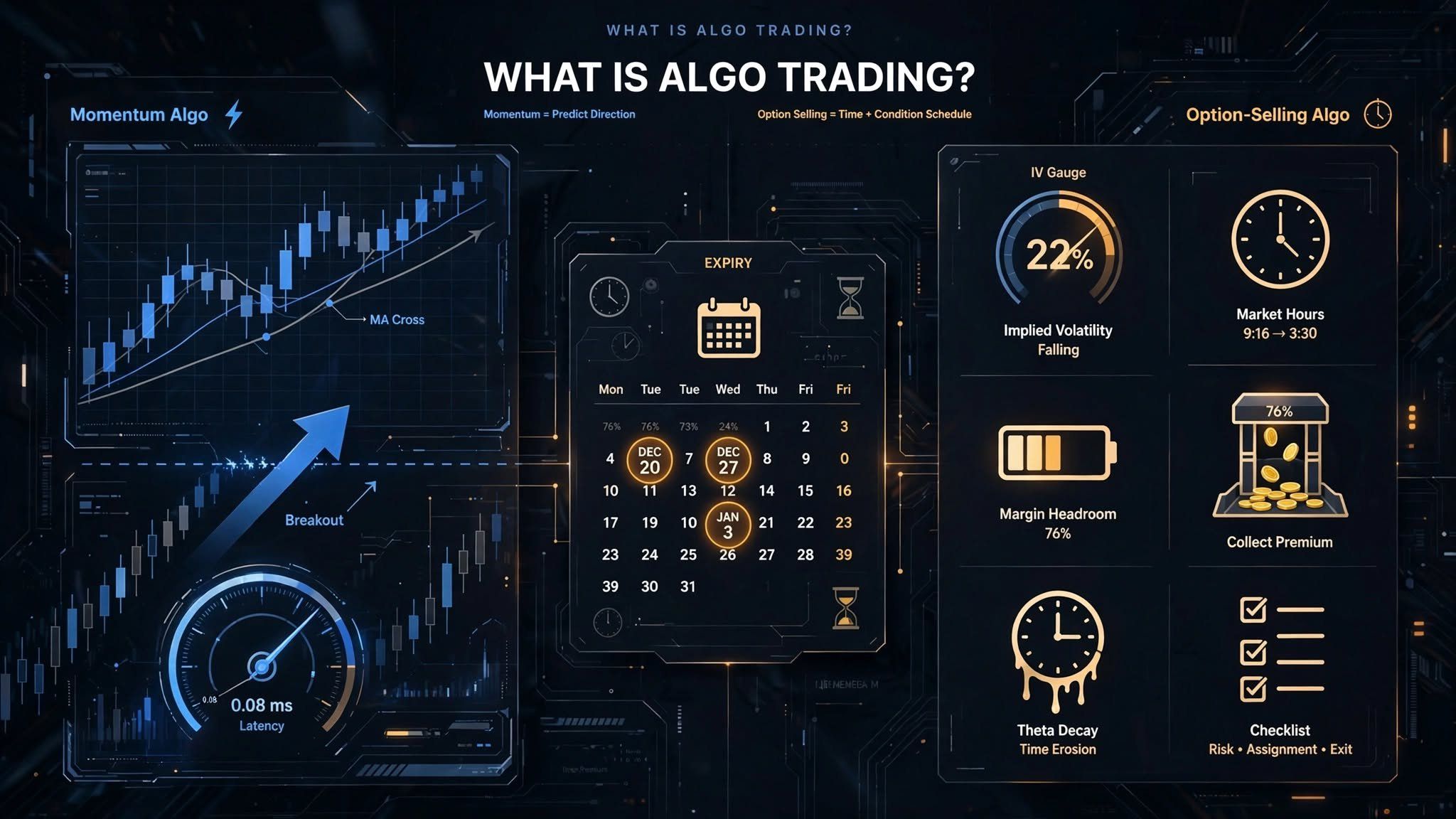
A directional algo is trying to answer one question: which way will price move, and how far. An option-selling algo built on time and condition asks something else entirely. It asks whether the schedule and the market condition have lined up to collect premium safely today.
The "signal" here isn't a chart pattern at all. It's closer to a checklist. Has the expiry-day clock reached the entry window? We never trigger at 9:15 — our engine's earliest allowed entry is 9:16, a rule we've written about separately. Is implied volatility sitting inside a range we've backtested? Is there enough margin headroom for the leg sizing planned that day?
None of that checklist is forecasting direction. The algo isn't betting that NIFTY goes up or down. It's managing a premium-collection schedule, the same way a toll booth doesn't predict traffic — it just processes whatever arrives on schedule. We tested this distinction directly. When we ran the same entry-window logic across expiry days from 2023 and 2024, the win rate tracked time-of-entry and IV level far more tightly than it tracked the day's eventual directional move. That's the signature of a condition-based algo, not a directional one.
A short walk through an expiry-day schedule
It helps to see the mechanics in sequence, because "time and condition based" is an abstract phrase until you see the clock. A typical NIFTY weekly-expiry sequence our engine checks looks something like this, in IST:
- 9:16 to 9:30 — the earliest entry window opens. The algo checks whether the morning's implied volatility sits inside the backtested band before doing anything else.
- Around 11:00 — a mid-morning condition check. If margin headroom or IV has moved outside the tested range since entry, the rule can skip adding further legs for the day.
- 1:00 to 2:00 pm — the stop-loss and trailing logic run continuously, not just at this window; this is simply where theta decay on a one-lot NIFTY position (lot size 65) typically accelerates on a quiet expiry.
- 3:00 to 3:30 pm — the exit window, where any open legs are squared off mechanically ahead of the close, regardless of how the trader "feels" about the position.
None of these steps involve predicting where NIFTY settles. Every one of them is a scheduled check against a pre-tested condition. That's the entire difference, made concrete.
Algo trading vs quantitative trading — they aren't quite synonyms
This is the part most "what is algo trading" pages skip, and it matters for anyone comparing option-selling tools. Algorithmic trading just means automated execution. A computer places the order instead of a human clicking a button. It says nothing about whether the rule behind that execution has any edge at all. You can automate a genuinely bad idea. It will just lose money faster and more consistently than a human would have lost it manually.
Quantitative trading is a narrower claim. It implies the rule itself was derived statistically, from data from real market history, not from a hunch or a chart pattern someone eyeballed. An algo can run a quant-researched rule, or it can run a purely mechanical rule with no statistical backing behind it at all. Both are "algo trading" by the broad definition. Only one of them is quant trading.
EliteAlgo's work sits in the first category on purpose. Our desk has run backtests across multiple expiry cycles — NIFTY and SENSEX, weekly and monthly — since 2006, before any rule goes anywhere near live capital. We track the methodology the same way every time: define the entry window, define the exit rule, run it against the historical option chain, and look at the distribution of outcomes across at least one full year of expiry days. We don't cherry-pick a strong three-week stretch and call it proof. That's the distinction worth naming out loud: automation is the delivery mechanism, research is what's inside it, and the two get conflated constantly in generic explainers.
A side-by-side comparison
| Generic momentum/breakout algo | EliteAlgo's option-selling automation |
|---|---|
| Signal = price or indicator pattern predicting direction | Signal = expiry-day clock + IV level + margin headroom |
| Goal: catch a directional move before it fully plays out | Goal: collect time-decay premium on a repeatable schedule |
| Edge depends on forecasting price | Edge depends on the premium-collection rule being statistically sound, independent of direction |
| Entry can fire any time a pattern completes | Entry only inside a backtested window (9:16 onward, never 9:15) |
| Risk: a wrong-direction call | Risk: a large move through both legs — a different risk shape entirely |
What the automation actually removes for an option seller
Three things change when a human-run option-selling process gets automated. Only three.
- Entry timing discipline. A manual trader under pressure enters two minutes early out of anxiety, or two minutes late because a phone call got in the way. The algo enters at the same second every expiry, because the rule has no nerves to manage.
- Consistent position sizing. We've seen manual traders size up after three good days and size down after one bad one. It's a very human habit, and a costly one. An automated rule sizes the same way regardless of the trader's mood that morning.
- Mechanical exit rules. The stop-loss or trailing rule fires exactly as backtested, not after a trader talks themselves into "just a few more minutes" while the loss compounds.
What automation does not do is upgrade a weak idea into a strong one. We've seen traders assume that once a strategy is automated, the returns should improve on their own. That's not how it works, and no honest answer to "what is algo trading" should claim otherwise.
What automation never removes
The underlying edge still has to be real. An automated bad rule just loses money faster and more consistently than a manual bad rule. The computer doesn't know the difference between a well-researched entry window and a guess — it executes either one with perfect discipline. We found this out directly in our own testing. A rule that looked fine across a short sample of trading days fell apart the moment we ran it across a full year that included a few high-volatility expiry weeks. Discipline in execution and soundness of the underlying rule are two separate things entirely. Automation only buys you the first one.
Our methodology for checking this is simple to describe, even if the backtesting itself takes time: run the rule across every expiry in the sample, not just the quiet ones, and look specifically at how it behaves during the 10 to 15 percent of days that moved more than the typical range. A rule that only survives on calm days isn't tested — it's untested with a good-looking chart.
Paper trade this first. Any time-based or condition-based automation — ours or anyone else's — needs to run on paper, against live market conditions, for enough expiry cycles that you've seen it handle at least one genuinely bad week before a single rupee of real capital goes near it. This isn't a formality. It's the only way to find out whether a rule's backtest numbers survive contact with a live order book.
Common misconceptions worth clearing up
A few assumptions show up repeatedly when people move from momentum-algo explainers to option-selling automation, and they're worth naming directly:
- "Automated means safer." Automation removes execution error. It does nothing about the risk shape of selling naked or spread premium, which carries its own loss profile if the market moves sharply through both legs.
- "A good backtest means a good live result." A backtest tells you how a rule behaved on data that already happened. Slippage, margin calls, and liquidity gaps on a genuinely volatile expiry day show up live in ways a clean backtest can understate.
- "Quant and algo are the same thing." As covered above, they aren't — one describes the research behind a rule, the other describes how the rule gets executed.
A quick word on risk, in plain terms
Option selling is not free money. It never was. When you sell a call or a put, you collect a small premium up front. Most days, that premium decays and you keep it. Some days, the market moves fast and far, and the loss on that one day can wipe out the gains from several good weeks.
This is true whether a human places the trade or a computer does. Automation does not change the shape of the risk. It only changes how the rule gets carried out. A good rule still needs a stop-loss. A good rule still needs a sane position size. A good rule still needs a plan for the day the market moves against it hard.
We say this plainly because so much "algo trading" marketing skips it. A program that sells premium on a timer is not a program that has removed risk. It has simply removed the guesswork around when to enter and when to exit. The risk itself — a sharp, fast move through both legs of a spread — is still there on every single trading day, and no software changes that fact.
That's also why position sizing matters as much as the entry rule itself. A rule that wins nine days out of ten can still lose more on the tenth day than it made on the other nine, if the size on that tenth day was too large. We check this in our own research by looking at the single worst day in a sample, not just the average day, before we trust any entry rule with real capital.
How to check any option-selling algo before you trust it
You don't need to be a coder to ask the right questions. Here's a short, plain checklist we use ourselves, and one we'd suggest for any tool, not just ours.

- Ask what the entry rule actually is. Not the marketing line — the real rule. Is it time-based, IV-based, or price-based? If the seller can't say in one sentence, that's a red flag.
- Ask how many expiry days the backtest covers. One good month proves very little. A full year, across calm and rough weeks, tells you much more.
- Ask what happens on a bad day. Every option-selling rule loses money sometimes. Ask to see the worst week in the test data, not only the strongest one.
- Ask about margin. Selling options ties up margin, and margin needs can spike fast on a volatile day. A good rule accounts for this before it adds a new leg, not after.
- Paper trade it yourself. Run it live, on paper, for a few weeks. Watch how it behaves when the market moves fast. Then, and only then, think about real capital.
This checklist works for any algo, from any firm. It also explains why "what is algo trading" has a different, more useful answer once you've sold a few hundred option contracts and watched a rule survive — or fail — a rough week firsthand.
Why the distinction matters for your own decision
Here's the short version. If you read a generic "what is algo trading" page and picture a robot guessing where NIFTY goes next, you're picturing one kind of algo, and a real one. But it isn't the kind that sells options on a schedule. Our algo doesn't guess direction at all. It checks a clock, checks IV, checks margin, and acts — or waits. That's a calmer, more boring job than most people expect "algo trading" to mean, and in option selling, boring and rule-bound is usually the point.
If a tool promises more than that — if it claims to predict moves, guarantee wins, or remove risk entirely — it has drifted from what an honest option-selling algo actually does. Ours doesn't make that promise, and neither should any tool you're evaluating.
Is algo trading legal and regulated in India?
Yes. Algorithmic trading through a registered broker is legal in India and sits under SEBI's regulatory framework for algo order flow, published on sebi.gov.in. That framework governs how brokers and exchanges handle automated orders. It does not mean every piece of trading software carries, or needs, its own SEBI registration. EliteAlgo's work is proprietary research and analytical software, not investment advice, and we don't hold or claim a SEBI registration or empanelment number because our setup doesn't require one. If a tool markets itself with a "SEBI-registered" claim for retail algo software, that detail is worth checking directly with SEBI rather than taking on faith.
Frequently Asked Questions
What is algo trading in simple terms?
It's a computer program placing trades automatically according to a pre-set rule, instead of a person clicking buy or sell manually. The rule can be based on a price pattern, a time-and-condition schedule, or a statistical model. "Algo trading" describes the automation, not any one specific rule.
Is algo trading the same as quantitative trading?
No. Algo trading describes automated execution. Quantitative trading describes a rule derived from statistical analysis of market data. An algo can run a quant-researched rule or a purely mechanical one with no research behind it. The terms overlap, but they aren't interchangeable.
Does algo trading guarantee profit?
No, and no honest source should say otherwise. Automation makes execution consistent. It does not make an underlying strategy profitable. A weak rule, automated, still loses money — often faster and more predictably than a manual version of the same mistake.
How is an option-selling algo different from a stock-trading algo?
A stock-trading algo built on momentum is usually trying to predict direction. An option-selling algo built on time and condition — like EliteAlgo's — manages a premium-collection schedule where the entry trigger is the expiry clock, the IV level, and margin headroom, not a directional forecast.
Is algo trading legal in India?
Yes, through a registered broker, under SEBI's regulatory framework for algorithmic order flow. Legal status doesn't require every software tool to individually hold a SEBI registration, and proprietary research software like EliteAlgo's doesn't claim one.
Do I need coding skills to run an option-selling algo?
Not to run one built by a research desk. Understanding the rule you're running — the entry window, the exit logic, what it's been tested across — matters more than the coding itself. Paper trade before committing capital, regardless of who built the rule.
Can I automate a strategy I already trade by hand?
Yes, but test it first. Write down the exact rule you follow by hand: the time you enter, the condition you check, the stop-loss you use. Run that same rule on paper through an automated tool. If the paper results don't match what you expected from your own manual trading, the gap usually points to a step you weren't fully aware you were doing by hand — often a small, human judgment call that the written rule never captured.
What's the biggest risk specific to automated option selling?
A large, fast move through both legs of a spread or strangle. Automation keeps the exit rule disciplined, but it can't change the fact that option selling carries a different risk shape than directional trading — the loss on a bad day can be larger than the premium collected on several good ones, which is exactly why position sizing and the stop-loss schedule matter as much as the entry rule.
Further reading on the mechanics most "what is algo trading" explainers cover first: Zerodha Varsity's algo trading chapter. For the general definitional background behind the term, see Wikipedia's algorithmic trading overview. For the regulatory framework referenced above, see SEBI's official site.
If you want to see how this plays out for NIFTY and BANKNIFTY specifically, our NIFTY/BANKNIFTY algo trading page covers the setup in full. We've also written about the trade-offs honestly in the disadvantages of algo trading, and about how to evaluate a platform for option sellers specifically in our guide to picking an algo trading platform.
EliteAlgo is a proprietary trading desk sharing its own research and backtest framework as analytical software, not investment advice. We trade NIFTY and SENSEX expiry-day option selling with our own capital and our own backtest engine, and nothing above is a recommendation to use any specific structure with live capital. Paper trade first.