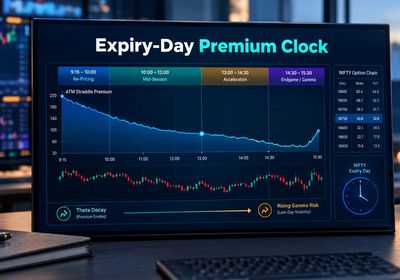

Choosing the best algo trading platform for option sellers in India comes down to one question most comparison articles skip: can the platform actually simulate and execute expiry-day, multi-leg option-selling strategies the way NIFTY and SENSEX traders run them in practice — not just backtest a single directional entry on a stock. Option selling is a volatility and theta-decay business, not a signal-following one, and the platform you pick has to reflect that difference in how it handles strike selection, margin, slippage, and expiry-day execution speed.
This guide breaks down what actually separates platforms for option sellers specifically, compares the leading options available to Indian traders in 2026, and gives you a framework to evaluate any platform against your own strategy — whether that's iron condors, short straddles, or delta-neutral adjustments on expiry day.
Quick Answer: What to Look for First
If you only have two minutes, here's the direct answer: the best algo trading platform for option sellers in India is the one that (1) lets you backtest multi-leg option strategies on real historical options-chain data, not just synthetic payoff diagrams, (2) supports expiry-day execution with sub-second order placement during the last hour of high gamma risk, and (3) gives you transparent slippage and margin reporting so your backtested numbers match what actually happens in your broker account. Platforms that only do single-leg equity/futures signals, or that backtest on daily candles instead of intraday options data, will systematically overstate your edge on theta-decay strategies.
Why Option Sellers Need a Different Platform Than Directional Traders
Most "best algo trading platform" roundups in India are written for directional traders — people running a moving-average crossover on Nifty futures or a breakout system on stocks. Option selling is structurally different in three ways that change what you need from a platform:
1. Multi-leg strategies, not single entries. A short strangle, iron condor, or ratio spread involves 2-4 legs entered and exited together, often with different strike distances from spot (ATM, OTM1, OTM2). A platform that only lets you backtest and execute one leg at a time forces you to manually stitch together fills — which introduces slippage and timing errors that don't show up until real money is on the line.
2. Theta decay and IV crush matter more than price direction. Your backtesting engine needs to model implied volatility behavior — not just price — because your P&L on expiry day is driven by IV crush and time decay as much as by NIFTY/SENSEX movement. Platforms built for equity signal-trading rarely model this correctly.
3. Expiry-day gamma risk demands execution speed. In the final hour before expiry, NIFTY and SENSEX options can move violently as gamma exposure increases. A platform with execution lag of even a few seconds can turn a well-designed short-premium strategy into a losing one. This is where broker API latency, order routing, and platform infrastructure genuinely matter — not just backtested win rate.
Core Evaluation Criteria for Option-Selling Platforms
Before comparing named platforms, use this checklist — it's the same one we apply internally when evaluating our own Backtesting Engine against alternatives:
| Criterion | Why It Matters for Option Sellers | What to Check |
|---|---|---|
| Multi-leg backtesting on real options data | Single-leg backtests overstate edge; real fills differ from theoretical mid-price fills | Ask if backtests use tick-level or 1-min bid/ask option data, not just settlement prices |
| Expiry-day / 0DTE strategy support | NIFTY has weekly expiries; most Indian option-selling edge lives in 0-1 DTE trades | Confirm the platform explicitly supports expiry-day (0DTE) backtesting and live execution |
| Slippage and margin realism | A strategy that looks profitable pre-slippage can be a loser post-slippage and post-margin | Look for a slippage model in the backtest report, and real-time SPAN+exposure margin checks |
| Broker API + order execution speed | Gamma risk on expiry day punishes slow order placement | Check documented average order latency and which brokers are natively supported |
| Risk controls (SL, max loss, position sizing) | Undefined-risk short options can wipe an account in one bad expiry | Platform should support hard stop-loss, max-loss-per-day, and auto square-off |
| Transparent, auditable strategy history | You need to trust the numbers before you trust the capital | Look for downloadable trade logs, not just a summary equity curve |
| SEBI-compliant, non-advisory positioning | Regulatory clarity protects you as a user | Platform should be clear it provides analytical/execution software, not investment advice |
Platform Comparison: What Option Sellers in India Actually Need
Here's how the major categories of platforms available to Indian option sellers stack up against the checklist above:
General-purpose algo platforms (broad strategy marketplaces)
These platforms let retail users build and deploy strategies across asset classes, often with a strategy-sharing marketplace. Strengths: large user base, wide broker integrations, low entry barrier for coding-light users. Limitation for option sellers specifically: backtesting engines on these platforms are frequently built around single-leg entries and daily/hourly candle data, which under-models the multi-leg, IV-driven nature of option selling. If you're testing a short-strangle or iron-condor strategy, verify the platform's backtest actually simulates leg-by-leg option fills rather than a synthetic payoff at expiry.
Signal/screener-driven platforms
These focus on generating buy/sell signals from technical indicators, with algo execution layered on top. They're strong for directional and momentum strategies but typically treat options as a leveraged proxy for direction rather than a volatility instrument — meaning strategies like calendar spreads, ratio backspreads, or delta-neutral adjustments are poorly supported or unavailable.
No-code/low-code strategy builders
These lower the technical barrier by letting users assemble strategies visually. Good for traders without a Python background. The tradeoff is usually flexibility — complex multi-leg adjustment logic (e.g., rolling a short strike when it's breached, or adding a hedge leg mid-day) can be hard or impossible to express in a drag-and-drop builder, which matters a great deal for expiry-day option-selling risk management.
Institutional-grade backtesting + execution platforms
Platforms purpose-built around intraday expiry-day option selling — like EliteAlgo's Backtesting Engine — are designed specifically around the three requirements above: multi-leg strategy construction on real intraday options data, expiry-day (0DTE) simulation with realistic slippage, and execution infrastructure tuned for the gamma-heavy last hour of NIFTY/SENSEX expiry sessions. This category trades some of the broad multi-asset flexibility of general platforms for depth on the exact problem option sellers are solving.
Common Mistakes Option Sellers Make When Choosing a Platform
Even experienced traders fall into predictable traps when evaluating algo platforms for option selling. Watching hundreds of strategy backtests come through our own pipeline, these are the five mistakes that show up most often:
Mistake 1: Trusting a backtest that uses settlement-price fills instead of live bid/ask. Many platforms compute option entry and exit prices from theoretical or settlement data rather than the actual bid/ask spread available at that timestamp. This can make a strategy look profitable by 15-20% more than it would be in live trading, because real fills always occur at a worse price than the theoretical mid. Always ask whether the backtest engine uses actual quoted spreads.
Mistake 2: Ignoring margin utilization until it's a live-trading problem. A backtest report that shows a clean equity curve can hide the fact that the strategy would have breached available margin on a specific day, forcing a broker-side square-off that never shows up in the simulated numbers. Platforms that don't track margin utilization per trade day are giving you an incomplete picture.
Mistake 3: Testing only on calm, low-volatility periods. It's tempting to run a quick backtest over the last three months and call it validated. But option-selling strategies behave very differently across VIX regimes — a strategy that performs well when India VIX sits around 11-13 can suffer outsized losses in a VIX 20+ environment with wide intraday swings. Always test across at least one high-volatility period, such as a budget-day session or a global risk-off event, before trusting the numbers.
Mistake 4: Underestimating expiry-day gamma risk in the platform's execution layer. Some platforms are built primarily for positional or swing strategies and bolt on intraday execution as an afterthought. For 0DTE option selling, the difference between a platform that places orders in under a second versus one with 3-5 second latency can be the difference between a strategy that works and one that bleeds on gamma spikes. This is rarely advertised prominently, so it's worth asking directly or testing with small size first.
Mistake 5: Choosing a platform based on marketing win-rate claims alone. A headline "85% win rate" is close to meaningless for a short-premium strategy without also knowing the average loss size on the losing 15%, the maximum drawdown, and the return-on-margin over a full year including tail-risk expiries. Undefined-risk option selling strategies can post high win rates for long stretches and then give back months of gains in a single adverse move — so always request max drawdown and worst-single-day figures alongside win rate.
Broker Integration and Execution Infrastructure
For NIFTY and SENSEX option sellers running strategies through the last hour of expiry, the quality of broker API integration is not a minor technical detail — it's often the difference between a strategy's backtested edge surviving contact with live markets or not.
Three things to verify with any platform before connecting live capital:
- Which brokers are natively supported, and whether the integration uses a direct API connection or a slower bridge/webhook layer. Direct API integrations with brokers that support fast order routing (rather than third-party polling layers) reduce the latency between a signal firing and an order reaching the exchange.
- Order retry and failure handling. On high-volume expiry days, order rejections due to margin, price band, or connectivity issues are common. A platform needs clear logic for retrying, alerting, or safely aborting a multi-leg entry if one leg fails to fill — an unhedged single leg from a failed multi-leg order is one of the most common causes of unexpected losses in option-selling automation.
- Real-time position and margin sync, not a periodically refreshed snapshot. If the platform's view of your open positions or available margin lags your broker's actual account state by even a minute during a fast-moving expiry session, it can approve a trade that your broker will reject — or worse, approve a trade that breaches your actual risk limits.
Pricing Considerations for Option Sellers Specifically
Pricing models for algo platforms in India vary widely — flat monthly subscriptions, per-strategy licensing, brokerage-linked revenue share, or tiered plans based on capital deployed or number of active strategies. For option sellers, the pricing question worth asking isn't just "what's the monthly cost" but "does the plan tier restrict multi-leg strategy count or expiry-day (0DTE) execution to a higher tier." Some platforms gate their most relevant features for option sellers — multi-leg backtesting depth, real-time margin tracking, or execution speed — behind premium tiers, while entry-level plans are built around simpler single-leg strategies. Review the Pricing page of any platform you're evaluating against the specific features listed in the criteria table above, not just the headline monthly cost.
A Practical Framework: How to Actually Test a Platform Before Committing Capital
Don't take backtested win rate at face value from any platform, including ours. Run this five-step validation before you deploy real capital:
- Pull the raw trade log, not just the summary stats. If a platform won't show you every individual leg's entry/exit price and timestamp, you can't verify the backtest is real.
- Compare backtested slippage assumptions to actual bid-ask spreads on the strikes you trade. NIFTY ATM options in the last hour of expiry can have wider effective spreads than the backtest assumes.
- Run the same strategy on at least 3 different volatility regimes — a low-VIX grind, a high-VIX expiry, and a gap-open day. A strategy that only works in calm markets isn't a robust edge, it's curve-fit.
- Paper-trade for 2-4 weeks on the platform's live execution before going live with capital, to measure real order latency against backtested assumptions.
- Check margin behavior under stress — does the platform's margin calculator match your broker's actual SPAN+exposure margin during a fast move, or does it lag and risk a forced square-off?
This is the same due-diligence process we recommend clients apply to our own Strategies before allocation — the goal isn't to trust the vendor's backtest, it's to independently verify it.
Frequently Asked Questions
Q: What is the best algo trading platform for option sellers in India? A: The best platform for option sellers is one that backtests multi-leg strategies on real intraday options data, supports expiry-day (0DTE) execution with realistic slippage modeling, and gives transparent trade-level reporting. Rather than a single universal answer, match the platform to your specific strategy type (multi-leg vs. single-leg, expiry-day vs. positional) using the criteria in this guide.
Q: Is algo trading legal for retail option sellers in India? A: Yes. Algorithmic trading is legal in India and regulated by SEBI. Retail traders can use SEBI-registered algo platforms and API-enabled brokers to automate strategies, subject to SEBI's algo trading framework and broker-level order approval requirements. Always verify a platform's SEBI-compliant order routing before connecting live capital.
Q: How is algo trading platform selection different for option sellers vs. option buyers? A: Option sellers need platforms that model theta decay, IV crush, and multi-leg margin correctly, since their edge comes from time decay and volatility contraction rather than directional price moves. Option buyers can often use simpler single-leg, direction-based platforms since their P&L is more closely tied to price movement alone.
Q: What backtesting data resolution do I need for expiry-day option selling? A: For NIFTY/SENSEX expiry-day (0DTE) strategies, you need intraday (1-minute or tick-level) options-chain data, not daily or hourly candles. Expiry-day P&L is highly sensitive to intraday IV and gamma behavior, which daily-resolution backtests cannot capture accurately.
Q: Can a backtest guarantee live trading results? A: No. A backtest — however data-rich — is a simulation based on historical conditions and cannot guarantee future results. Differences in slippage, liquidity, and market regime between the backtest period and live trading always introduce some deviation. Use backtests to evaluate strategy logic and risk characteristics, not as a promise of future returns.
Q: What risk controls should an option-selling platform have by default? A: Look for hard stop-loss per leg or per strategy, maximum daily loss limits, automatic square-off before expiry-day settlement risk windows, and position-sizing controls tied to available margin — not just profit-target automation.
A Note on Risk and Regulatory Positioning
Option selling — particularly undefined-risk strategies like short strangles and naked shorts — carries substantial capital risk, including the possibility of losses exceeding the premium collected. Algo trading platforms, including backtesting and execution tools referenced in this guide, are analytical and execution software, not investment advice. Historical backtest performance does not guarantee future results. Traders should independently assess their risk tolerance, understand margin requirements with their broker, and consult a SEBI-registered investment advisor for personalized advice before deploying capital to any option-selling strategy. For regulatory context on algorithmic trading in India, refer to SEBI's algo trading circulars and the NSE's derivatives segment documentation.
The Bottom Line
There's no single "best" algo trading platform that fits every option seller — but there is a clear filter: does the platform actually understand multi-leg, IV-driven, expiry-day option selling, or was it built for directional signal trading and retrofitted with an options tab? Run the five-step validation framework above on any platform — including ours — before committing capital, and weight expiry-day execution speed and slippage transparency as heavily as backtested win rate. For NIFTY and SENSEX option sellers specifically, that combination of multi-leg backtesting depth and expiry-day execution infrastructure is what separates platforms that hold up in live trading from ones that only look good in a backtest report.
Explore EliteAlgo's Backtesting Engine, Strategies, and Pricing to see how this framework applies to our own platform — or read our comparison of EliteAlgo vs. other algo trading firms in India for a head-to-head breakdown.
This article was reviewed by the EliteAlgo research team, which builds and backtests intraday NIFTY/SENSEX option-selling strategies daily using tick-level options-chain data. EliteAlgo's platform and content are provided as analytical and execution software for informational purposes and do not constitute investment advice under SEBI regulations.