
A protective put is the simplest hedge in options. You hold something, you buy a put on it, and your worst-case loss gets a ceiling. The price of that ceiling is the premium. That's the whole trade, and most pages ranking for it stop right there.
This guide goes a little further. It covers how to pick the strike and expiry, what the premium adds up to over a year, and the part textbooks skip: someone is selling you that put, and that person is often an option seller who sees the same trade from the other side. If you sell options on NIFTY or SENSEX, the mirror view matters more than the textbook one.
Paper trade this first. Every number below is a made-up example to show the arithmetic. None of it is a quote, a tip or a promise of any return. This is analytical material, not investment advice.

What a protective put is
You own an asset: a stock, an index ETF, a NIFTY futures position or a basket. You buy one put option on the same underlying for each unit you want covered. If the price drops below the put's strike, the put gains value and offsets the loss on the asset. If the price rises, the asset gains and the put expires worthless, so you've lost only the premium.
People call it portfolio insurance, and the comparison holds up well. The strike works like the deductible. The premium works like the insurance cost. The expiry is the policy term. Per the Options Industry Council, a protective put (also called a married put when bought together with the stock) gives you downside protection while leaving the upside open, minus the cost of the option.
Here's a hypothetical. NIFTY trades at 24,000 and you hold a long position worth one unit of index exposure. You buy the 23,500 put for a premium of 120 points.
- Maximum loss: the 500 points between 24,000 and 23,500, plus the 120-point premium, so 620 points per unit.
- Break-even: 24,120. The index has to rise 120 points before you're ahead.
- Upside: unlimited in theory, always 120 points less than an unhedged holder.
A drawdown from 24,000 to 21,000 would cost an unhedged holder 3,000 points. With the put, the loss stops at 620. That's the entire sales pitch, and it's honest as far as it goes.
Choosing the strike: deductible versus premium
The strike decides how much pain you take before the insurance kicks in. Pick one close to the current price and the cover is tight, but the premium is high. Pick one far below and the premium shrinks, but you absorb a bigger loss first.
Take the same 24,000 spot with a hypothetical one-month expiry:
| Put strike | Distance from spot | Illustrative premium | Worst-case loss |
|---|---|---|---|
| 24,000 (at the money) | 0% | about 300 points | 300 points |
| 23,500 | about 2.1% below | about 120 points | 620 points |
| 23,000 | about 4.2% below | about 55 points | 1,055 points |
| 22,000 | about 8.3% below | about 12 points | 2,012 points |
Those premiums are invented for the illustration. Real ones depend on implied volatility on the day, and implied volatility moves a lot around events. Check the live option chain on your broker or on the NSE site before you size anything.
Notice what the table does. Moving from the at-the-money put to the 23,000 put cuts the cost by roughly 80%, but it more than triples the worst-case loss. Neither choice is right in general. The question to ask is how much loss you can sit through without being forced out of the position. Answer that first, then look at the premium.
A common middle path is a strike 3% to 5% below spot. It won't save you from a small dip. It's meant for the tail event, the kind of gap that wrecks accounts, and it's priced like one.
Choosing the expiry: weekly, monthly or longer
Expiry is where most beginners overpay. A weekly put looks cheap in rupees, because the absolute premium is small. Spread it over time and it isn't cheap at all.
Time decay works against the buyer, and it works fastest in the last days of an option's life. A long-dated put loses value slowly each day but costs more upfront. A weekly put bleeds quickly, and you have to rebuy it every week to stay covered.
- Weekly: cheap per purchase, expensive to maintain, and you pay the bid-ask spread 52 times a year. It suits a hedge you want for one specific event, like a budget day or a policy meeting.
- Monthly: the usual compromise. You roll roughly twelve times a year.
- Longer-dated: fewer rolls and slower decay, but a larger cash outlay and, on NSE index options, limited liquidity in the far contracts. Always check the open interest and spreads before you rely on one.
Which expiries exist for NIFTY and SENSEX has changed over the years, and so have the contract rules. Don't trust a blog post, this one included, for the current list. The NSE and BSE contract specification pages and the latest exchange circulars are the source. SEBI publishes its own circulars on derivatives at sebi.gov.in.
What the insurance really costs over time
One premium looks small. Twelve of them don't. This is the part that quietly kills most "always hedge" advice, so run the numbers on your own hypothetical.
Suppose a 120-point monthly put on a 24,000 index, rolled every month for a year with no claim:
- 12 purchases × 120 points = 1,440 points
- 1,440 ÷ 24,000 = 6% of the position's value, every year, before brokerage and charges
Now try weekly puts at an illustrative 45 points each: 52 × 45 = 2,340 points, which is 9.75% a year. That's a larger drag than many people's expected return from the position itself.
So a permanent protective put is a bet that the drops you avoid are worth more than the premiums you pay. Sometimes they are. A 2008-style fall makes years of premiums look cheap. A calm trending year makes them look like pure waste. The honest summary is that insurance has a negative expected value on average, which is exactly why insurers exist, and you buy it for the outcomes you can't survive, not to make money.
It's also why many practitioners hedge only some of the time. They add the put when a position is large relative to the account, when a known event is close, or when they can't watch the screen. Run that test on a spreadsheet using past prices. A short methodology note helps: pick a sample of past months, price a put 3% below spot at the start of each, and compare the payoff with the premium paid. The result usually shows many small losses and a few large wins, which is exactly the shape insurance is supposed to have.
The other side of the trade: who sells that put
Every put you buy has a seller. On the exchange it's usually a market maker, a prop desk or an option seller who wants the premium. And here's where perspective flips.
The buyer pays 120 points hoping not to need the policy. The seller collects 120 points hoping the same thing: that the put expires worthless. Both are comfortable with a calm market. They disagree about the tail.
From the seller's side, that 23,500 put looks like this:
- Maximum gain: the 120-point premium.
- Break-even: 23,380, which is 23,500 minus 120.
- Risk: a loss that grows point for point below 23,380, down to zero on the index. Not unlimited, but very large.
That's a short put, and it's the building block of strategies like selling cash-secured puts on NIFTY. A seller isn't buying insurance. A seller is the insurer, and an insurer thinks about pricing, capital and what happens in a bad year.
That's why sellers rarely ask "should I hedge?" in the textbook sense. They ask a narrower question: what's the cheapest protection that keeps one terrible day from erasing many good ones? For a short strangle or straddle, the answer is usually a far out-of-the-money long put (and call) bought as a wing. It's the same instrument as a protective put, but it's bought against a short option instead of a long holding. The position becomes a defined-risk spread, and the long wing is funded by the premium collected on the short strike.
If you sell options on expiry day, that wing is doing a different job than it does for a stockholder. Expiry-day moves can be sharp inside a single session, so the wing is there for the gap-and-spike scenario, not for a slow bleed. Our guide to hedging an option-selling position goes through how to size those wings and what they cost against the premium collected. Read it next if you sell weeklies.
One more point from the seller's chair. When you buy a put, you're paying a price that already includes the seller's margin of safety. Implied volatility typically trades above the volatility that later shows up, a gap often called the volatility risk premium. Academic and exchange research on index options has long reported that this premium favours sellers on average, though never in every period. It doesn't make selling safe. It does explain why buying protection all the time costs more than it pays out, and why the tail is where sellers get hurt.

Protective put vs collar vs futures hedge
The put is one of three common ways to cap downside on a long position. Each trades something different for the protection.
Collar
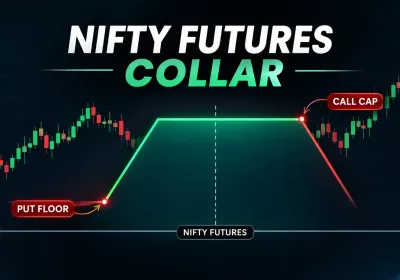
A collar adds a short call to the long put. You buy the 23,500 put and sell, say, a 25,000 call. The call premium pays for some or all of the put, so the net cost can drop close to zero. The price you pay is the upside: above 25,000 you stop participating. It's the protective put combined with a covered call on NIFTY futures, and it suits someone who wants a fixed range of outcomes and doesn't mind giving up the big rally.
Futures hedge
Shorting an index future against a long holding removes the exposure almost entirely, in both directions. It's cheap to put on, with no premium, but you've also given up the upside, and a margin call can arrive on the short leg while the long leg sits in profit. The risk shapes of futures and options are quite different, as laid out in our note on futures vs options risk shape. A put has a bounded, known cost. A futures hedge has an unbounded, path-dependent one.
Side by side
| Hedge | Upfront cost | Upside kept? | Main catch |
|---|---|---|---|
| Protective put | Full premium | Yes, minus premium | Decay; costs add up over a year |
| Collar | Near zero | Capped at the call strike | Short call can lose in a rally |
| Futures hedge | None (margin only) | No | Margin calls, full downside and upside removed |
A stop-loss order is the fourth option, and the one most traders reach for first. It costs nothing until it triggers, but it protects only if the market trades through your price in an orderly way. Gaps can jump straight past a stop and fill far below it. A put's protection doesn't depend on execution in a fast market, which is its real edge over a stop. Neither is better in every case.
A short checklist before you buy one
Write down the answers before the order goes in. If you can't, you're not ready to place it.
- What loss would force me out of the position? That sets the strike.
- How long do I need the cover? That sets the expiry.
- What will it cost over the full holding period, not just this one purchase?
- Is the underlying liquid enough in that contract that I can exit the put cleanly?
- Have I checked the contract details, margin and charges against the current exchange circular and my broker's page, instead of a number I read in an article?
EliteAlgo is a proprietary desk that trades NIFTY and SENSEX option structures for itself, so none of this is client advice. If you build rules like these into an automated approach, backtest them across calm and violent months and run them on paper first. Our algo trading strategies page describes how rule-based option structures are organised on the desk.
Frequently Asked Questions
What is a protective put?
It's a put option bought against an asset you already own. The put gains value if the asset falls, so your loss is capped at the gap between the purchase price and the strike, plus the premium paid. If the asset rises, you keep the gain minus the premium.
When should I buy a protective put?
Usually when a position is large for your account, when an event with a known date is close, or when you can't watch the market. Buying one all the time is expensive, because the premiums add up (6% a year or more in the illustration above). Many traders use it selectively for that reason.
Is a protective put the same as a married put?
The payoff is identical. The term "married put" is used when the stock and the put are bought together at the same time as one trade. "Protective put" is the broader name and also covers a put added later to a position you already hold.
How much does a protective put cost?
It depends on the strike, the expiry and the implied volatility on the day. Closer strikes and longer expiries cost more. Look at the live option chain instead of relying on a published figure, and add up the cost across every roll, not a single purchase.
Can I buy a protective put on NIFTY?
NIFTY has listed index options, so a put can hedge a NIFTY futures position or an index-tracking portfolio. A put on the index only matches your holding if the holding tracks the index closely. Check the contract specification, lot size and margin rules on the NSE site and your broker's page, because they change.
Protective put or stop-loss: which is better?
Neither wins every time. A stop-loss is free until it triggers, but it can fill well below your price after a gap. A put costs premium but its protection doesn't rely on execution in a fast market. Traders who can't accept a gap risk tend to prefer the put. Those who value low cost tend to prefer a stop.
Sources and further reading
- Options Industry Council: protective put
- Investor.gov: investor education from the US SEC
- SEBI: circulars and investor education
- Flattrade: protective put glossary
- Bajaj Broking: protective put guide
This article is analytical software and research content from EliteAlgo, not investment advice. Paper trade first. Past behaviour of any structure does not predict future results.