Paper trade every number and rule on this page before you risk live capital on it. Nothing here is investment advice, a tip or a return promise. EliteAlgo is a proprietary trading desk, and this is analytical writing about how a structure works.
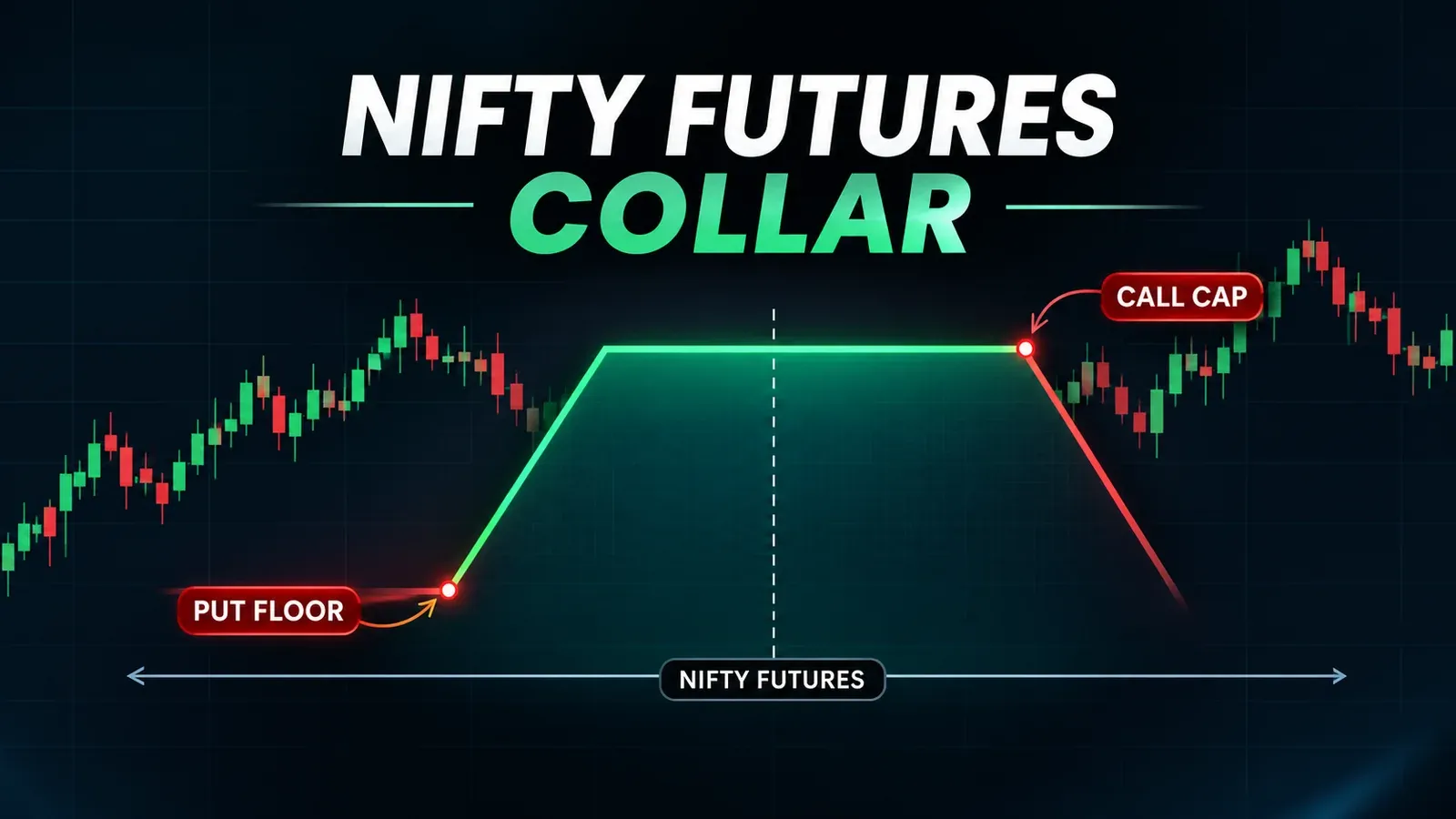
A collar is a long position wrapped in two options. You hold the stock or the futures contract. You buy a put below the market, which sets a floor. You sell a call above the market, which sets a ceiling and pays for some or all of the put. Your result is then boxed between two prices, whatever the market does.
Most pages on this topic explain it with a US stock and a dollar sign. Indian holders face different details: futures and options settle in different ways, lots are fixed-size, and stock options settle by physical delivery. This guide covers the collar the way a NIFTY or stock-futures holder meets it. It sits next to the covered call and cash-secured put guide on this site, which is the better place to start if the single-leg versions are new to you.

What a collar is: long position, bought put, sold call
Three legs, one purpose.
- Leg 1: the long position. Shares you own, or a long futures contract.
- Leg 2: a long put, usually out of the money, below today's price. It pays you if the market falls through its strike.
- Leg 3: a short call, out of the money, above today's price. You collect its premium, and you give up gains beyond its strike.
The Options Industry Council, which runs the education site optionseducation.org, describes the same structure as a protective collar: a protective put and a covered call held together against the same underlying. Per the OIC page, the put limits the loss and the call limits the gain. That symmetry is the whole idea.
The collar is not a bet on direction. It is what you build when you already hold something, you want to keep holding it, and you'd rather not sit through a deep fall. You are choosing to swap the tails of your outcome for certainty. The price of that swap is the upside above the call strike.
Read it as two separate decisions glued together. The put is insurance, and insurance costs premium. The short call is a sale of upside, and that sale brings premium in. A collar is simply the two done at once so the sale pays the bill. If the sold call is worth about the same as the bought put, the net cost is close to zero. We come back to that in the zero-cost section, because "close to zero" hides something.
Payoff in one table
Use hypothetical numbers so the mechanics stay clear. These are illustration prices, not a forecast or a live quote. Say you are long one NIFTY futures contract bought at 25,000. You buy a 24,500 put for 120 points and sell a 25,600 call for 115 points. Net premium paid is 5 points, a small debit. Written as a formula:
max loss = (entry - put strike) + net debit = (25000 - 24500) + 5 = 505 points
max gain = (call strike - entry) - net debit = (25600 - 25000) - 5 = 595 points| NIFTY at expiry | Futures P&L (points) | 24,500 put | 25,600 call (sold) | Premium, net | Total (points) |
|---|---|---|---|---|---|
| 23,500 | -1,500 | +1,000 | 0 | -5 | -505 |
| 24,500 | -500 | 0 | 0 | -5 | -505 |
| 25,000 | 0 | 0 | 0 | -5 | -5 |
| 25,600 | +600 | 0 | 0 | -5 | +595 |
| 26,500 | +1,500 | 0 | -900 | -5 | +595 |
Two numbers define the box. The worst case is the distance from entry down to the put strike, plus the net premium: 500 + 5 = 505 points. The best case is the distance from entry up to the call strike, minus the net premium: 600 - 5 = 595 points. Move to 23,500 or to 26,500 and the answer is the same as at the strike. That is the collar working as designed.
To convert points into rupees, multiply by the lot size in force. That number changes by exchange circular, so don't hard-code it from an article. Check the NSE equity derivatives contract specifications page for the current lot size before you size anything.
Notice what the table does not show: the days in between. A collar's mark-to-market before expiry moves with time value, volatility and the distance to each strike, so the loss at 24,500 on day three is usually smaller than 505 points. The floor and the ceiling are expiry facts. They are not a promise about every day of the trade.
The "zero-cost" collar and what it really costs
A zero-cost collar is one where the call premium you sell equals the put premium you buy, so no cash changes hands for the options. Traders like the phrase because it sounds free. It isn't, and the real costs are worth listing.
- The ceiling is the cost. You paid for the floor by giving up everything above the call strike. If the market rallies 8% and your call strike sat 3% above entry, you forgo the rest. That is a real price, paid in missed profit rather than in rupees.
- Brokerage, STT and charges still apply. Two option legs mean two sets of charges to open and, if you close early, two more. Rates change, so read the current schedule on your broker's page and the exchange circulars instead of trusting a figure in a blog post.
- Margin. A short call on top of a long position is a covered position in theory, but whether your broker nets it, and by how much, is a broker-and-exchange rule that differs by instrument. Ask before you assume.
- Skew. Index puts usually trade at higher implied volatility than calls at the same distance from the market. A put 2% below spot is typically pricier than a call 2% above. To match premiums, you often have to put the call strike closer to spot than the put strike, which shrinks your upside box faster than your downside one.
Skew is the point most beginner guides skip. In a "zero-cost" build on NIFTY, it often shows up as an asymmetric collar: a floor 3% below, a ceiling 2% above, and a feeling of being protected for free. The box is real, but it leans against you.
There is a way to see this concretely. Take the hypothetical example above. The put was 500 points out of the money and cost 120. The call was 600 points out of the money and cost 115. If the market priced the two wings symmetrically, the call at 500 points out would have cost more than 115. The reason you could sell a call 600 points out for nearly the same premium is that the put wing is the richer one. You paid up for the left tail and sold the right tail cheap. That is not an error. It is what the market charges for downside protection.
Optionsamurai, Firstrade and Religare, which all rank for this keyword, cover the zero-cost idea. They treat it mostly as a free hedge. The better framing is that a zero-cost collar swaps a cash cost for an opportunity cost, and you should price the opportunity cost before you place the order.
Collar on NIFTY futures vs on a stock
The mechanics match. The details around them don't.
NIFTY futures plus index options
Index futures and index options are cash-settled. Nothing is delivered. At expiry, the futures leg settles to the final settlement price and the option legs settle to their intrinsic value. That makes a futures collar clean to run: no shares to receive, no delivery obligation, nothing hanging after the close on expiry day.
The main thing to line up is expiry. The futures contract and both options should reference the same underlying and, ideally, the same expiry month. If you collar a monthly futures contract with weekly options, the legs expire on different days and the box only exists on the day the shortest leg survives. A weekly short call can expire worthless on Tuesday while you are still long a futures contract that runs till month-end. After that, you are unhedged on the upside and still carrying the put, which is a different position from the one you started with.
This is also where it differs from expiry-day selling. EliteAlgo research looks at selling options into a weekly expiry, and the leg that gets sold is usually short-dated on purpose. A collar wants the opposite match: legs that live as long as the thing you are protecting. Our guide to covered calls on NIFTY futures goes through the single-leg version of that timing problem.
A stock you own, plus stock options
If you hold shares in a demat account, you can collar them with stock options on the same name, but only if the stock is in the F&O segment, and only in whole lots. The lot is a fixed block of shares, which means your holding has to be a multiple of that block to be fully collared. A holding of 1.4 lots is a collar on one lot and 0.4 lots of naked exposure. Look up the lot on the contract specifications page rather than relying on memory.
Stock options also trade thinner than index options. Wider bid-ask gaps are normal, and the strikes you'd like may not exist or may have almost no volume. That matters because a collar has two option legs, and each pays the spread at entry and at exit. For a thinly traded stock, the spread alone can eat a large part of the "free" premium.
Physical settlement and expiry-week care for stock options
This is the section that US-based pages cannot write for you. In India, stock derivatives that go in-the-money into expiry are settled by physical delivery, not cash. SEBI's circulars set the framework, and the exchanges implement it. Read the current circular rather than a summary; the sebi.gov.in site lists them by date, and the rules have been revised more than once.
For a collar on shares you own, here is why that matters.
- Short call, in the money at expiry. You are obliged to deliver shares. If you hold them, that's the covered case: they get called away at the strike and you get the cash. Your collar ends in a sale.
- Long put, in the money at expiry. You hold the right to sell at the put strike. Exercise is automatic for in-the-money contracts under the settlement process. You deliver the shares and receive the strike price.
- Shares that aren't in your demat when delivery is due. This is where it bites. If the call is assigned and you don't have enough shares free to deliver, you face a short delivery, with auction and penalty consequences. Pledged shares, shares in transit after a sale, or a holding that doesn't cover the full lot can all cause it.
The practical habit is to decide what you want to happen before the last week. If you don't want the shares called away, close or roll the short call before expiry week, when the in-the-money call is still a mark-to-market number rather than a delivery obligation. Similarly, if the put is in the money and you'd rather keep the position than sell at the strike, sell the put in the market for its remaining value instead of letting it go to settlement.
The final week is also when option values stop behaving gently. Gamma rises, so small index moves swing option values a lot. A collar that looked quiet at 20 days out can need a decision every day at 3 days out. If you can't watch it, set the rule in advance: roll at a stated number of days left, or close the whole structure.
For an index collar there is none of this. Cash-settled, nothing to deliver. That single difference is why some holders prefer to hedge a stock-heavy portfolio with an index collar, and accept the basis risk (your stocks don't move exactly like NIFTY) in exchange for easy settlement.

Collar vs covered call vs protective put
The three structures are cousins. Each answers a slightly different worry.
| Structure | Legs | Downside | Upside | Net premium |
|---|---|---|---|---|
| Covered call | Long + short call | Open, cushioned only by the premium | Capped at the call strike | Credit |
| Protective put | Long + long put | Capped at the put strike | Open | Debit |
| Collar | Long + long put + short call | Capped at the put strike | Capped at the call strike | Near zero if built that way |
A covered call collects income and ignores a crash. A protective put survives a crash and bleeds premium while nothing happens. The collar sits between them: it gives up the income-style premium of the covered call, because it spends that premium on the put, and it gives up the open upside of the protective put.
So which is "safer"? For the loss tail, the collar and the protective put are both safer than the covered call because both have a floor. For the cost of that safety, the collar is cheaper than the protective put in premium terms. For upside, the protective put wins and the collar loses. If you hold a position you strongly expect to rise, a collar is the wrong tool. If you hold a position you fear for a stated period, say through a result, a budget or a policy event, and you'd accept a capped outcome, it fits.
Compare it too with a vertical spread, which also caps both ends. A vertical spread caps risk on an options position you build from scratch. A collar caps risk on a position you already own. And if the real problem is that a short option book needs protection rather than a long stock holding, our write-up on hedging an option-selling position covers that other side of the same coin.
Choosing the strikes and the expiry
There is no right answer, only trade-offs that you decide in advance.
Put strike. A put closer to the market costs more and protects sooner. A put further out costs less and leaves a bigger gap of loss you must tolerate. Some holders pick the put strike from the loss they can stomach in rupees, then work backwards to the strike. That's the sensible order: the loss limit comes first, and the strike follows.
Call strike. A call close to the market brings in more premium and caps profit sooner. One far out brings in little and leaves room to run. If you set the call strike where you'd happily sell the position anyway, a call-away is an outcome you chose, not a surprise.
Expiry. Match the legs to the risk window. Protecting through one event? Pick the expiry just after it. Protecting a core holding for a quarter? Use a farther expiry, and expect to roll. Longer-dated options cost more in absolute premium but less per day, so a collar rolled monthly pays the spread and charges twelve times a year rather than four. Those frictions add up over a year more than most people expect.
One more rule from a research habit we do follow: write the exit rules before the entry. What happens if the underlying gaps through the put strike overnight? What if it closes just above the call strike on the last day? Decide it on a quiet day. The same discipline appears across everything we build, from backtests to a collar, and the same point applies: a rule you write under pressure is usually a worse rule.
When a collar is the wrong tool
A few cases where people reach for a collar and shouldn't.
- You want to keep every rupee of a rally. The call takes that away.
- The underlying is illiquid. Entering and leaving two option legs costs too much.
- You plan to hold for years. Rolling a collar over and over costs charges and caps every rally, so a long-run holder may do better with a plain position and a sized-down allocation.
- You don't actually own what you are hedging. A collar-shaped payoff built without the underlying is a different animal, a risk reversal, and it has an open-ended side.
It also doesn't fix a bad entry. A collar bounds how much a position can lose from here. It can't un-lose what already happened. And if the stock gaps down past the put strike and keeps falling, the collar has done its job by stopping at the floor, which still might be a loss you hate.
How this was put together
On method: the payoff table and examples above use hypothetical prices that we chose to show the mechanics, and they are labelled as illustration throughout. The structural description follows the Options Industry Council collar page (optionseducation.org). The settlement points follow SEBI and NSE material, which you should re-read in their current form because the rules and lot sizes change. Competitor guides from Firstrade, Bigul, Optionsamurai, Moomoo and Religare were read to see which questions searchers expect answered. This page's methodology is explanation, not a backtest, and it makes no claim about how a collar performs historically.
Checked against the sources named in the text on 20 November 2026. If you spot an error, tell us and we will correct it.
Frequently Asked Questions
What is a collar strategy in options?
It is a long position (shares or a futures contract) combined with a bought put and a sold call. The put sets a floor, and the call sets a ceiling. Your profit and loss stay between the two strikes, adjusted for the net premium you paid or received.
Is a collar strategy bullish or bearish?
Neither, strictly. You hold the position because you are bullish or at least willing to hold, and you add the collar because you want protection. It's best read as defensive. You give up some upside in exchange for a limit on the downside.
What is a zero-cost collar?
A collar where the premium from the call you sell matches the premium of the put you buy, so the options cost nothing up front. The cost is hidden elsewhere: the capped upside, trading charges, and often a call strike that sits closer to the market than the put strike because puts carry higher implied volatility.
Can I use a collar on NIFTY futures?
Yes. Hold a long NIFTY futures contract, buy a NIFTY put and sell a NIFTY call on the same expiry. Index derivatives are cash-settled, so there is no delivery at expiry. Match the option expiries to the futures expiry, or the protection will end before the position does. Check the current lot size on the NSE contract specifications page.
What happens to a collar at expiry?
If the price ends between the strikes, both options expire worthless and you keep the underlying. If it ends above the call strike, the call is exercised against you and the position is sold or settled at that level. If it ends below the put strike, the put pays out. For stock options in India, in-the-money contracts settle by physical delivery, so make sure the shares are available.
Collar vs covered call: which is safer?
The collar, for downside. A covered call leaves the loss side open apart from the small cushion of the premium, and the collar has a put that sets a floor. The cost of that safety is that the collar earns less income, since part of the call premium pays for the put.
Reminder: nothing on this page is investment advice. Paper trade first, and use your own risk limits.