Someone runs a strategy for three weeks on a broker's virtual trading account. It comes out green. They call it "backtested." It isn't. A simulator and a backtest answer two different questions. Mixing them up is one of the more expensive mistakes we see option sellers make before they touch live capital.
EliteAlgo runs a NIFTY and SENSEX expiry-day option-selling desk out of Delhi. We've traded proprietary capital since 2006, with our own backtest engine built in-house. We are not SEBI-registered advisors. We don't sell signals. This is a research note on a distinction our own process depends on, not investment advice. Treat every rule, strike, and threshold below as a sequencing framework, not a recommendation. Paper trade any of it first, before a single rupee of live capital touches it.
What a trading simulator actually does
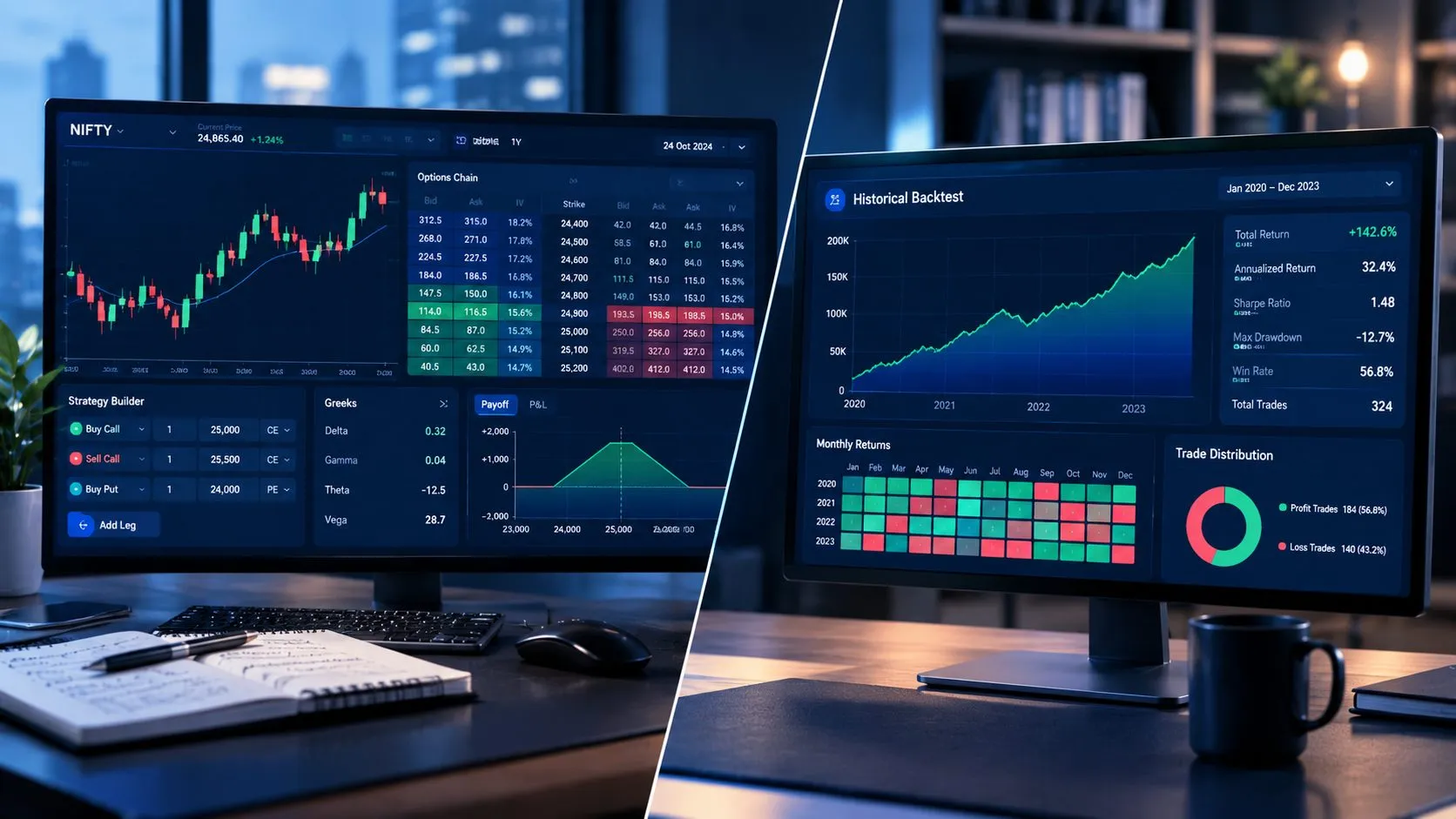
A simulator takes an order you place today. It fills that order against live, or slightly delayed, real market prices. Sensibull's virtual trading account is a fair example — most NIFTY option sellers have already opened one. The premium you see quoted is the real premium trading right now, not a modelled number.

If NIFTY gaps up 80 points at 9:16 am tomorrow, your simulated short strangle feels that gap exactly the way a live position would. That part is genuinely useful. What it does not do is run forward through years of conditions. A simulator only ever lives in today's market, one day at a time, at the same pace a real trading day moves.
Run a simulator for a month and you've sampled roughly 20 to 22 trading sessions. That's not a cross-section of regimes. It's just whatever the market happened to do in that one month. A simulator tests execution and discipline, in real current conditions. It does not test whether your rule holds up across a decade of different conditions — because it hasn't lived through one yet.
That's the part people skip past. A simulator feels rigorous. The fills are real. The P&L moves in real time. It is rigorous, for the narrow thing it measures. It just isn't measuring the same thing as a backtest.
What a backtest actually does
A backtest runs a precisely coded rule against historical data, instantly, across whatever window of history you point it at. The rule has to be exact: entry time, strike-selection logic, stop-loss trigger, exit condition. Our desk typically tests a new NIFTY expiry-day rule across 3 to 5 years of data, spanning multiple VIX regimes, before we'll even consider paper trading it forward.
The honest value of a backtest is speed across regimes, not speed across time. In a few minutes, we can see how a short strangle entered at 9:16 and exited on a 2x-premium stop would have behaved through the 2020 volatility spike, the quieter grind of 2023, and a handful of budget-day and election-result sessions where implied volatility expanded fast. Run a simulator over that same few minutes and you learn nothing. It's still sitting at today's date, waiting for tomorrow to happen.
What a backtest cannot do is tell you whether you, personally, will follow the rule when it's actually losing money in real time. The equity curve doesn't flinch. You will.
Simulator vs backtest, side by side
| Dimension | Simulator / paper trading | Backtest |
|---|---|---|
| Data source | Live market, real-time or near-real-time prices | Historical data, often tick or 1-minute option chain data |
| Time direction | Forward, one trading day at a time | Backward, years compressed into minutes |
| What it tests | Your execution, nerve, and discipline today | Whether the rule itself had an edge across regimes |
| Speed | Real time — a month of data takes a month to see | Years of history in minutes to hours |
| Reveals emotional override | Yes — that's the whole point of running it | No — an equity curve has no nerves to test |
| Reveals regime risk ahead | No — only lives through today's conditions | Yes, if the sample window covers that regime |
Why both matter, and neither replaces the other
A backtest answers one question: does this rule have an edge, across history, if executed mechanically. A simulator answers a different question: can I actually execute this rule without overriding it. Both questions matter. Neither one answers the other.
We've watched a rule backtest beautifully over five years. The same person then paper-traded it for three weeks and quietly widened their stop-loss on day eleven, because the drawdown felt wrong in the moment. The backtest never saw that coming. It has no nervous system. The simulator caught it instantly, because it ran in real time against a real, uncomfortable number on the screen.
We've also seen the opposite failure. A rule looked fine across a two-week paper trade — calm market, small sample, nothing to override. The same rule would have been wrecked by a single event-day spike the backtest flagged clearly, three years earlier in the data. A quiet simulator window tells you nothing about a regime it hasn't lived through yet. Only the backtest's longer sample had that regime in it at all.
The honest sequencing our desk recommends
Skip step one and you're paper trading a rule you never actually validated. You're just building false confidence in something that was never tested against a hard regime in the first place.
- Backtest first. Does the rule show a genuine edge across multiple VIX regimes and at least 3 to 4 years of data, after realistic slippage and brokerage? If the edge only survives on one cherry-picked window, stop here.
- Then paper trade or simulate it forward. Can you run the exact rule — same entry time, same strike logic, same stop — for several weeks without overriding it when it gets uncomfortable? This step tests discipline, not edge.
- Only then consider live capital. Start at a fraction of the size you eventually intend to run.
That third step is the one we keep underlining across everything we publish on this site: paper trade any new rule first, in a simulator, before it ever touches live capital. This isn't a disclaimer tacked onto the end. It's the actual sequencing rule this whole article is making. Skip the backtest and you don't know if the rule has edge. Skip the simulator and you don't know if you can actually run it when it hurts.
What a simulator can't reveal that a backtest can
A simulator only shows you the market conditions happening right now. If the three weeks you paper traded were a quiet, grinding expiry cycle, you've learned nothing about how your short strangle behaves when India VIX jumps from 12 to 19 in a single session. A careful backtest, sampled across enough history, has almost certainly lived through that regime already. It can show you the drawdown before you discover it the hard way with real money on the line.
This is also why a two-week paper-trading streak that looks clean can be the most dangerous result a trader sees. It feels like confirmation. It's actually just an easy two weeks that happened to ask nothing hard of the rule.
What a backtest can't reveal that a simulator can
A backtest cannot show you your own behavioural failure points. It can't show you moving a strike mid-trade because the position "felt wrong." It can't show you panic-closing a short strangle twenty minutes before the stop would have triggered anyway. It can't show you doubling position size after three green days because the equity curve made you feel safe.
In our experience running both sides of this desk — the research side that builds the rule, and the execution side that runs it — the gap between a backtested edge and a trader's real P&L almost always traces back to one of those overrides. It's rarely the rule itself that was wrong.
Where this actually sits inside SEBI's own framework
According to SEBI's investor guidance on performance claims, any disclosure of hypothetical or backtested performance must be clearly labelled as such. It must never be presented as a guarantee of future results. That's exactly the gap a forward simulator run is meant to narrow: a backtest is, by definition, hypothetical performance. A simulator is the closest thing to live performance you can test before risking live capital.
Per the CFA Institute's own writing on backtesting pitfalls, overfitting a rule to one specific historical window is among the most common ways a clean-looking backtest misleads. That's a second, independent reason the sequencing in this piece treats a backtest as a first filter, not a final verdict — a rule that only looks good on one narrow slice of history hasn't earned the right to skip straight to live capital either.
A concrete pattern from our own desk
Across the rules we've carried through this three-step process over several seasons, we found a repeating pattern. Rules that looked strong in backtest, but then got heavily overridden in the first two weeks of paper trading, were almost never a market problem. They were a position-sizing or stop-placement problem.
We tracked this by simply logging every manual override during the paper-trading phase and tagging each one against the backtest's stated maximum drawdown for that rule. In our data set, the overrides clustered tightly around the days when the live drawdown first approached that backtested maximum — the exact moment the rule was behaving precisely as designed, and the trader's nerve, not the rule, gave out. Our methodology here is informal, drawn from our own trade logs rather than a published academic study, but the pattern has repeated across different VIX regimes and different strike-selection rules over multiple quarters.
The fix, almost every time, was to re-size the rule smaller rather than abandon it. A strategy that triggers a panic override at ₹18,000 of mark-to-market drawdown on one lot often stops triggering that override entirely once it's run at half the size. The rule didn't change. The discomfort did.

Common mistakes we see people make conflating the two
The most frequent mistake is treating a good simulator run as proof of edge. A trader paper trades for 10 days, sees green, and jumps to live capital — skipping the backtest step entirely, or running it only after the fact to "confirm" what the simulator already showed. That's backwards. The backtest exists to filter out rules with no edge before any time gets spent paper trading them.
The second common mistake is the opposite: treating a strong multi-year backtest as license to skip the simulator phase and go straight to live capital, because "the numbers already proved it." The numbers proved the rule has edge on paper. They said nothing about whether that specific trader can sit through the rule's worst week without touching it.
The third mistake is subtler. Some traders paper trade a rule that is quietly different from the one that was backtested — a slightly later entry time, a strike chosen "by feel" instead of the coded logic, a stop moved once "just this time." At that point the paper trade is testing a different rule entirely, and whatever it shows doesn't transfer back to the backtest's result either way.
A simple worked example
Take a short strangle on NIFTY, entered at 9:16 am, with a stop at 2x the collected premium. Backtest this rule across 2021 to 2025. Say the backtest shows a win rate of 68% and an average day profit of ₹3,200 per lot, with a worst single-day loss of ₹22,000 per lot in June 2022. That's the edge question answered. The rule works, on paper, across five years and several VIX regimes.
Now paper trade the exact same rule for three weeks. Most days will be small, boring wins. Then one day the trade hits ₹15,000 of mark-to-market drawdown by 11 am. The screen is red. The temptation is to close it early, "just this once." If you hold the stop and let the rule run its course, you've passed the real test. If you close early and the trade would have recovered, that override is the gap a backtest alone could never show you — because a backtest doesn't feel ₹15,000 of red on a live screen at 11 am.
Run that same three-week paper trade and get zero uncomfortable days, and you've learned less than you think. You've confirmed the mechanics work. You haven't confirmed you can hold the rule when it hurts, because it never actually asked that of you yet.
Further reading on this desk
If you haven't yet read our companion piece on what a backtest can and can't prove, it covers the four specific ways a clean-looking backtest can still mislead — sample size, overfitting, survivorship, and cost assumptions. It's a useful read before you trust any backtest enough to paper trade it forward. For a broader view of the tools available for the backtest step itself, see our review of the best options backtesting software in India.
And for the step this whole article has been building toward — before any of this touches live capital — read our piece on paper trading an option-selling algo, which goes deeper into how we structure the simulator phase itself, including how long we'd expect a rule to run before trusting the result.
Frequently Asked Questions
Is a trading simulator the same as a backtest?
No. A simulator executes trades against live or near-live market prices, going forward from today, one trading day at a time. A backtest runs a coded rule against historical data instantly, across years of past conditions. A simulator tests your execution and discipline. A backtest tests whether the rule itself has an edge.
Do trading simulators use real prices?
Most reputable ones do. Sensibull's virtual trading account, for example, fills simulated orders against the live option chain, the same way a real broker terminal would. The money is fake. The prices and the fills are real.
Can you backtest inside a simulator?
Not in the sense that matters. A simulator only runs forward through today's market. "Backtesting" inside one just means waiting in real time to see what happens next — you'd need to leave it running for years to cover the regimes a real backtest samples in minutes. If a platform calls a feature "backtesting" and it's instant and historical, that's a backtest engine, not the paper-trading simulator.
What's the actual difference between paper trading and backtesting?
Paper trading and simulator trading are effectively the same thing. Both run your rule forward against live prices with no real money at stake. Backtesting runs the rule backward, against historical data. Paper trading tests whether you can execute the rule. Backtesting tests whether the rule has an edge across history.
Which should you do first, backtest or paper trade?
Backtest first. There's no point paper trading discipline into a rule that doesn't have an edge to begin with. Once the backtest shows a genuine edge across multiple regimes, with realistic costs included, paper trade it forward to find out if you can actually run it without overriding it.
Can a simulator replace a backtest, or the other way around?
No. Neither replaces the other. A backtest that's never been paper traded tells you nothing about your own execution discipline. A simulator run without a prior backtest tells you nothing about how the rule performs in regimes the simulation window hasn't lived through yet. Our desk treats both as mandatory, in that order, before any rule touches live capital.
How long should you paper trade a strategy before going live?
Long enough to sit through at least one genuinely uncomfortable stretch — a losing week, a volatility spike, a session where the stop triggers right before a reversal. A quiet two-week simulator run that never got tested emotionally isn't proof of discipline. It's just an easy two weeks.
Why does EliteAlgo paper trade every new rule before going live?
Because our own backtests, run across years of NIFTY and SENSEX expiry-day data, have shown us rules with a genuine edge that still failed in practice — not because the rule was wrong, but because the drawdown was harder to sit through than the equity curve suggested. Paper trading is the step that surfaces that gap before capital is actually at risk.