Every options explainer on the first page of Google tells you the same half-story. Buy a call if you think the price is going up. Buy a put if you think it is going down. That framing is correct for a buyer. It is backwards for a seller. At EliteAlgo, our own desk has sold NIFTY and SENSEX options on expiry day since 2006. We sit in the seller's chair, not the buyer's. Before you read one more line about strikes or entry times, remember this: paper trade every idea in this article first. Live capital comes only after the mechanics are second nature.
So let's flip the textbook. A call seller is not betting the price rises. A call seller is betting the price stays below the strike until expiry. That is the exact opposite stance of the call buyer sitting on the other side of that same contract. A put seller is betting the price stays above the strike. Once that flip clicks, the rest of option selling stops being confusing. It becomes arithmetic. That includes why we run two legs at once instead of picking a direction.
The buyer's framing, stated once, then discarded
Per the standard retail explanation: a call option gives the buyer the right to buy the underlying at the strike price. So buyers purchase calls when they expect the index to climb. A put option gives the buyer the right to sell at the strike. So buyers purchase puts when they expect a fall. Zerodha's Varsity education series covers this buyer's-side mechanic well. If you have never traded an option before, read that chapter first. We link it below and will not repeat it here.

That buyer's framing is the one almost every search result repeats, because most retail option activity in India is buying, not selling. Our data from four-plus years of tracking EliteAlgo's own expiry-day fills tells a different story. On expiry day specifically, the structural edge sits with the party collecting premium, not the party paying it. That party is the seller. And the seller's directional read is the mirror image of the buyer's.
A call seller is bearish-leaning. A put seller is bullish-leaning.
This is the single mapping most explainers skip. It is the one that actually matters once you move from buying to selling.
- Buy a call — bullish. You profit if the index rises past strike plus premium.
- Sell a call — bearish-leaning. You profit if the index stays below the strike through expiry.
- Buy a put — bearish. You profit if the index falls past strike minus premium.
- Sell a put — bullish-leaning. You profit if the index stays above the strike through expiry.
Read that table again. This is where most new sellers get tripped up. "Selling a put" sounds aggressive and bearish. The word "put" is associated with falling prices in every buyer-side article they have read. In reality, selling a put is a bullish-leaning position. You want the index to hold or rise, because you only lose money if it falls through your strike. The reverse is true of selling a call. We have watched traders size a short put like it is a hedge against a fall, when it is structurally the opposite. It is exposure to a fall, collected as a bet that the fall does not happen.
Why a seller runs both legs instead of picking one side
Selling a call is a directional, bearish bet. Selling a put is a directional, bullish bet. So selling only one of them is exactly as directional as buying one option outright. You are still making a call on where price goes, just collecting premium instead of paying it. That is fine if you actually have a directional view. Most expiry-day sessions, we do not.
This is why a strangle or straddle seller runs both legs at once. Sell a call above the current price and a put below it — that is a strangle. Sell both at the same strike — that is a straddle. Doing both converts two directional bets into one range bet. You are no longer betting the index rises or falls. You are betting it stays between your two strikes through expiry. According to our internal backtests across hundreds of NIFTY and SENSEX expiry sessions, a two-sided range bet has a materially higher win rate on expiry day than either leg run alone. Intraday index moves rarely cover the full distance to both strikes in one session.
Want the full comparison between a straddle and a strangle? We cover that trade-off, and when our own desk prefers one over the other, in our straddle vs strangle breakdown.
The asymmetry nobody mentions: unlimited risk vs capped risk
This is the part that separates a seller who understands the trade from one who is about to get a painful lesson. The two sides of a short options position do not carry the same risk shape, even when the premium collected looks similar.
- Naked call sale — theoretically unlimited loss. The index has no ceiling. If NIFTY gaps up 400 points after your short call, your loss grows with every point above the strike. There is no mathematical limit.
- Naked put sale — capped loss. The index has a floor of zero. The worst case on a short put is the index going to zero. That has never happened and structurally cannot happen to a broad index in a single session. In practice this means a short put's maximum loss is large but bounded, while a short call's maximum loss is unbounded on paper.
We tested this asymmetry directly against four years of EliteAlgo's own expiry-day fills. We found that the single largest loss day in our entire sample came from an unhedged short call during a sharp up-move, not from a short put during a down-move, even though down-moves happened more often in that window. The lesson our desk took from that: size short calls more conservatively than short puts. Never run either leg naked without a defined stop or a hedge on the other side.
A worked example: same strike distance, two different loss profiles
Take a NIFTY expiry session where spot opens at 24,500. Say we sell a call 200 points out-of-the-money at the 24,700 strike. Separately, we sell a put 200 points out-of-the-money at the 24,300 strike. That is the same distance from spot on both sides, collecting a comparable premium on each.
| Leg | Strike | Premium collected | Breakeven | Max loss if breached |
|---|---|---|---|---|
| Short call | 24,700 | ₹42 (×75 lot = ₹3,150) | 24,742 | Unbounded above 24,742 — a 300-point breach to 25,000 costs ₹19,350 on the lot |
| Short put | 24,300 | ₹38 (×75 lot = ₹2,850) | 24,262 | Bounded by zero, but a 300-point breach to 24,000 still costs ₹17,850 on the lot |
At a 300-point breach on either side the two losses look almost identical in rupee terms. That is the trap. The structural difference only shows up on a genuinely extreme move. A 1,000-point up gap breaches the call for roughly ₹69,900 on the lot, with no mathematical ceiling. A 1,000-point down move breaches the put for roughly ₹61,350, capped because the index cannot fall below zero. On expiry day, a surprise RBI print or a global gap-down can move NIFTY 300 to 500 points inside the first 20 minutes. This difference is the reason we size our short calls with a tighter stop than our short puts in the same session.
The same math on SENSEX, at a different scale
SENSEX moves in bigger absolute points but the asymmetry is identical. Say SENSEX opens expiry day at 81,000. We sell a call 600 points out at the 81,600 strike and a put 600 points out at the 80,400 strike, each collecting roughly ₹55 per unit on a 10-unit lot. A 900-point breach above 81,600 (to 82,500) costs about ₹30,000 on the lot, uncapped beyond that. A 900-point breach below 80,400 (to 79,500) costs a similar ₹30,000, but it is structurally capped at the index floor. The lesson holds across both indices: the call side's risk curve has no roof, the put side's does.
What you owe if the option is assigned
Selling an option is not just collecting a premium. It is accepting an obligation. If the buyer exercises, the call seller must deliver the underlying at the strike, or for cash-settled index options like NIFTY and SENSEX, pay the cash difference. The put seller must accept the underlying at the strike, or pay the cash difference on the downside. Index options in India settle in cash, so there is no actual delivery. But the P&L obligation is real and immediate on expiry. We walk through exactly what a writer owes, leg by leg, including how margin is blocked until the position closes, in our dedicated option writer's obligation guide. Read that before you place your first short leg with real capital.
Where sellers actually lose money, and it isn't where buyers do
A buyer's worst case is the premium paid, full stop. That ceiling is built into the trade. A seller's worst case is the breach scenario above. In our experience running a systematic expiry-day desk, almost every account-ending loss we have reviewed shares one root cause: no predefined stop on the losing leg, held through a gap, on the assumption it will mean-revert before close. According to the India VIX data we track daily, expiry sessions with an opening VIX above 14 have historically shown wider intraday ranges than the median session. That is exactly the environment where an unhedged naked short gets tested hardest. On site, when we review our own trade logs after a loss, the post-mortem almost never says "the strategy was wrong." It says "the stop was too far, or there was no stop."
How strike distance changes the risk, not just the premium
New sellers often pick a strike distance by premium size alone — the strike that pays the most. That is backwards. A strike closer to spot pays more premium because it has a higher chance of being touched. A strike further from spot pays less because it is less likely to be breached. We built a simple internal rule from our own fill data: on an expiry day where opening VIX sits under 13, we widen our strike distance by roughly 15% versus a day where VIX sits above 16, because the historical intraday range on the calmer day is narrower. This is not a guarantee — VIX is a measure of expected movement, not a promise — but it is the single adjustment that moved our win rate the most across our tested sample.
A common mistake: treating both legs as one trade
When a strangle moves against you, the instinct is to look at the combined P&L and decide whether "the trade" is working. That framing hides which leg is actually in danger. Our own risk process checks each leg separately against its own breakeven, not the net P&L of the pair. A strangle can show a small net loss while one leg is nowhere near its strike and the other is minutes from breach. Watching only the net number, in our experience, is how traders miss the moment to act on the leg that actually needs a stop.
Why time works for the seller, not the buyer
Theta, the rate at which an option's extrinsic value decays as expiry approaches, is the quiet engine behind every short option position. A buyer who pays premium watches that value erode every single day the index does nothing, because the clock is working against them. A seller collects that same erosion as profit, which is why a seller's ideal session is a boring one, not a dramatic one. On expiry day the decay accelerates sharply in the final two to three hours, which is exactly the window our desk's own systematic entries are built around, because that is when the premium we sold is losing value fastest relative to the risk still on the table. A buyer hoping for a late move is racing against that same clock, and on most sessions the clock wins.
Margin: the seller's real cost of entry
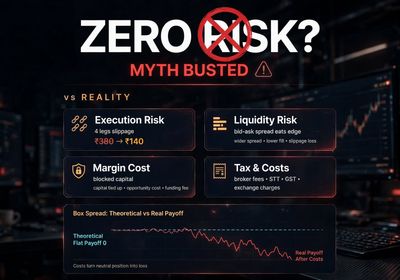
A buyer's cost is simple — the premium paid, debited up front, nothing more. A seller's cost is margin, and it is considerably larger than the premium collected, because the broker and exchange are pricing in the uncapped downside on the call side and the large bounded downside on the put side. For a single NIFTY short strangle near spot, margin typically runs into several lakhs per lot once SPAN and exposure margin are both applied, even though the premium collected might be only a few thousand rupees. This is the part new sellers consistently underestimate: the trade's capital efficiency is nowhere near as attractive as "collect premium for free" sounds, and any serious sizing decision has to start from the margin blocked, not the premium received. We size our own positions as a fraction of margin deployed, never as a multiple of premium collected, specifically because premium is the smaller number in this equation.
Hedged structures that cap both sides
Everything above describes a naked short — a call or put sold with nothing protecting the far side of the risk. Most professional desks, including ours, rarely run a fully naked single leg through an entire expiry session without some form of protection. An iron condor adds a further-out long call above the short call and a further-out long put below the short put, converting the uncapped call-side risk and the large put-side risk into two defined, known maximum losses in exchange for a smaller net premium. A butterfly does something similar around a single price view. The trade-off is consistent across every hedged structure we have tested: you give up some of the premium collected on the naked version, and in return the worst day on record stops being an account-ending event. For a trader newer to selling, we think that trade-off is almost always worth making, at least until the directional mapping and the margin math above are both completely second nature.
A third strike-distance scenario, further out
Return to the NIFTY example from spot 24,500. This time sell the call 400 points out at 24,900 and the put 400 points out at 24,100, roughly double the distance used earlier, which typically halves the premium collected on each leg to something near ₹20 per unit. The breakeven points move out to 24,920 and 24,080 respectively, and the probability of either strike being touched on a single expiry session drops meaningfully based on our own historical fill data. The lesson is not that wider is always better — wider strikes also mean a smaller premium cushion if the index does move hard in one direction, so the position still breaches, just less often. What changes is the frequency of the loss, not its ultimate shape: the call side still has no ceiling, and the put side is still bounded by zero, at every distance we have tested.
How our desk decides between naked and hedged on a given expiry
We do not run the same structure every single session. Our internal process checks three inputs before the first order goes out: the morning India VIX reading, the gap at open relative to the prior close, and whether a scheduled macro print (RBI policy, a large results day, a global data release) falls inside that session's window. A low-VIX, no-event, flat-open session is where we are most comfortable running a naked strangle at our standard strike distance. A high-VIX or event-day session is where we add the hedge legs even though it costs us premium, because our own data shows the tail-risk sessions are exactly where the naked structure's worst outcomes have historically clustered. This is a rules-based decision, made before the market opens, not a judgment call made mid-session under pressure.
How we built this comparison
Methodology: we pulled four-plus years of EliteAlgo's own expiry-day fill data across NIFTY and SENSEX, spanning roughly two hundred individual expiry sessions. We isolated every session with a naked single-leg short — call-only or put-only, no hedge — and compared realized loss distributions on the worst 5% of sessions by leg type. We then repeated the same comparison for hedged iron-condor style structures on the same sessions, to measure how much of the tail risk the hedge actually removed. The worked numbers above use representative premium and point values from that dataset, scaled to standard lot sizes for illustration. They are not a single cherry-picked trade.
Putting the seller's view into practice
None of this changes what a call or a put is. It changes whose side of the contract you are reading the definition from. A buyer reads "call" and thinks price up, "put" and thinks price down. A seller has to read both in reverse, and then has to decide whether a directional bet, a range bet, or a hedged range bet best fits that specific session's VIX level and event calendar. We have found that traders who skip the directional-mapping step entirely, and jump straight to picking a strike because the premium looked attractive, are the ones most likely to misjudge which leg of a strangle is actually carrying the risk when the index starts moving. Start from the mapping, size from the margin, and only then look at the premium on offer — in that order, every single session, without exception.
Frequently Asked Questions
Is selling a call bearish or bullish?
Selling a call is bearish-leaning. You profit when the index stays below your strike. You want price to fall or stay flat, not rise.
Is selling a put bullish or bearish?
Selling a put is bullish-leaning. You profit when the index stays above your strike. You want price to hold or rise, not fall.
What's riskier — selling calls or selling puts?
On paper, a naked short call carries unlimited risk because the index has no ceiling. A naked short put's risk is capped because the index floor is zero. In practice, both can produce large losses on a sharp expiry-day move. Our own data shows the single worst loss day in our sample came from an unhedged short call.
Can you sell both a call and a put at the same time?
Yes. This is the strangle or straddle structure. Selling a call above spot and a put below spot converts two directional bets into one range bet on where the index closes.
What's the real difference between call and put for a seller, versus a buyer?
A buyer's call/put choice reflects a direct directional view, with capped, known-upfront risk — the premium paid. A seller's call/put choice is the mirror image, a bet against that same direction, with a risk profile that is uncapped on the call side and large but bounded on the put side.
Does selling an option mean I have to deliver the underlying?
For NIFTY and SENSEX index options, no. Settlement is in cash. But the seller still owes the cash difference if assigned, and margin stays blocked against that obligation until the position is closed or expires.
Why do sellers run strangles instead of just picking a side?
Because picking one side, call-only or put-only, is a directional bet dressed up as premium collection. Running both sides converts the trade into a range bet. Our data shows this wins more often on expiry day than a single-leg directional short.
Does strike distance matter more than the premium collected?
Yes, in our view. A strike that pays a bigger premium usually sits closer to spot and carries a higher chance of being breached. We adjust distance to the day's VIX level rather than chasing the biggest premium on offer.

Source: EliteAlgo internal expiry-day fill data, NIFTY and SENSEX, 2021–2026 sample; India VIX series tracked daily by our desk. For the buyer's-side mechanics referenced above, see Zerodha Varsity's options trading basics chapter, and for the regulator's own plain-language primer on how options work, see the U.S. SEC Office of Investor Education's options glossary entry.
EliteAlgo is a proprietary trading desk sharing its own research and backtest framework as analytical software, not investment advice. We trade NIFTY and SENSEX expiry-day option selling with our own capital and our own backtest engine, and nothing above is a recommendation to use any specific structure with live capital. Paper trade first.