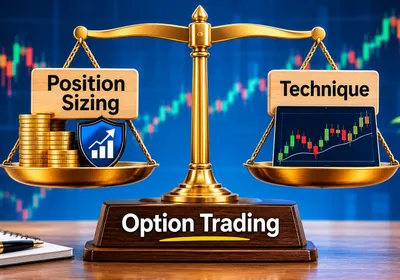

Every week someone writes to us after paying ₹15,000 to ₹60,000 for an option-trading course. They all ask a version of the same question. "I understand the strategy now. Why isn't it working?" The honest answer is simple. A course taught them a technique. It never told them whether that technique has an edge on NIFTY or SENSEX expiry days, under real costs, over a sample large enough to mean anything. Those are two different products. Most buyers don't find out they bought only the first one until they've already lost money finding out the hard way.
What a decent course can actually give you
We're not going to pretend courses are worthless. That would be as dishonest as the course-seller pages that currently dominate this search term, every one of them claiming their own course is the answer. A well-structured course does something real. It compresses weeks of scattered YouTube videos, forum threads and half-finished blog posts into a few hours of ordered learning. Greeks, strike selection, margin mechanics, the vocabulary of theta decay and IV crush — a good instructor gets a beginner through that faster than self-study usually does.
That's a genuine, if modest, time-saving value. We've watched new traders spend three months piecing together what a competent course covers in a weekend. For someone starting from zero, that compression is worth paying for.

That's also the ceiling. A course can make you fluent in the language of options. It cannot, by its nature as instructional content, tell you whether the specific rule you're planning to trade has a statistical edge on NIFTY's expiry-day behaviour across 2024-2026. Say the rule is: sell a strangle at 9:20, exit at a fixed stop, re-enter once if stopped early. Testing whether that rule actually works requires historical option-chain data, a precisely defined entry and exit, and a sample large enough to separate skill from luck. Instruction doesn't do that job. Only data and a disciplined test can.
The pattern worth naming: techniques taught, never tested
Here's what stands out when you scan the course landscape ranking for this keyword. Most courses teach technique without ever backtesting it in front of the student. A module explains iron condors in detail. Another module explains the "sell premium when IV is high" idea, with charts to match. None of them run that idea through five years of actual option-chain history and show the student the resulting equity curve, the drawdown, the win rate.
A course can be excellently taught. Clear slides, a patient instructor, good worked examples. It can still be teaching an idea nobody has tested. Good teaching and tested ideas are independent variables, not the same thing. Buyers tend to assume the first implies the second. In our experience watching this niche for years, it rarely does.
Our methodology at EliteAlgo starts from the opposite direction. We built our own backtest engine specifically because we wanted to know, for every rule we trade, what happened across roughly 420 expiry-day sessions under real slippage and real brokerage — not what a strategy "should" do in theory. When we ran a simple short-strangle rule with no additional filters through our engine, the headline return looked reasonable on a quick glance. Once we layered in realistic cost assumptions, the edge thinned out considerably. A course slide can't show a student that kind of result. A backtest, run honestly against a real cost model, will.
Why real costs change the answer so much
Here's a simple example. Say a short strangle on NIFTY looks like it makes ₹4,000 per lot per trade on paper. That number often comes from a clean chart, with no slippage and no brokerage built in. Add real costs back in — brokerage, STT, exchange fees, and the slippage you actually get filling an order near expiry — and that ₹4,000 can shrink fast. Sometimes it shrinks to ₹1,500. Sometimes it turns negative.
A course rarely shows this step. It's not deliberate deception in most cases. It's just not what a course is built to do. Teaching a concept and stress-testing it against real costs are two separate jobs, done by two separate processes. A backtest engine does the second job. A course does the first.
We ran this exact exercise on our own desk. A plain short-strangle rule, no filters, no adjustments, tested across roughly 420 expiry sessions. At zero cost, the equity curve looked encouraging. Once we applied our standard cost model — real brokerage, real exchange charges, realistic fill slippage — the curve flattened. The strategy still worked, but it worked far less well than the clean version suggested. That gap between "clean" and "costed" is the single most common thing a course never shows a student, because showing it would mean running a real backtest, not teaching a lesson.
Spotting the marketing pattern on course-seller pages
Scan ten pages that rank for "option trading course" and a pattern repeats. Big claims up front. A results screenshot from one good week. A countdown timer pushing you to enrol today. Very little about sample size. Almost nothing about cost assumptions. Few, if any, mention a losing month at all.
That pattern alone tells you something useful. A seller confident in a tested result usually leads with the test, not with urgency. A seller leading with urgency and scarcity is often selling conviction, not evidence. Neither approach is illegal. But they are not the same thing, and a buyer deserves to know which one they're looking at before paying.
One more pattern worth watching: course pages that show only profitable trades, never a losing stretch. Every real strategy, tested honestly, has losing stretches. A page with zero losing examples across months of claimed "track record" is not showing you the full picture, whatever the reason.
Course, mentorship, or SEBI-registered advice — know which one you're buying
There's a compliance distinction buyers routinely miss. A paid course or a mentorship subscription is not the same thing as a relationship with a SEBI-registered Research Analyst or Investment Adviser. The SEBI Investor Charter sets out what a registered adviser must disclose, and what recourse an investor has if that adviser falls short. None of that framework applies to someone selling a video course on how options work.
That's not a knock on courses. Teaching concepts is a legitimate product on its own terms. It's a caution about conflating two different relationships. If a course seller's marketing leans on language that sounds like personalised investment advice — "follow our calls," "guaranteed setups," "assured monthly income" — ask directly whether the seller holds the registration that framework actually requires. We've written separately about the SEBI regulatory framework for algo trading if you want the fuller picture of what registration involves and why it exists.
EliteAlgo itself is proprietary trading research, not an advisory service. We build and test our own strategies for our own trading. We don't manage client money, and we don't issue buy or sell calls to subscribers. Knowing which category a seller falls into — course, advisor, or neither — is step one before you pay anyone anything.
What a backtest actually involves, in plain terms
A backtest is not magic. It's a simple process, done carefully. First, you write the rule down exactly. Not "sell premium when volatility is high." That's too vague to test. You need something like: sell a strangle at 9:20 AM, a fixed distance from the spot price, exit at 3:15 PM or on a stop, no re-entry.
Next, you run that exact rule against historical option-chain data. Not one good week. Not one good month. A real sample. We use roughly 420 expiry sessions for our own testing, and we'd rather see a smaller real edge over that many sessions than a huge edge over just ten.
Then you add costs. Real brokerage. Real exchange fees. Real slippage on fills, not the mid-price you wish you'd gotten. This step is where most informal "backtests" on social media fall apart, because it's tedious and it shrinks the headline number.
Finally, you look at the whole picture, not just the average. Win rate matters. So does the worst losing month. So does how long a losing streak can run before it turns around, if it turns around at all. A rule with a great average return and one catastrophic month is a different risk profile than a rule with steady, modest gains. A course slide showing one equity curve rarely shows you that distinction.
A practical self-test before you pay for any course
Before handing over money for an options course, ask the seller one specific question. What exactly will be backtested live, in front of me, with what sample size, and under what cost assumptions? A seller with a real tested track record answers in specifics: "we ran this entry rule across roughly 400 expiry sessions, here's the win rate and here's the worst drawdown month."
A seller with nothing actually tested answers vaguely, or pivots straight to testimonials and screenshots of profitable trades cherry-picked from good weeks. That vagueness is informative on its own. It's often the clearest signal on the entire sales page, clearer than anything in the pitch itself.
Push the question further if you can. Ask how the course handles the gap between "this pattern looks right on the chart I'm showing you" and "this pattern has a measurable edge across hundreds of sessions, net of real costs." If the instructor can't walk you through that distinction with specifics, they likely haven't tested the idea themselves. They are teaching what looks plausible, not what has been measured and proven over time.
Where a backtest fits that a course never can
We'll be upfront about what EliteAlgo actually offers, because it isn't a substitute for the fundamentals a course teaches. It's a different category of product. We don't sell instructional content explaining what a strangle is or how theta decays. We sell a backtested, researched trading engine — rules already run through years of NIFTY and SENSEX expiry-day data, with the costs, slippage and drawdowns already measured and disclosed in our own reports, not left for the buyer to discover later.
If you already know the vocabulary — Greeks, margin, strike selection — and want a rule that's been tested rather than taught, that's a different need from what a beginner course serves. If you need the fundamentals first, go learn them; we'd rather you start with a basic backtesting walkthrough than jump straight to live capital. Neither product replaces the other. They answer two different questions, and a good decision usually involves both at different points.

And whatever you learn, from a course, from our research, from your own reading, paper trade it first on a desk like ours. A tested strategy sitting in a backtest report is still not the same as your own execution, your own broker's fills, and your own discipline under live market pressure. Paper trade this first, whatever the source — course or backtest. We go deeper into exactly what a backtest can and can't prove in a separate piece, which is worth reading alongside this one before you commit real money to any strategy, learned or tested.
Who this comparison is actually for
This isn't aimed at someone who already knows options cold and just wants a tested rule. It's aimed at the much bigger group of readers who are deciding between two paths right now. One path is: pay for a course, learn the concepts, then figure out testing later, maybe never. The other path is: learn the concepts for free or cheap, from genuinely good free resources, then spend the money saved on actually testing an idea before trading it live.
Both paths can work. The mistake is treating a course as if it already answers the testing question, when it was never built to. If you take a course, treat it as step one of two. If you skip the course and go straight to backtesting someone else's rule, make sure you still understand the mechanics well enough to know what you're testing and why. Skipping both steps — no real learning, no real testing — is how most new option sellers lose money fast, course or no course.
A reasonable rule of thumb: if a course costs ₹30,000 and promises a strategy, ask what it would cost to backtest that same strategy properly instead. Often it's a fraction of that, through free tools or an engine like ours, and it tells you something a course brochure never will — whether the rule survives contact with real market history.
The short version, if you're deciding today
A course is worth it for one job: learning the mechanics of options faster than scattered free content would get you there. It is not worth it as proof of an edge, because that's not a job teaching can do. Treat the two as separate purchases, bought for separate reasons, from separate places if needed.
If you're weighing a specific course right now, ask the seller the self-test question above before you pay — what gets backtested, over what sample, under what costs. Write the answer down. If it's vague, that's your answer about the course, not just about the strategy. And once you do have a rule, from a course or from your own reading, run it through a real backtest with real costs before you run it with real money. Paper trade the result after that, not instead of it. That order — learn, test, paper trade, then live — is slower than jumping straight from a course to live capital. It's also the order that keeps new option sellers from losing real money finding out the hard way what a backtest would have shown them for free.
Frequently Asked Questions
Is paying for an option trading course worth it?
It can be, if your goal is to learn concepts and vocabulary faster than piecing them together from scattered free content would. It is a poor fit if you're buying it expecting proof that a specific strategy has an edge. No course, however well taught, can test a rule for your exact market and timeframe. Our data from testing rules this way consistently shows that proof comes from a backtest, not from a lesson.
Can a trading course promise profit?
No credible one will. Options trading carries real risk of loss on every trade, and no instructional product changes that. Per the SEBI Investor Charter, any promotional claim promising assured returns from market participation is a claim regulators treat with suspicion, and so should a buyer.
What should a good options course include?
Clear coverage of Greeks and margin mechanics, real option-chain examples rather than abstract diagrams, honest discussion of loss scenarios, and ideally some demonstration — even a simple one — of how a taught idea performs when actually tested against historical data rather than just described in a slide deck.
Is a trading course the same as a SEBI-registered advisor?
No. A course or mentorship teaches concepts. A SEBI-registered Research Analyst or Investment Adviser operates under a specific regulatory framework, with disclosure obligations and a registration number, per the SEBI Investor Charter cited above. If a course's marketing sounds like personalised buy or sell advice, ask whether the seller actually holds that registration before paying.
How do I evaluate a trading course before buying?
Ask what specifically will be backtested in front of you, over what sample size, and under what cost assumptions. A vague or testimonial-only answer tells you something useful by itself. Also check whether the course distinguishes clearly between "this looks right" and "this has been tested and measured" — those are not the same claim, and a course that treats them as interchangeable is teaching you less than it seems.
How long should a course's sample size be before I trust its results?
Longer than one season. Indian expiry-day option markets behave differently depending on the volatility regime — a calm stretch and a stressed stretch, like a sharp VIX spike, can produce very different outcomes for the same rule. A sample that only covers a few calm months tells you little about how the rule behaves when markets turn choppy. We lean toward a year or more of expiry sessions, covering at least one stretch of real stress, before drawing any conclusion about a rule's edge.
Where does a backtest fit if I've already taken a course?
Right after it. A course gets you fluent in the vocabulary and mechanics. A backtest tells you whether the specific rule you want to trade actually had an edge across real market history, under real costs. Run the rule through a proper backtest before risking live capital, and paper trade the result before that — course graduates skip this step more often than they should, usually because nothing in the course pointed them toward it.
EliteAlgo is a proprietary trading desk sharing its own research and backtest methodology as analytical software, not investment advice. We trade NIFTY and SENSEX expiry-day option selling with our own capital and our own backtest engine, and nothing above is a recommendation to buy any specific course or run any specific rule with live capital. Paper trade first.